

12 Best Cybersecurity Certifications in 2026 (Ranked by Career Value)
Discover the best cybersecurity certifications in 2026 ranked by career value, salary impact, and demand. From Security+ to CISSP, find the right cert for your goals.
Last updated: August 2026
The 2025 ISC2 Cybersecurity Workforce Study reports a global shortfall of nearly 4 million cybersecurity professionals, yet employers are still filtering candidates by certification status before interviews even begin. The best cybersecurity certifications in 2026, ranked by genuine career value, include credentials like CompTIA Security+, CISSP, and Google's Cybersecurity Certificate, each validated against employer demand, salary impact, and direct relevance to emerging threats in AI security and cloud-native environments.
Choosing the wrong certification is a costly mistake. Some credentials look impressive but carry little weight with hiring managers. Others are entry-level stepping stones being pursued by people who already have five years of experience. Every certification in this guide was evaluated on four criteria: employer demand, measurable salary impact, exam accessibility, and alignment with 2026 threat trends.
This guide is built for beginners entering the field, career changers pivoting from IT or adjacent roles, and experienced professionals deciding where to invest next. The rankings reflect what the job market actually rewards, not what certification vendors want you to buy.
TL;DR: The best cybersecurity certifications in 2026 remain critical career investments, with the field continuing to be one of the fastest-growing sectors in the U.S. economy. CISSP holders report a median U.S. salary above most other credentials, making it the highest-paying certification available, while Security+ dominates job listings as the most in-demand entry point for employers. Rather than stacking multiple certifications broadly, data supports going deep on one high-value credential before expanding, a strategy that pays off especially as AI and cloud trends reshape which skills hiring managers prioritize. Choosing the right certification depends on your career stage, with practical, hands-on credentials like OSCP and CySA+ gaining significant traction in 2026 hiring decisions.
Key Takeaways
- CISSP holders report a median U.S. salary above $120,000, making it the highest-paying cybersecurity certification in 2026 and the strongest credential for professionals targeting senior or management-level roles.
- Security+, CISSP, and CISM appear most frequently across 2026 cybersecurity job listings, meaning candidates should prioritize at least one of these three credentials to maximize their visibility to employers at scale.
- The right certification is role-specific, not universal. Applied skill credentials like OSCP suit penetration testers, while CISM is better positioned for security managers, so candidates should match their certification path to their target job function before enrolling.
- Data favors going deep on one certification over stacking multiple credentials, as practitioners and hiring signals both point to demonstrated expertise in a single domain carrying more career weight than a broad collection of entry-level badges.
- AI and cloud trends are actively reshaping which certifications carry weight in 2026, meaning candidates should evaluate whether their target credential has been updated to reflect modern threat environments and cloud-native security responsibilities.
Why Do Cybersecurity Certifications Still Matter in 2026?
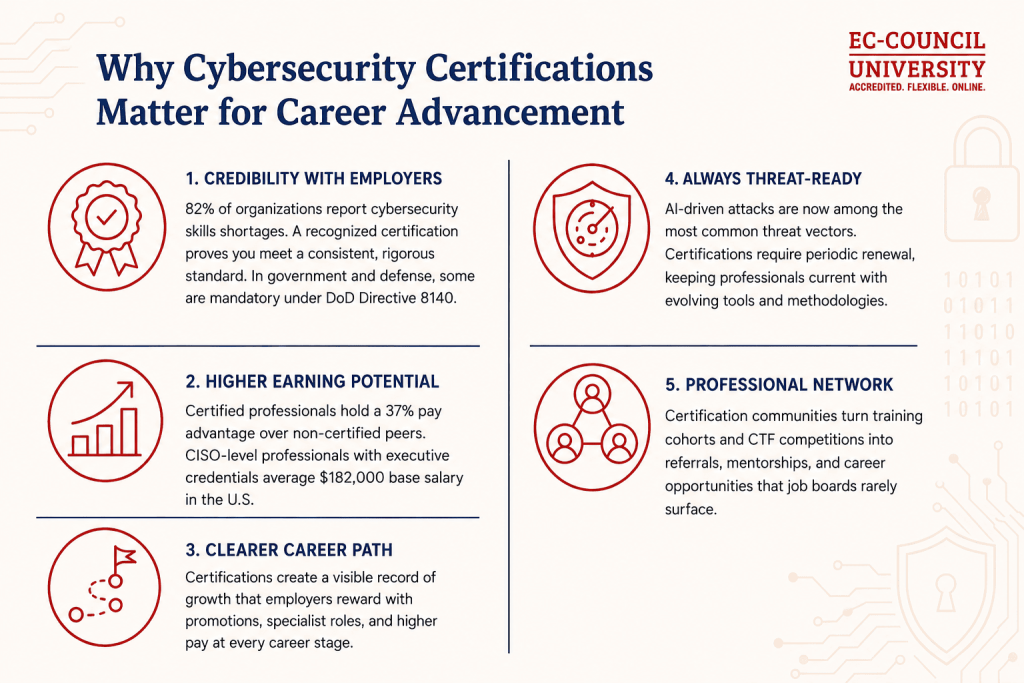
Cybersecurity is not a dying industry. It is one of the fastest-growing fields in the entire U.S. economy, and certifications remain the primary gatekeeping mechanism employers use to screen candidates at scale. According to the U.S. Bureau of Labor Statistics, information security analyst roles are projected to grow 33% through 2033, nearly five times faster than the average for all occupations. The ISC2 2024 Cybersecurity Workforce Study placed the global workforce gap at 4.8 million unfilled positions, a figure that has held stubbornly high for three consecutive years.
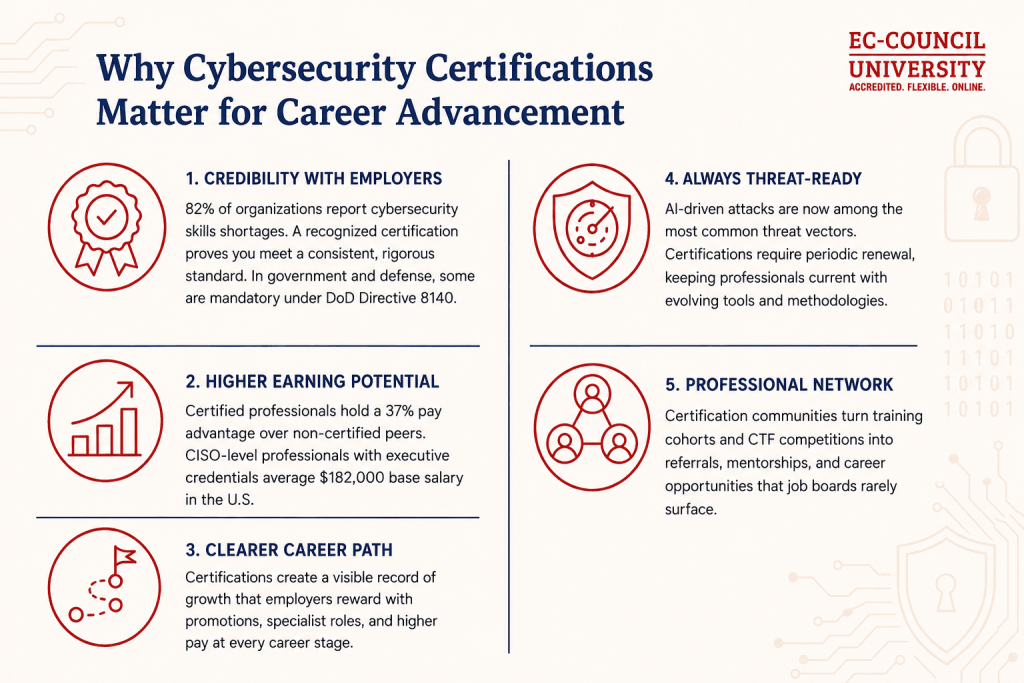
Image source: [EC-Council University (ECCU)](EC-Council University (ECCU))
CyberSeek data shows that hundreds of thousands of U.S. cybersecurity job postings remain open at any given time, with employers explicitly naming credentials like CompTIA Security+, CISSP, and CEH directly in listing requirements. Certifications are not soft signals of competence here. They function as hard filters: applicants without them are frequently screened out before a human reviewer ever reads the resume.
The AI displacement concern deserves a direct answer. AI is generating new cybersecurity specializations rather than eliminating existing ones. Roles like AI security analyst and prompt injection tester did not exist in meaningful numbers three years ago. Organizations defending AI-assisted attack surfaces need credentialed professionals who understand adversarial machine learning, not fewer of them.
For anyone targeting federal or defense work, certifications are legally non-negotiable. DoD Directive 8140 mandates specific credentials for every information assurance role within the Department of Defense. No certification means no eligibility, full stop.
The threat landscape in 2026 reinforces all of this. AI-assisted phishing campaigns, cloud misconfigurations, and supply chain compromises are driving enterprise security budgets higher. These are precisely the domains that top high-income skills in the market reflect. If anything, the credential premium is growing, not shrinking.
Key takeaway: Certifications in 2026 are hiring prerequisites in roughly half of all posted cybersecurity roles, not optional resume padding.
What Is the Highest-Paying Cybersecurity Certification in 2026?
Holding the right certification doesn't just open doors, it sets your salary floor. CISSP holders report a median U.S. salary above $120,000, making it the most consistently high-paying credential in the field, according to ISC2's 2024 Cybersecurity Workforce Study. CISM holders follow closely at a median above $115,000, while senior penetration testers carrying an OSCP frequently exceed $130,000 in competitive markets like New York, San Francisco, and Washington D.C.
| Certification | Issuing Body | Avg. U.S. Salary (2026) | Experience Required | Exam Cost |
|---|---|---|---|---|
| CISSP | ISC2 | ~$120,000, $145,000 | 5 years in 2+ security domains | $749 |
| CISM | ISACA | ~$115,000, $138,000 | 5 years in information security mgmt | $575, $760 |
| OSCP | Offensive Security | ~$110,000, $135,000 | Intermediate to advanced hands-on | $1,499 (90-day lab) |
| CISA | ISACA | ~$105,000, $128,000 | 5 years in IS audit/control | $575, $760 |
| CEH | EC-Council | ~$95,000, $120,000 | 2 years networking/security | $950, $1,199 |
| CompTIA Security+ | CompTIA | ~$75,000, $95,000 | None (entry-level) | $392 |
| CC (Certified in Cybersecurity) | ISC2 | ~$65,000, $80,000 | None (entry-level) | Free (limited time) |
Salary varies significantly by role, industry, and geography. A CISSP-certified CISO at a Fortune 500 firm earns well above these medians, while the same credential at a mid-size regional company may land closer to the lower bound. According to Glassdoor's 2024 salary data, total compensation for senior cybersecurity architects routinely clears $160,000 when bonuses and equity are included.
Can you make $200,000 a year in cybersecurity? Yes, but it requires stacking a senior credential (CISSP or CISM) with 10+ years of experience, a leadership title (CISO, VP of Security), or a high-demand specialization like cloud security architecture or offensive security research. The certification alone won't get you there, the career trajectory around it will.
Entry-level credentials like Security+ and CC function as salary accelerators, not salary maximizers. They compress the timeline to your first $70,000, $80,000 role, which is why they remain strong certification ROI plays for career changers and recent graduates.
Pro Tip: If maximizing long-term earnings is the goal, target CISSP or CISM within five years of entering the field, both credentials carry measurable salary premiums across nearly every industry vertical.
The credential that pays most depends on where you sit in your career arc. Early on, any cert beats none. At the senior level, CISSP and OSCP pull the widest salary gaps versus uncertified peers in their respective disciplines.
The 12 Best Cybersecurity Certifications in 2026, Ranked
Knowing which certifications deliver the highest career ROI is exactly where most candidates get stuck. The list below cuts through that uncertainty by ranking each credential on employer demand, salary impact, and real-world relevance to 2026's threat landscape.
Watch: 100k+ ONLY - Best Certs for Cyber and IT Jobs (2026)
https://www.youtube.com/watch?v=OV4YFMTp3t0
The consensus top 5 among hiring managers and career coaches, confirmed across ISC2 surveys, LinkedIn job data, and practitioner forums, are CompTIA Security+, CISSP, CEH, CISM, and CISA. These five appear in more job postings, salary studies, and recommended learning paths than any other credentials in the field. The remaining seven on this list address specialized tracks where demand has accelerated sharply.
Best Entry-Level Cybersecurity Certifications
For candidates with zero to two years of experience, three certifications offer the strongest combination of accessibility, employer name recognition, and career momentum. If you are searching for the best cybersecurity certifications in 2026 for beginners, start here.
1. CompTIA Security+
- Issuing body: CompTIA
- Experience required: None formally; CompTIA recommends Network+ and two years of IT experience
- Exam cost: $404 (as of August 2026)
- Best for: Early-career candidates entering IT security, government contractors, help desk professionals moving into security roles
- Why it matters in 2026: Security+ is approved under U.S. DoD Directive 8570, making it a hard requirement for thousands of federal and defense contractor positions. It is the single most requested entry-level certification in U.S. cybersecurity job postings.
8. CCNA (Cisco Certified Network Associate)
- Issuing body: Cisco
- Experience required: None formally; one to two years of networking experience recommended
- Exam cost: Approximately $330 (as of August 2026)
- Best for: Candidates who need to solidify networking fundamentals before pursuing security-specific certifications
- Why it matters in 2026: You cannot defend a network you do not understand. CCNA builds the TCP/IP, routing, and switching knowledge that makes security certifications like CySA+ and CISSP significantly easier to absorb. Most experienced hiring managers flag weak networking fundamentals as a common failure point for junior analysts.
9. ISC2 CC (Certified in Cybersecurity)
- Issuing body: ISC2
- Experience required: None
- Exam cost: Currently free to sit (as of August 2026), with a $50 annual maintenance fee after certification
- Best for: Career changers, students, and anyone who cannot yet justify the cost of Security+
- Why it matters in 2026: ISC2 launched the CC specifically to lower the barrier into the profession. The free exam is not a permanent policy, so early movers get maximum value. For candidates exploring online learning paths, resources like CrowdStrike courses pair well with the CC's threat detection and incident handling content.
Pro Tip: Complete the ISC2 CC first if cost is a barrier. Once employed in a security role, use employer tuition assistance to fund Security+ within 12 months. Stacking both signals commitment without requiring upfront investment.
Best Advanced Cybersecurity Certifications
These five credentials demand real-world experience, carry significant exam investment, and open the highest-paying roles in the field. Do not sit CISSP or CISM without meeting the experience prerequisites. Multiple practitioners flag this as a costly mistake: failing an experience audit wastes exam fees and delays the credential by months.
2. CISSP (Certified Information Systems Security Professional)
- Issuing body: ISC2
- Experience required: Five years of paid work experience across two or more of the eight CISSP domains
- Exam cost: $749 (as of August 2026)
- Best for: Senior security professionals targeting architect, director, or CISO-track roles
- Why it matters in 2026: CISSP remains the gold standard for senior positions globally. Its eight domains span risk management, cryptography, network security, and software development security, making it the broadest credential on this list. According to ISC2's 2024 Workforce Study, CISSP holders report median U.S. salaries above $120,000.
4. CISM (Certified Information Security Manager)
- Issuing body: ISACA
- Experience required: Five years of information security work experience, with three years in security management
- Exam cost: $575 for ISACA members, $760 for non-members (as of August 2026)
- Best for: Security managers and professionals on a CISO career path
- Why it matters in 2026: CISM targets the business side of security, covering governance, risk management, and incident response from a management perspective. Organizations facing new SEC cybersecurity disclosure rules increasingly need leaders who can translate technical risk into board-level language.
5. CISA (Certified Information Systems Auditor)
- Issuing body: ISACA
- Experience required: Five years of professional experience in information systems auditing, control, or security
- Exam cost: $575 for ISACA members, $760 for non-members (as of August 2026)
- Best for: Audit, compliance, and risk professionals; especially relevant in financial services and healthcare
- Why it matters in 2026: Regulatory expansion across the EU (NIS2, DORA) and continued SEC enforcement in the U.S. have pushed CISA demand higher than at any point in the past decade. Audit-focused roles now command premium salaries at Big Four firms and financial institutions.
7. OSCP (Offensive Security Certified Professional)
- Issuing body: OffSec
- Experience required: No formal prerequisite; strong Linux, networking, and scripting skills expected
- Exam cost: Included with OffSec's PEN-200 course bundle, starting at approximately $1,499 (as of August 2026)
- Best for: Aspiring penetration testers and red team operators
- Why it matters in 2026: OSCP's 24-hour hands-on exam is the industry benchmark for offensive security. It cannot be memorized, only earned through demonstrated exploitation skill. Senior penetration testers holding OSCP routinely command salaries exceeding $130,000 in major U.S. markets.
10. GCIH (GIAC Certified Incident Handler)
- Issuing body: GIAC (Global Information Assurance Certification)
- Experience required: None formally; practical SOC experience strongly recommended
- Exam cost: Approximately $979 (as of August 2026)
- Best for: SOC analysts and incident responders
- Why it matters in 2026: GCIH validates detection, response, and containment skills against real attack scenarios. As mean time to detect (MTTD) becomes a tracked KPI at enterprise security operations centers, employers specifically request this credential in Tier 2 and Tier 3 SOC analyst job descriptions.
Best Cloud and Specialized Certifications
Three additional credentials address the fastest-growing specialization areas in enterprise security.
3. CEH (Certified Ethical Hacker)
- Issuing body: EC-Council
- Experience required: Two years of information security experience, or completion of official EC-Council training
- Exam cost: Approximately $950 to $1,199 depending on training bundle (as of August 2026)
- Best for: Red team aspirants and security professionals seeking a structured ethical hacking framework
- Why it matters in 2026: CEH is frequently listed alongside Security+ in government and defense contractor job postings. While OSCP carries more weight among pure offensive security practitioners, CEH's broader recognition in formal procurement and compliance contexts keeps it consistently in demand.
6. CySA+ (CompTIA Cybersecurity Analyst)
- Issuing body: CompTIA
- Experience required: Three to four years of hands-on information security or related experience
- Exam cost: $404 (as of August 2026)
- Best for: Blue team analysts, SOC analysts, and threat hunters working with SIEM platforms
- Why it matters in 2026: CySA+ bridges the gap between entry-level Security+ and senior certifications. Its focus on behavioral analytics and threat intelligence maps directly onto the toolsets SOC analysts use daily, including Splunk, Microsoft Sentinel, and CrowdStrike Falcon.
11. AWS Security Specialty
- Issuing body: Amazon Web Services
- Experience required: Five years of IT security experience, two years working with AWS
- Exam cost: $300 (as of August 2026)
- Best for: Cloud security engineers and architects at AWS-heavy organizations
- Why it matters in 2026: With over 60% of enterprise workloads now running in public cloud environments, according to Flexera's 2025 State of the Cloud Report, cloud-native security expertise commands a measurable salary premium. AWS Security Specialty validates IAM, encryption, logging, and incident response within the AWS ecosystem specifically.
12. Microsoft SC-200 (Microsoft Security Operations Analyst)
- Issuing body: Microsoft
- Experience required: Familiarity with Microsoft 365, Azure, and basic threat mitigation practices recommended
- Exam cost: $165 (as of August 2026)
- Best for: SOC analysts and security engineers working in Microsoft-stack environments
- Why it matters in 2026: Microsoft Sentinel has become the dominant SIEM platform in mid-market and enterprise organizations. SC-200 certifies hands-on competence with Sentinel, Defender for Endpoint, and Microsoft Purview, making it one of the most practical credentials available for analysts embedded in Microsoft environments. Pairing SC-200 with broader online automation courses accelerates proficiency with Sentinel's playbook and Logic Apps automation features.
Important: Certifications 11 and 12 require renewal more frequently than vendor-neutral credentials. AWS Security Specialty requires recertification every three years; Microsoft certifications must be renewed annually via a free online assessment.
Key differentiator across all 12: The certifications that consistently appear in 2026 job postings share one trait: they test applied skill, not just memorized theory. OSCP, GCIH, and CySA+ require hands-on demonstrations. Security+, CISSP, and CISA test decision-making under realistic scenario constraints. Pure recall-based credentials are losing ground in hiring conversations as AI tools make factual lookup trivially easy.
How Should You Choose the Right Cybersecurity Certification for Your Career Goals?
Applied skill tests like OSCP and CySA+ dominate 2026 hiring precisely because the "right" certification is never universal, it is role-specific. The most valued credential for a SOC analyst is functionally useless on a penetration tester's resume, and vice versa. Choosing correctly means working backwards from the job you want, not forward from the cert that sounds impressive.
Follow this four-step framework before committing a dollar or an hour of study time.
Step 1: Identify your target job role. Narrow down the discipline before evaluating any credential. The major tracks and their corresponding certification paths break down clearly:
| Target Role | Entry Cert | Mid-Level Cert | Advanced Cert |
|---|---|---|---|
| SOC Analyst | CompTIA Security+ | CySA+ | GCIH |
| Penetration Tester | eJPT / CEH | OSCP | GPEN |
| Security Manager | CISSP (Associate) | CISM | CISSP |
| Auditor / Compliance | CompTIA Security+ | CISA | CRISC |
| Cloud Security Engineer | AWS Cloud Practitioner | AWS Security Specialty | CCSP |
Step 2: Map your experience level honestly. Most entry-level certs assume one to two years of IT exposure. OSCP recommends networking fundamentals and scripting ability before you register. CISSP requires five years of paid security experience to earn the full credential. Skipping tiers wastes exam fees, the average retake adds $300 to $700 in direct costs depending on the cert.
Step 3: Cross-reference active job listings. Search LinkedIn Jobs and Indeed for your target role in three geographic markets. Filter by "posted last 30 days." If a certification appears in fewer than 20% of matching postings, deprioritize it. According to Cyberseek's workforce data, Security+, CISSP, and CISA consistently rank among the top five most-requested credentials in active U.S. job postings (as of July 2026).
Step 4: Calculate the true total cost. Exam fees, official training, practice labs, and renewal CPE requirements add up fast. CISSP renewals require 120 CPE credits over three years. OSCP's lab environment subscription runs separately from the exam fee. Budget the full lifecycle cost, not just the registration price.
Important: Cert stacking without hands-on practice is a red flag to technical interviewers in 2026. Building a portfolio that impresses recruiters through home labs and documented projects carries weight that a credential list alone cannot replicate.
The most effective cybersecurity career roadmap in 2026 pairs one well-chosen, role-aligned certification with demonstrated, hands-on competence, not a resume stacked with logos.
Which Cybersecurity Certifications Are Most In-Demand in 2026 Job Listings?
Hiring signals confirm what salary data only implies: employer demand in 2026 cybersecurity job postings is highly concentrated around a small cluster of credentials. Security+, CISSP, and CISM appear most frequently across all seniority levels in job listings scanned across LinkedIn, Indeed, and Simply Hired, according to Coursera's analysis of late 2025 hiring data. Security+ dominates entry- to mid-level postings; CISSP and CISM lock the manager and architect tiers.
Beyond that core trio, the composition of in-demand certifications shifts sharply by role type:
- Cloud-heavy job descriptions increasingly name the AWS Security Specialty and Microsoft SC-200 (Security Operations Analyst) as explicit requirements, reflecting enterprise migration to hybrid cloud environments where vendor-native security tooling has become the default operational layer.
- SOC analyst listings are showing measurable growth in CySA+ requirements, as hiring managers seek demonstrable blue-team competency beyond what Security+ alone signals. Employers want proof that candidates can triage alerts, not just define them.
- Offensive security postings show rising OSCP frequency, particularly at firms with dedicated red teams or product security functions. Its hands-on, exam-by-exploitation format is treated as a hard filter by technical hiring managers.
The government and defense sectors follow an entirely different logic. DoD 8140 compliance mandates specific approved certifications for personnel in designated cyberspace work roles. Security+, CISSP, and CEH all appear on the DoD 8140 approved list, making those credentials non-negotiable for federal contractors and military cyber positions rather than simply preferred.
According to ISC2's 2024 Cybersecurity Workforce Study, 72% of organizations require at least one certification as a hiring prerequisite, underscoring why cybersecurity job postings in 2026 treat these credentials as baseline filters rather than differentiators.
Note: If you're targeting government or public sector technology roles, confirm which specific DoD 8140 work role category your target position falls under before selecting a cert, the approved list varies by role level and function.
Across the private sector, Security+ remains the single most versatile credential in active job listings, appearing in more postings than any other certification at the entry-to-mid career level (as of Q2 2026).
Should You Stack Certifications or Go Deep on One? What the Data Says
Security+'s dominance in job listings answers the question of what to get first. The harder, more consequential question that no competitor article addresses directly is: how many certifications should you actually pursue, and in what sequence?
On Reddit's r/cybersecurity and r/CompTIA, "cert stacking" debates run weekly. The recurring pattern is a candidate who holds Security+, Network+, A+, and CC simultaneously but cannot land interviews, because hiring managers see a resume full of foundational logos and no demonstrated depth. Collecting entry-level certifications in parallel produces diminishing returns fast. Each additional badge adds marginal signal to a recruiter while consuming study time that could build actual skill.
The comparison worth making is cert ladder vs. cert sprawl:
| Approach | What It Looks Like | Outcome |
|---|---|---|
| Cert Ladder | Security+ → hands-on lab → CySA+ or OSCP | Demonstrates progression and applied depth |
| Cert Sprawl | Security+ + Network+ + A+ + CC simultaneously | Signals breadth without evidence of competence |
SOC analyst practitioners frequently warn against taking CISSP or CASP+ too early, and the data supports the caution. CISSP requires a minimum of five years of paid work experience across two of eight security domains, per ISC2's official requirements. Candidates who sit the exam without that lived context see sharply lower pass rates, because the questions are designed to test seasoned judgment, not textbook recall.
The CPE burden is a practical concern that rarely enters these discussions. Holding five active certifications simultaneously can mean managing 150+ CPE hours per renewal cycle across different renewal schedules and vendors. That time spent renewing old credentials is time not spent building skills in labs, CTF competitions, or real incident response.
Pro Tip: The most effective certification strategy in 2026 follows a simple three-step rhythm: earn one cert, apply those skills in a lab or on the job for 3 to 6 months, then pursue the next tier. This is the same principle that makes skill-building with structured application more durable than passive credential accumulation in any technical field.
The practitioner consensus is clear: one well-chosen cert with six months of applied practice outperforms four entry-level badges stacked in the same period, both in interview performance and in actual job readiness.
How Are AI and Cloud Trends Reshaping Cybersecurity Certifications in 2026?
That practitioner consensus around depth over breadth becomes even more strategic when you factor in where the certification landscape itself is shifting. Three structural changes are rewriting which credentials carry weight in 2026 hiring conversations.
First, AI security has become a formal exam domain, not a footnote. ISC2 has updated the CISSP Common Body of Knowledge to include AI governance, model security, and prompt injection as testable concepts. Candidates who earned CISSP before 2024 are studying these additions through continuing education requirements. This reflects a broader industry acknowledgment that AI systems introduce attack surfaces, from adversarial inputs to training data poisoning, that traditional security frameworks never anticipated. According to the ISC2 2025 AI in Cybersecurity Report, 88% of cybersecurity professionals said AI is already affecting their daily workflows, and that figure is reshaping exam blueprints across multiple certification bodies.
Second, cloud-native certifications have crossed the threshold from optional to required. AWS Security Specialty and Google Professional Cloud Security Engineer now appear as explicit requirements, not preferences, in enterprise architect and cloud security engineer postings as organizations complete their infrastructure migrations. These credentials prove operational fluency, not just conceptual familiarity.
Third, SIEM-specific credentials are gaining serious traction in SOC hiring. Splunk Core Certified User and Elastic Security Analyst certifications address a direct employer pain point: candidates who understand detection engineering in theory but cannot build a correlation rule inside an actual platform on day one. Employers want proof of tool proficiency, and these credentials deliver exactly that signal.
Pro Tip: The best-positioned candidates in 2026 pair a vendor-neutral foundational cert (Security+ or CISSP) with at least one cloud or SIEM-specific credential. That combination addresses both strategic and operational hiring criteria simultaneously.
Understanding how AI has changed how we learn matters here too: the tools reshaping cybersecurity exams are the same ones transforming every professional learning path in 2026.
Last updated: August 2026
Frequently Asked Questions
Is cybersecurity still worth it in 2026?
Yes, cybersecurity remains one of the most in-demand and recession-resistant career fields in 2026. The global talent shortage continues to push salaries higher, and the rise of AI-driven threats has created entirely new job categories that did not exist just a few years ago. If anything, the urgency for skilled professionals has increased, not decreased.
What is the highest-paying cybersecurity certification in 2026?
The CISSP (Certified Information Systems Security Professional) and the Google Cloud Professional Security Engineer certification consistently rank at the top for salary outcomes in 2026, with certified professionals often earning between $140,000 and $200,000 annually in senior roles. Cloud security and AI security specializations are also commanding significant salary premiums compared to general certifications.
Is cybersecurity being replaced by AI?
AI is automating certain repetitive tasks like log analysis and threat pattern detection, but it is not replacing cybersecurity professionals. In fact, AI has expanded the field by creating demand for specialists who can secure AI systems, audit machine learning models, and respond to AI-generated attacks. The role is evolving, not disappearing.
Which cybersecurity certifications are most in demand in 2026 job listings?
CompTIA Security+, CISSP, and cloud-specific credentials such as the AWS Security Specialty and Microsoft SC-900 series appear most frequently in job postings in 2026. Employers are increasingly filtering for certifications that demonstrate both foundational security knowledge and hands-on cloud or AI security skills.
Can you make $200,000 a year in cybersecurity?
Reaching $200,000 per year is achievable in cybersecurity, but it typically requires a combination of a high-value certification, several years of specialized experience, and a senior or leadership role such as CISO, Principal Security Architect, or Cloud Security Lead. Geographic location and industry, particularly finance and defense, also play a major role in hitting that income level.
Conclusion
The cybersecurity job market in 2026 rewards specificity, and the single most important lesson from this guide is that your certification should map directly to a target role, not simply follow a popularity ranking. Whether you are pursuing a penetration testing career with the OSCP, moving into governance with the CISSP or CISM, or building a foundation with Security+ or CySA+, alignment between credential and career goal is what converts a certification into a salary increase.
As AI security and cloud skills become baseline expectations in job listings, certifications that incorporate these domains will carry increasing weight in hiring decisions.
Your concrete next step: open the CyberSeek Career Pathway tool right now, identify the one role you are targeting in the next 12 months, and cross-reference it against the comparison table in this article. That single action will tell you more about which of the best cybersecurity certifications in 2026 deserves your time and money than any general ranking ever could.