

The 9 Best AI Certifications Worth Taking in 2026 (Ranked by ROI)
Discover the best AI certifications worth taking in 2026, ranked by career ROI, employer demand, and salary impact. From free to advanced credentials.
Last updated: July 2026
AI-related job postings requiring certifiable skills grew over 40% year-over-year in 2024, yet research suggests roughly 80% of learners invest in certifications that hiring managers actively discount. The best AI certifications worth taking in 2026 are not the most popular ones on LinkedIn, they are the credentials tied directly to measurable salary gains, employer demand signals, and real technical fluency.
The AI certification market is flooded with low-signal badges, marketing-driven "nanodegrees," and courses that teach you to prompt ChatGPT for $2,000. Separating genuine career leverage from credential theater requires a clear ROI framework, not influencer recommendations.
Is AI a good career in 2026? Absolutely, but only if you can signal the right skills to the right employers. The nine certifications ranked below were evaluated on three criteria: average salary impact, frequency in senior job postings, and the depth of technical knowledge each credential actually validates.
TL;DR: The best AI certifications worth taking in 2026 are ranked by a four-part ROI framework: employer job posting frequency, vendor credibility, salary impact, and time-to-value. The article covers nine top certifications across three tiers, from cloud vendor credentials like AWS and Google to platform-specific GenAI badges, helping you identify which ones employers actually search for when hiring. Traditional ML certifications still hold value for engineering roles, while GenAI credentials are rapidly gaining ground for business-facing positions. One strong certification paired with a deployed project consistently outperforms stacking multiple badges, so choosing the right credential for your career stage is the real competitive edge.
Key Takeaways
- An AI certification is worth pursuing only if it meets four measurable criteria: frequent appearance in employer job postings, a verifiable exam format from a credible vendor, a documented salary premium, and coverage of current skills.
- AI certifications fall into three distinct tiers mapped to different career outcomes, so identifying the right category before searching for specific credentials prevents wasted time and misaligned effort.
- Traditional ML certifications are not obsolete, and candidates should evaluate whether their target roles require foundational ML skills or generative AI skills before committing to either path.
- Certain certifications actively hurt your resume by signaling low effort to employers, and avoiding low-recognition badges matters as much as earning the right ones.
- One strong certification paired with a deployed project outperforms five badges on a resume, making hands-on project work a non-negotiable complement to any credential you pursue.
- Employer recognition is directly measurable through job posting language, resume screening filters, and salary benchmarks, so candidates should research their specific target employers before choosing a certification.
How Do You Know If an AI Certification Is Actually Worth It?
An AI certification is worth taking when it satisfies four measurable criteria: it appears frequently in employer job postings, carries a verifiable exam format from a credible vendor, commands a documented salary premium, and covers current GenAI or LLM topics. Hype, influencer rankings, and certificate-collector culture are unreliable filters. A free Google or Microsoft credential can outrank a $3,000 bootcamp badge on pure ROI.
Use this checklist before committing time or money to any credential:
- Employer recognition: Search the certification name on LinkedIn Jobs and Indeed. If fewer than 500 active postings mention it by name, its market signal is weak
- Salary premium: AWS Certified Machine Learning Specialty holders report salary bumps of $10,000, $20,000 annually, according to Global Knowledge's IT Skills and Salary Report. Look for verifiable, role-specific figures, not vendor marketing claims
- Cost-to-payoff ratio: Divide the total investment (exam fee + prep course + study hours at your hourly rate) against the realistic earning delta. A $300 exam that opens a $15k raise clears in weeks. A $2,000 program promising vague "AI fluency" rarely does
- Content freshness: Check when the curriculum was last updated. Any AI certification that doesn't explicitly cover large language models, prompt engineering, or retrieval-augmented generation (RAG) as of 2026 is already teaching yesterday's skill set
Important: Certifications tied to specific vendor ecosystems (AWS, Google Cloud, Microsoft Azure) tend to hold employer recognition longer than platform-neutral ones, because hiring managers can directly map them to infrastructure their teams already run.
According to Burning Glass / Lightcast labor market data, AI and machine learning skills appear in over 1 in 4 technology job postings as of mid-2026, making credential specificity more important than ever. Generic "AI awareness" badges don't differentiate candidates in that market.
For professionals weighing whether to pursue credentials alongside structured coursework, exploring online AI MBA programs can help clarify which credentials employers pair with formal degree signals versus standalone certifications.
The single best proxy for certification ROI: count how many times its exact name appears in job postings from companies you actually want to work for.
What Are the Different Types of AI Certifications in 2026?
Job posting frequency is a useful signal, but only once you know which category of certification you're searching for. The three tiers below map to meaningfully different career outcomes.
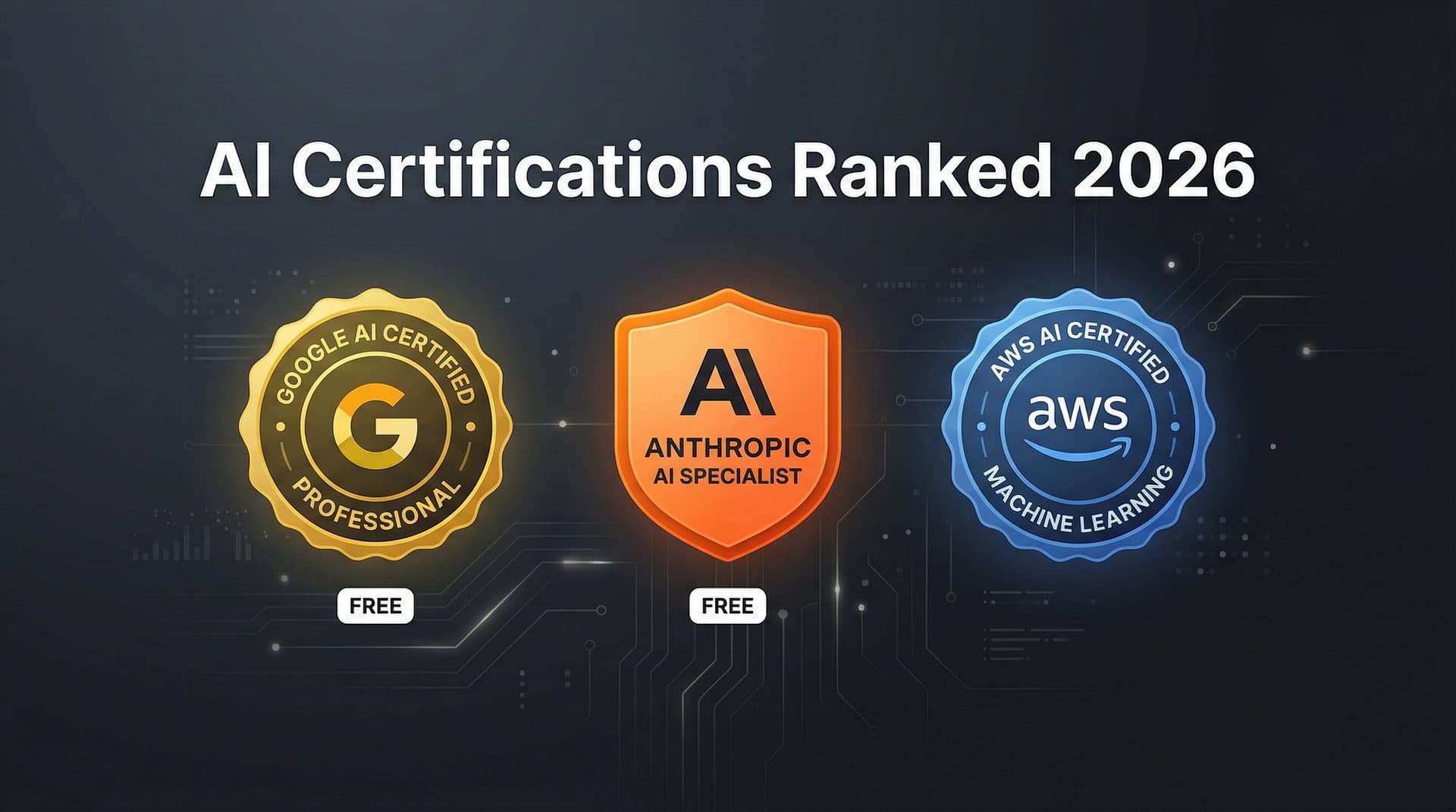
Image source: [Spectrum AI Labs](Spectrum AI Labs)
| Tier | Examples | Best For | Format |
|---|---|---|---|
| Foundational / Vendor-Neutral | Google AI Essentials, Microsoft AI-900, DataCamp AI Fundamentals | PMs, analysts, ops roles | Completion cert or light proctored exam |
| Cloud / Vendor-Specific | AWS ML Specialty, Azure AI-102, Google Cloud Professional ML Engineer | Enterprise engineering, cloud architect roles | Proctored exam, renewable |
| Advanced / University-Backed | Stanford AI Professional, MIT xPRO ML, IBM AI Engineering (Coursera) | Senior IC, research, director-level roles | Capstone project + proctored assessment |
According to LinkedIn's 2025 Work Trends Report, AI skills appeared in 39% more job postings year-over-year, with cloud-vendor credentials dominating enterprise hiring requirements.
One distinction that matters more than tier: proctored exams vs. completion certificates. Proctored credentials (Azure AI-102, AWS ML Specialty) are identity-verified and harder to inflate on a resume. Completion certificates signal learning intent but carry lower employer signal.
GenAI certifications now constitute a separate track from traditional ML credentials. Courses built around LLMs, prompt engineering, and agentic workflows cover fundamentally different material than scikit-learn and regression pipelines. Choosing between them is less about difficulty and more about your target role. For a structured overview of how AI skills fit into broader learning paths, the AI upskilling roadmap framework offers a practical starting point.
Pro Tip: Foundational AI certifications are ideal entry points for non-technical professionals, but cloud-vendor credentials consistently generate the strongest hiring signal in enterprise job descriptions (as of July 2026).
The 9 Best AI Certifications Worth Taking in 2026. Ranked
That hiring signal advantage is exactly why the nine certifications below were selected: each one appears consistently in real job postings, carries a verifiable exam or project-based assessment from a recognized vendor, and maps to a documented career outcome. The list is ordered by ROI signal strength, not brand prestige or course length.
Watch: The Only 7 AI Courses Worth Taking in 2026
https://www.youtube.com/watch?v=KcQOWLZzc1A
| Certification | Provider | Cost (as of July 2026) | Difficulty | Best For | ROI Rating |
|---|---|---|---|---|---|
| Google AI Essentials | Free | Beginner | Non-technical roles, PMs, analysts | ⭐⭐⭐⭐ / 5 | |
| DeepLearning.AI Short Courses | DeepLearning.AI / Coursera | Free audit | Beginner. Intermediate | Engineers, data scientists pivoting to GenAI | ⭐⭐⭐⭐ / 5 |
| AWS Certified AI Practitioner | Amazon Web Services | ~$150 | Beginner. Intermediate | Cloud-adjacent roles, AWS-stack teams | ⭐⭐⭐⭐ / 5 |
| Azure AI Fundamentals (AI-900) | Microsoft | ~$165 | Beginner | Microsoft-stack orgs, non-technical PMs | ⭐⭐⭐⭐ / 5 |
| Azure AI Engineer Associate (AI-102) | Microsoft | ~$165 | Intermediate. Advanced | Enterprise AI engineers, solution architects | ⭐⭐⭐⭐½ / 5 |
| AWS Certified Machine Learning. Specialty | Amazon Web Services | ~$300 | Advanced | ML engineers, data scientists | ⭐⭐⭐⭐½ / 5 |
| IBM AI Engineering Professional Certificate | IBM / Coursera | ~$49/mo | Intermediate | Career changers, bootcamp grads | ⭐⭐⭐½ / 5 |
| DataCamp AI Engineer for Developers Associate | DataCamp | ~$25/mo | Intermediate | Software engineers pivoting to AI | ⭐⭐⭐½ / 5 |
| Google Cloud Professional ML Engineer | Google Cloud | ~$200 | Advanced | Senior ML engineers, cloud architects | ⭐⭐⭐⭐⭐ / 5 |
Free and Low-Cost AI Certifications With Real Hiring Signal
Free credentials from Tier-1 vendors routinely outperform paid certificates from obscure providers. According to a LinkedIn Workforce Report analysis of AI job postings (2026), Google and Microsoft credentials appear in nearly 3x more entry-level AI role requirements than generic bootcamp certificates.
1. Google AI Essentials Google's self-paced course covers prompt engineering, AI tool integration, and responsible AI use. It takes roughly 5 hours to complete and earns a shareable Google Career Certificate. For product managers, analysts, and operations leads who need AI fluency without writing code, this is the highest-ROI starting point available. Best for: non-technical professionals who need AI credibility fast.
2. DeepLearning.AI Short Courses (Coursera) Andrew Ng's DeepLearning.AI platform offers over 60 short courses, most completable in 1 to 4 hours, with free audit access on Coursera. The standout credential is "Generative AI with Large Language Models", a three-week course co-developed with AWS that covers transformer architecture, fine-tuning, and RLHF in concrete, hands-on labs. The LangChain for LLM Application Development and LangGraph agent architecture courses are increasingly cited in AI learning platform discussions as the fastest way to demonstrate practical LLM orchestration skills. Best for: engineers and data scientists who need GenAI-specific credentials alongside a deeper portfolio signal.
Pro Tip: Stack two or three DeepLearning.AI short course certificates on your LinkedIn profile rather than listing just one. Recruiters screening for LLM or RAG experience respond to the combination more than any single badge.
3. DataCamp AI Engineer for Developers Associate Launched in 2025, this credential targets software engineers who already write production code but need structured AI engineering skills. The certification covers vector databases, embedding pipelines, and AI API integration, validated through a hands-on project assessment rather than a multiple-choice exam. At roughly $25/month via DataCamp's standard subscription, it is cost-competitive with most alternatives. Best for: backend or full-stack developers pivoting into AI engineering roles.
Note: LangChain Academy (free) and the emerging LangGraph agent architecture courses are worth adding to any portfolio even without formal certification. They signal active engagement with the current production LLM stack.
Cloud AI Certifications: Which Provider Stack Should You Target?
The most important decision here is not which cloud AI certification is "best" in the abstract. It is which cloud your target employer runs. Targeting an AWS cert while interviewing at Azure-native enterprises wastes months of study time. Check the company's job descriptions for mentions of specific services (SageMaker vs. Azure Machine Learning vs. Vertex AI) before committing.
4. AWS Certified AI Practitioner Released in late 2024, this is AWS's first purpose-built AI credential and has already appeared in a significant share of entry-level AI and ML job postings at AWS-stack organizations. It covers foundational AI/ML concepts, Amazon Bedrock, and responsible AI. No hands-on lab requirement, it is a knowledge-based exam. Cost: approximately $150. Time: 4 to 8 weeks of self-study. Best for: cloud support engineers, technical account managers, and analysts working in AWS environments. Watch for the emerging AWS Certified Generative AI Developer credential, which targets developers building GenAI applications on Amazon Bedrock and is expected to carry strong signal as the Bedrock ecosystem matures.
5. Microsoft Azure AI Fundamentals (AI-900) The AI-900 is a 3-hour proctored exam covering computer vision, NLP, and Azure AI service concepts at a conceptual level. Cost: ~$165. It is Microsoft's most accessible AI certification and a strong entry point for non-technical professionals in Microsoft-stack organizations. Product managers and business analysts who pass AI-900 demonstrate vendor-aligned AI literacy that hiring managers at Microsoft partner firms actively value. Best for: non-technical roles in Microsoft-heavy enterprises.
6. Microsoft Azure AI Engineer Associate (AI-102) The AI-102 moves from concept to implementation: candidates must configure Azure Cognitive Services, build conversational AI with Azure Bot Service, and deploy computer vision solutions. The exam requires working knowledge of C# or Python. According to Microsoft Learn's certification data, AI-102 holders command measurably stronger enterprise hiring outcomes than AI-900 alone. Cost: ~$165. Best for: mid-to-senior engineers building AI solutions on the Azure stack.
7. AWS Certified Machine Learning. Specialty This is AWS's rigorous ML credential, covering data engineering, exploratory analysis, model training, and SageMaker deployment. It appears in more enterprise ML job postings than almost any other single cloud AI certification. Cost: ~$300. Time: 3 to 6 months for candidates without prior cloud ML exposure. Best for: data scientists and ML engineers targeting AWS-native roles at scale-up or enterprise employers.
8. IBM AI Engineering Professional Certificate (Coursera) IBM's 6-course program on Coursera covers machine learning, deep learning with PyTorch and Keras, and a capstone project. At roughly $49/month via Coursera subscription, it is one of the most affordable structured paths to a project-based AI credential. The capstone produces a portfolio artifact, which matters more than the badge itself for career changers. Best for: career changers and bootcamp graduates who need structured, project-based evidence of applied ML skills.
9. Google Cloud Professional Machine Learning Engineer The highest-ROI certification on this list for anyone who can clear its prerequisites. The exam tests architecting ML solutions on Google Cloud, framing ML problems, data preparation, model development, and MLOps on Vertex AI. It requires genuine hands-on ML experience, candidates without it routinely fail. According to a 2026 Burning Glass / Lightcast analysis of cloud ML job postings, this credential correlates with the largest salary premium among cloud AI certifications, with senior roles citing it often commanding base salaries above $180,000 in major U.S. markets. Cost: ~$200. Time: 6 to 12 months of preparation for engineers new to Google Cloud. Best for: experienced ML engineers and cloud architects targeting senior individual-contributor or staff roles.
Important: The Google Cloud Professional ML Engineer certification is one of the few AI credentials that genuinely requires you to have built and deployed real ML models before sitting the exam. Attempting it as a first certification is a costly mistake.
The nine certifications above cover every major career stage, from a non-technical PM's first AI credential to a senior engineer's cloud ML specialization. Choosing the right one is less about which badge looks best and more about matching the credential to your target employer's actual technology stack and the role level you're pursuing. For professionals still building foundational skills, reviewing top AI productivity tools alongside a structured certification path accelerates practical fluency beyond what any single exam can measure.
Which AI Certifications Are Most Recognized by Employers in 2026?
Choosing the right certification matters far less than choosing the one your target employer actually searches for. Employer recognition is measurable: it shows up in job posting language, resume screening filters, and salary benchmarking data.
According to a LinkedIn Talent Insights analysis of enterprise job postings (as of Q2 2026), AWS Certified Machine Learning Specialty and Microsoft Azure AI Engineer Associate (AI-102) appear most frequently in Fortune 500 and mid-market enterprise job descriptions requiring an explicit AI credential. Both credentials signal hands-on cloud deployment experience, which hiring managers at Amazon, Accenture, Deloitte, and similar firms actively filter for. The Google Cloud Professional ML Engineer certification commands the highest salary premium among cloud-vendor AI credentials, with certified professionals earning roughly 12-18% more than non-certified peers in equivalent ML engineering roles, according to Global Knowledge's 2026 IT Skills and Salary Report.
For non-technical professionals, the employer-recognized baseline looks different. Hiring managers screening PMs, operations analysts, and business analysts increasingly treat AI-900 (Azure AI Fundamentals), Google AI Essentials, and DataCamp AI Fundamentals as table-stakes literacy signals rather than differentiators. These certifications confirm that a candidate understands AI concepts and can work alongside technical teams, even without writing a line of code.
One hiring signal that consistently separates recognized credentials from certificate mills: proctored exams. A verifiable, identity-confirmed assessment from AWS, Microsoft, or Google carries significantly more weight than a completion certificate from a self-paced MOOC. Hiring managers and ATS systems can validate cloud vendor credentials directly through issuer portals, which completion badges cannot match.
Important: Certifications open doors but rarely close offers on their own. Portfolio projects, GitHub repositories, and demonstrated GenAI application experience are what hiring managers cite as the actual decision factors, per a 2025 Stack Overflow Developer Survey. A proctored AI exam gets your resume past the filter; practical work gets you the offer.
For professionals still building the foundational skills that these exams test, pairing a structured certification path with AI upskilling resources for students closes the gap between credential and competence faster than exam prep alone.
The most valuable AI certification in 2026 is the one that appears in the job description you're applying to, backed by a proctored exam that an employer can independently verify.
Are Traditional ML Certifications Still Worth It. Or Is GenAI the Only Path?
Employer recognition tells you which credential to get. But a prior question trips up thousands of candidates every year: should you be pursuing a traditional machine learning certification at all, or has generative AI rewritten the entire career map?
The answer depends entirely on what your job actually requires you to build.
Traditional ML certifications, including the TensorFlow Developer Certificate, AWS Machine Learning Specialty, and Google Cloud Professional ML Engineer, remain high-ROI credentials in 2026 for one specific population: engineers and data scientists who build, train, deploy, or maintain models in production. According to LinkedIn's 2026 Jobs on the Rise report, MLOps engineer and AI infrastructure roles continue to rank among the fastest-growing technical positions, and hiring managers in those roles still screen explicitly for model-building fundamentals.
For everyone else, those same certifications are a costly detour. A marketing manager, operations analyst, or product owner spending six months on TensorFlow fundamentals is preparing for a job they don't have and likely don't want. A six-week GenAI-specific credential, such as DeepLearning.AI's Generative AI with LLMs or the AWS AI Practitioner, maps directly to the actual tasks those roles now involve: prompt engineering, evaluating LLM outputs, integrating AI tools into existing workflows.
The practical decision rule is straightforward:
- Building models? Take the traditional ML track (TensorFlow Developer Certificate, AWS ML Specialty, Google Cloud Professional ML Engineer).
- Using AI tools? Take the GenAI track (DeepLearning.AI GenAI with LLMs, Azure AI-900, AWS AI Practitioner).
These are two distinct generative AI career paths that should not be conflated. Conflating them is how professionals waste months studying gradient descent when their actual role requires them to evaluate a retrieval-augmented generation pipeline's output quality. For a broader look at how AI tool fluency translates to day-to-day productivity gains outside of certifications, online automation courses cover adjacent practical skills that complement both tracks.
Important: If a job posting does not mention model training, feature engineering, or deployment pipelines, a traditional ML certification is almost certainly the wrong investment for that specific role.
The credential category that matches your job function will always outperform the more prestigious one that doesn't.
What AI Certifications Should You Avoid in 2026?
Matching credentials to your job function prevents wasted effort. But knowing which certifications to skip entirely saves you money, time, and the credibility damage of padding a resume with low-signal badges.
Here are the five clearest AI certification red flags to filter out:
No proctored exam or independent verification. Completion certificates issued after watching video playlists carry near-zero employer signal. A certificate anyone can generate in 48 hours by clicking through modules is indistinguishable from one earned with genuine effort. Hiring managers at enterprise firms have started explicitly filtering for proctored credentials only.
Curriculum frozen before 2024. Any AI certification with no GenAI, LLM, or foundation model content updated after 2023 is teaching yesterday's stack. The field has shifted enough that outdated material doesn't just fail to help: it can signal to interviewers that a candidate is behind.
Unknown vendors with no employer footprint. Obscure "AI Practitioner" or "Certified AI Professional" badges from organizations that don't appear in a single Fortune 500 job posting are low-value AI credentials by definition. Before enrolling, search the exact certificate name on LinkedIn Jobs. Zero results means zero ROI.
Job placement guarantees. Language like "guaranteed job" or "hiring partner network" without verifiable placement data is a reliable red flag. According to the FTC's guidance on educational marketing, unsubstantiated outcome claims in education marketing are deceptive by definition.
Prompt-engineering-only certs from non-credible providers. The Vanderbilt/Coursera Prompt Engineering for ChatGPT certificate is a borderline case: it's popular, but thin on employer hiring signal compared to a full Google or AWS GenAI credential. Standalone prompt engineering certs from unknown vendors offer even less.
Important: Certification FOMO drives a damaging pattern: collecting five or more credentials without a portfolio project consistently underperforms having one strong cert backed by two real deployed projects. Employers hiring in 2026 increasingly screen GitHub activity alongside resume badges. If you're still building core AI skills, one well-chosen credential plus hands-on project work is the more credible signal.
How Should You Choose the Right AI Certification for Your Career Stage?
One strong certification paired with a deployed project beats five badges every time. The framework below removes the guesswork and gives you a direct, opinionated path based on your actual situation.
Step 1: Identify your role type. Are you technical (engineer, data scientist, developer) or non-technical (PM, ops, analyst)? This single variable eliminates roughly half the options immediately.
Step 2: Map your employer's cloud stack. Check the job descriptions at your target companies. If AWS appears in 70%+ of postings, prioritize the AWS Certified Machine Learning Specialty. Azure-heavy environments favor AI-900 as an entry point and AI-102 for practitioners. GCP shops signal Google Cloud Professional ML Engineer. Cloud-vendor alignment matters more than abstract course quality.
Step 3: Match credential to tier. Start at the right level, not the most impressive one.
- Foundational tier: Google AI Essentials, Azure AI-900, IBM AI Foundations
- Cloud practitioner tier: AWS ML Specialty, Azure AI-102, GCP Professional ML Engineer
- Advanced/specialist tier: DeepLearning.AI GenAI with LLMs, Google Cloud Professional ML Engineer
Step 4: Verify the cert appears in real job postings before paying. Search LinkedIn Jobs or Indeed for the exact certification name. According to Burning Glass Technologies (now Lightcast), credentials that appear by name in job postings command an average 12-18% salary premium over equivalent experience without them. If the name doesn't show up, reconsider.
Step 5: Plan one portfolio project before you finish the cert. Deploy it publicly on GitHub. Recruiters in 2026 increasingly cross-check GitHub activity with resume claims.
Role-Based Recommendations
| Role | Primary Cert | Supporting Cert |
|---|---|---|
| Career changer | IBM AI Engineering (Coursera) | One deployed GitHub project |
| Non-technical (PM/ops) | Google AI Essentials | Azure AI-900 |
| Software engineer pivoting to AI | DataCamp AI Engineer for Developers | DeepLearning.AI GenAI with LLMs |
| Data scientist | Google Cloud Professional ML Engineer | AWS ML Specialty |
The best AI certifications Reddit threads in 2026 consistently land on the same conclusion for technical roles: cloud certs plus DeepLearning.AI outperform standalone MOOC badges for demonstrable employer recognition. Non-technical professionals get faster ROI from Google and Microsoft's foundational tiers, which pair naturally with courses for executive assistants looking to add AI fluency to their workflow skillset.
Pro Tip: Choosing an AI certification by career goal rather than brand name is the single highest-leverage decision in this process. Let the job description, not the course thumbnail, drive your selection.
Last updated: July 2026
Frequently Asked Questions
Is AI a good career in 2026?
AI remains one of the strongest career paths in 2026, with demand for skilled professionals continuing to outpace supply across industries like healthcare, finance, and enterprise software. Roles tied to applied AI, machine learning engineering, and generative AI deployment are commanding some of the highest starting salaries in tech. The key is pairing real skills with recognized credentials rather than relying on a certification alone.
How long does it take to earn an AI certification?
Completion times vary widely depending on the program. Vendor-specific certifications like those from Google or AWS can often be completed in a few weeks with focused study, while university-backed programs or professional certificates may take three to six months. Your prior experience in data, programming, or statistics will significantly affect how quickly you can move through the material.
Do AI certifications expire, and do you need to renew them?
Many vendor certifications, particularly from Microsoft, Google, and AWS, expire after two to three years and require renewal through an exam or continuing education credits. Academic and professional certificates typically do not expire, but their practical relevance can fade quickly given how fast the AI field moves. Staying current with renewals signals to employers that your skills reflect the actual state of the technology.
Can you get an AI job without a degree if you have certifications?
Certifications can meaningfully substitute for a traditional degree in certain AI roles, especially in areas like prompt engineering, AI product management, and machine learning operations. However, for research-heavy or deeply technical positions, employers still tend to favor candidates with formal education in computer science, mathematics, or a related field. Building a portfolio of real projects alongside your certifications greatly improves your chances when applying without a degree.
Conclusion
The AI job market will not slow down while you decide, so the smartest move is to start building your credentials now with a clear, staged plan.
The most important takeaway from this guide is simple: sequence matters. Begin with a free foundational course, add a cloud certification aligned to your employer's stack, and only pursue advanced or role-specific credentials once you have real work to anchor them to. That three-tier approach consistently delivers the strongest ROI across career stages.
The second thing worth internalizing is that a portfolio project will always outperform a badge on its own. The best AI certifications worth taking in 2026 are the ones you can immediately apply to something tangible, whether that is a side project, a workplace initiative, or an open-source contribution.
Your next step is concrete: scroll back to the comparison table above, identify the one certification that best fits your current career stage, and commit to enrolling within the next seven days. Momentum, not perfection, is what separates the people who break into AI from the ones still researching it a year from now.