

Top 15 High-Income Skills to Learn in 2026 (Backed by Hiring Trends)
Discover the top 15 high-income skills to learn in 2026, backed by real hiring data from LinkedIn, WEF, and BLS. Includes salary ranges and learning paths.
Last updated: July 2026
The World Economic Forum's Future of Jobs 2025 report projects 97 million new roles will emerge by 2030, and the workers who capture those roles and their salaries will be separated from everyone else by one factor: skill selection. The top 15 high-income skills to learn in 2026, backed by hiring trends from LinkedIn, the WEF, the Bureau of Labor Statistics, and Glassdoor, represent the specific competencies employers are already paying a premium to source right now.
Not every skill qualifies as high-income. The ones that do share three traits: measurable scarcity in the current labor market, verifiable employer demand reflected in active job postings, and a direct link to revenue or cost outcomes that justify above-median compensation. Skills meeting all three criteria command salaries ranging from $95,000 to over $250,000 annually, based on aggregated BLS and Glassdoor data across industries.
What makes 2026 a critical inflection point is timing. LinkedIn's 2024 Skills on the Rise report found that the skills required for most roles have already shifted by 65% since 2015, and that rate is accelerating. Learning the right skill now, before market saturation, is the difference between entering a field as a premium hire and entering it as a commodity.
TL;DR: The top 15 high-income skills to learn in 2026 are ranked by scarcity, measurable ROI, and hiring demand, giving you a data-backed roadmap instead of generic career advice. AI Engineering leads the list with median base salaries of $150,000 to $200,000, while Cybersecurity offers unmatched job security with 3.5 million unfilled roles globally. The article also highlights overlooked skills that most guides ignore, where lower applicant volume can give you a competitive edge. A decision framework at the end helps you match the right skill to your background and goals.
Key Takeaways
- AI Engineering is the highest-paying skill of 2026, with a median US base salary of $150,000 to $200,000, making it the top priority for anyone with a technical background willing to specialize.
- Cybersecurity offers unmatched career stability, with 3.5 million unfilled jobs globally and a talent shortage that has persisted for over a decade, meaning trained candidates face minimal competition.
- High-income skills do not require a four-year degree. They are defined by scarcity, measurable ROI to employers, and the ability to transfer across industries, making self-directed learning a viable path.
- Tier 2 skills (ranked 4 through 10) consistently pay above the US median household income of roughly $80,000, offering a lower barrier to entry than AI engineering or cloud architecture while still delivering strong returns.
- The five overlooked skills ranked 11 through 15 appear in fewer than 20% of career-advice roundups, meaning learners who pursue them face a smaller pool of trained candidates and a higher chance of standing out to employers.
- Choosing the right skill requires a personal decision framework. Start by matching your existing background to the skill before investing time or money into any learning path.
What Makes a Skill 'High-Income' in 2026?
A high-income skill is a specialized, learnable capability that commands above-median compensation because it is scarce, delivers measurable ROI to employers, and transfers across industries without requiring a four-year degree. According to the World Economic Forum's Future of Jobs Report 2025, 39% of existing skill sets will be disrupted or made obsolete by 2030, concentrating employer budgets on a narrowing set of high-value competencies.
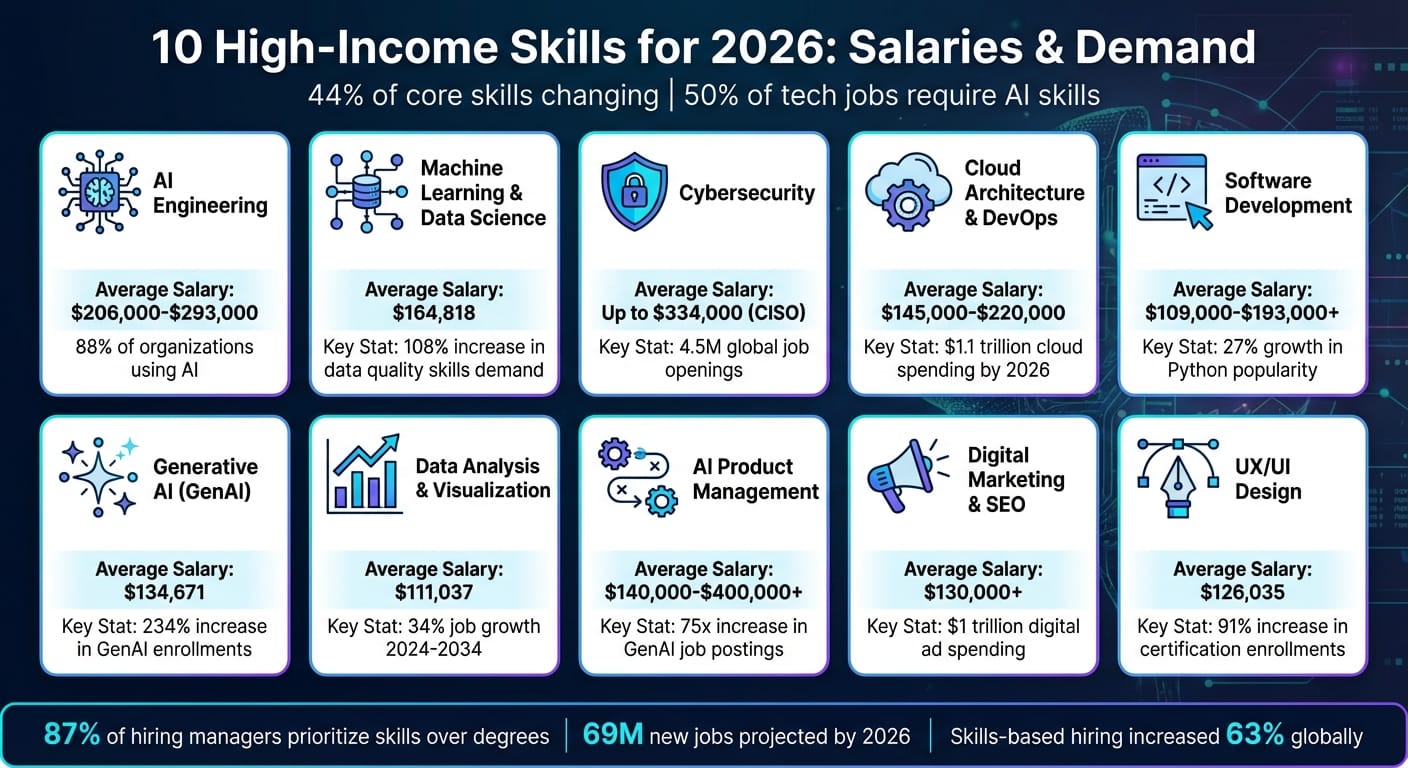
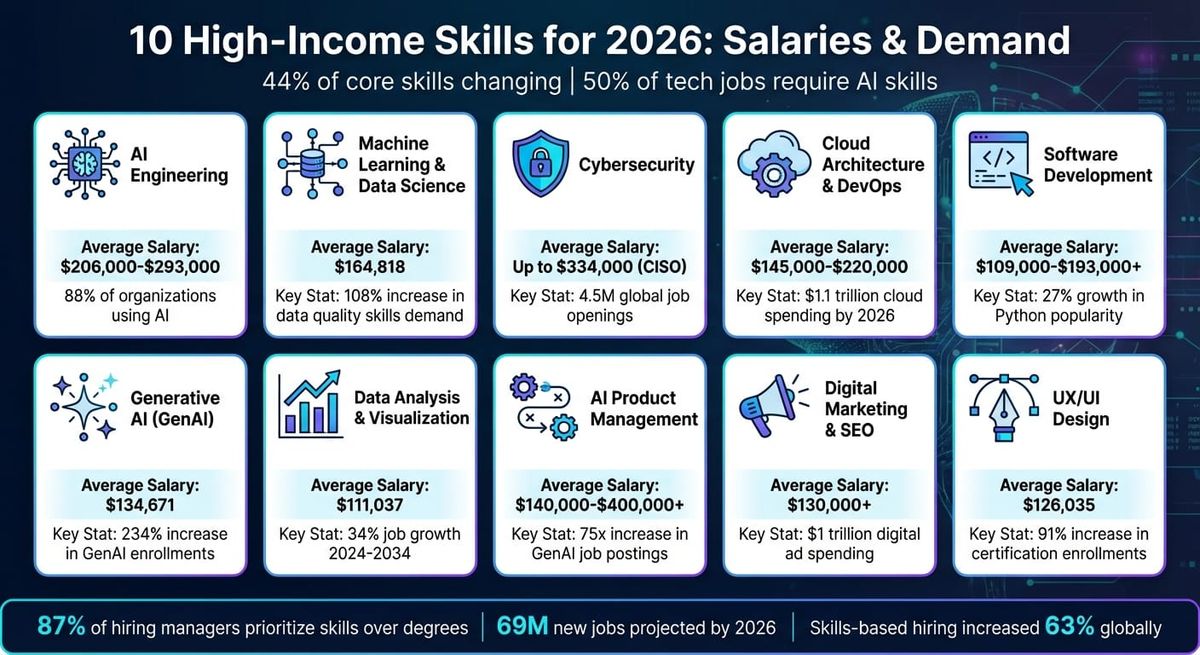
Image source: [LockedIn AI](LockedIn AI)
Every skill in this list meets three hard criteria:
- Median salary above $85,000 USD (as of 2026)
- Documented year-over-year job posting growth, per LinkedIn's Jobs on the Rise data
- Achievable without a 4-year degree, through certifications, bootcamps, or self-directed learning
Skills-based hiring has accelerated sharply. Google, IBM, and Amazon have formally dropped degree requirements for roles including data analyst, cloud engineer, and UX designer, signaling a structural shift in how employers measure qualification. As covered in our analysis of skills needed in the AI era, credentials now compete directly with demonstrated, portfolio-backed ability.
Key differentiator: Scarcity drives the premium. The skills below share one trait: demand is outpacing supply by a measurable, documented margin.
How These 15 Skills Were Ranked (Our Methodology)
Documenting that scarcity is real requires more than anecdote. Each skill on this list was scored against four measurable criteria, then assigned to an income tier based on US median base salary data from Glassdoor and LinkedIn as of Q1 2026.
The four ranking criteria:
- BLS occupational growth rate, projected 10-year job growth from the Bureau of Labor Statistics Occupational Outlook Handbook
- Median salary. Glassdoor and LinkedIn salary data, Q1 2026, US-based unless noted
- Job posting volume. LinkedIn and Indeed listing counts mentioning the skill directly
- Time-to-competency, realistic months for a beginner to reach entry-level hiring standards
| Tier | Median Salary Range | Example Skills | Avg. Time-to-Competency |
|---|---|---|---|
| Tier 1 | $120K+ | AI Engineering, Cloud Architecture | 12–18 months |
| Tier 2 | $85K, $119K | Cybersecurity, Data Engineering | 6–12 months |
| Tier 3 | $60K, $84K | UX Design, Digital Marketing | 3–6 months |
Skills appear in Tier 1 through Tier 3 order throughout this article. For a practical path to building these capabilities, see this AI upskilling roadmap built around closing the skills gap by role.
1. AI Engineering. The Highest-Paying Skill of 2026
Topping every credible hiring benchmark in 2026, AI Engineering commands a median base salary of $150,000 to $200,000 in the United States, according to Glassdoor and LinkedIn salary data (as of Q1 2026). Job postings for AI Engineers have grown more than 40% year-over-year, making this the single fastest-growing high-compensation role in tech.
The critical distinction: AI Engineering is not general machine learning. A machine learning engineer builds models. An AI Engineer takes those models into production, building the pipelines, APIs, and monitoring systems that keep LLMs running reliably at scale. The discipline combines software engineering rigor with deep ML knowledge, specifically around LLM deployment, MLOps pipelines, and model fine-tuning.
Core competencies the role requires:
- Training, fine-tuning, and evaluating large language models using PyTorch and TensorFlow
- Building retrieval-augmented generation (RAG) pipelines and agent workflows with LangChain
- Versioning models, automating retraining, and monitoring drift using MLOps tooling
- Packaging and deploying models via Hugging Face Hub and inference endpoints
- Designing evaluation frameworks to measure output quality, latency, and cost
Credentials that accelerate hiring:
- Google Professional Machine Learning Engineer certification
- AWS Certified Machine Learning Specialty
Pro Tip: Candidates who combine a Hugging Face portfolio of fine-tuned models with a deployed LangChain application consistently outperform pure-credential applicants in technical screens, based on practitioner reports from ML engineering communities in 2026.
Time to competency: 9 to 18 months for someone with a solid Python background. The steepest barrier is mathematical: linear algebra, probability theory, and calculus are non-negotiable prerequisites before touching model architecture. If Python fundamentals need reinforcing first, dedicated Python and Flask courses provide a structured starting point.
Best for: Software engineers and data scientists ready to specialize. Career changers without prior programming experience should budget 24 to 30 months.
Key limitation: The math floor is real. Skipping statistics and linear algebra to rush into LLM tooling produces engineers who can run tutorials but cannot debug production failures.
AI Engineering sits at the intersection of the highest salary premiums and the widest supply gap of any skill tracked for this report, making it the unambiguous top priority for 2026 upskilling.
2. Cybersecurity, 3.5 Million Unfilled Jobs and Growing
While AI engineering claims the top salary tier, cybersecurity offers something arguably more valuable for career stability: a structural talent shortage so severe that demand has outpaced supply for over a decade. According to Cybersecurity Ventures, the global cybersecurity workforce gap stands at 3.5 million unfilled positions as of 2026, a figure that has held firm despite rising enrollment in training programs. The U.S. Bureau of Labor Statistics projects 33% job growth for information security analysts through 2033, one of the fastest growth rates tracked across all occupations.
Median cybersecurity salaries range from $112,000 to $140,000 for mid-level roles in the United States, with senior cloud security engineers and CISO-track professionals regularly clearing $175,000 or more.
Key specializations commanding the highest premiums:
- Penetration testing (ethical hacking): Simulating real-world attacks to expose vulnerabilities before adversaries do
- Cloud security: Securing AWS, Azure, and GCP environments, currently the fastest-growing sub-discipline
- Incident response: Containing and remediating active breaches, with 24/7 demand in finance and healthcare
- SIEM operations: Managing threat detection platforms like Splunk using rule-based and ML-driven alerting
Essential certifications, ranked by entry path:
- CompTIA Security+, the industry baseline; achievable in 6–12 months with no prior experience
- CEH (Certified Ethical Hacker), validates offensive security techniques for penetration testing roles
- CISSP, the senior-level benchmark for architects and managers; requires 5 years of experience
Core tools professionals must know: Splunk (SIEM), Wireshark (packet analysis), Nessus (vulnerability scanning).
Industries hiring most aggressively in 2026: finance, healthcare, federal government, and SaaS platforms scaling their compliance obligations. For those interested in government-sector roles specifically, the top government software providers shaping public-sector infrastructure give useful context on where security contracts concentrate.
Important: Many federal and defense-contractor roles require a U.S. security clearance, which adds 6–18 months to the hiring timeline. Factor this in if government is your target sector.
Limitation: The threat landscape evolves continuously. Certifications expire, and tools change. Budget for 40–60 hours of annual continuing education to maintain credentials and stay current with emerging attack vectors.
Best for: Detail-oriented problem solvers, IT professionals looking to upskill, and anyone who enjoys adversarial thinking. If you are building foundational technical skills alongside cybersecurity, pairing this path with online CrowdStrike courses accelerates fluency with enterprise-grade security tooling used by actual SOC teams.
Cybersecurity is the rare high-income skill where entry-level demand is nearly as strong as senior demand, making it one of the most accessible six-figure career transitions available in 2026.
3. Cloud Architecture & DevOps. The Infrastructure Backbone of Every Business
Cloud infrastructure sits at the intersection of every digital initiative a company runs, which is why cloud architects and DevOps engineers consistently appear as the same bundled hire in 2026 job postings. According to Gartner, global cloud spending is projected to exceed $1 trillion by 2027, a trajectory that makes cloud computing careers among the most recession-resistant in tech.
Salary benchmarks (as of Q1 2026):
- Cloud Architects: $130K, $165K median US base salary
- DevOps Engineers: $110K, $135K median US base salary
The two roles share a core toolchain. Employers rarely advertise one without expecting fluency in the other.
Core tools and platforms:
- AWS (market leader, ~31% cloud market share), the default exam target for most practitioners
- Microsoft Azure, dominant in enterprise and hybrid environments
- Google Cloud, preferred in data-heavy and ML workloads
- Kubernetes and Docker, container orchestration and packaging, required in virtually every DevOps pipeline
- Terraform, infrastructure-as-code tool that defines cloud resources declaratively
- Jenkins and GitHub Actions. CI/CD automation for code deployment pipelines
Certification roadmap (time-to-competency: 6–9 months for associate level):
- AWS Certified Solutions Architect. Associate
- Google Professional Cloud Architect
- Microsoft Azure Administrator (AZ-104)
Important: Certification alone will not get you hired. Employers consistently screen for hands-on lab experience. AWS Free Tier and Google Cloud Skills Boost provide structured lab environments at low or no cost, these belong on your resume, not just the badge.
Building cloud competency pairs naturally with coding platform practice, since scripting skills in Python or Bash directly accelerate Terraform and pipeline work.
Best for: IT administrators transitioning to cloud roles, software developers adding infrastructure depth, and systems engineers seeking senior-level compensation.
Cloud architecture's salary ceiling rises with specialization: a generalist AWS architect earns $130K, while a cloud security architect or multi-cloud specialist regularly clears $170K+.
4. 4–10. The Next Seven High-Income Skills Ranked by Earning Potential
Tier 2 skills occupy a compelling middle ground: lower barrier to entry than AI engineering or cloud architecture, yet salaries that consistently outpace the US median household income of roughly $80,000. According to LinkedIn's 2026 Jobs on the Rise report, roles anchored to data, design, and digital delivery are growing faster than companies can hire for them.
| Skill | Median Salary (2026) | Top Certification | Time-to-Job-Ready |
|---|---|---|---|
| #4 Data Science & Analytics | $100K, $130K | Google Data Analytics Certificate | 4–6 months |
| #5 Generative AI & Prompt Engineering | $90K, $130K | Google AI Essentials / OpenAI courses | 1–3 months |
| #6 Software Development | $95K, $130K | Portfolio-based + bootcamp | 4–6 months |
| #7 UX/UI Design | $85K, $115K | Google UX Design Certificate | 4–6 months |
| #8 Product Management (AI Products) | $110K, $145K | CAPM / Product School | 6–12 months |
| #9 Digital Marketing & SEO | $65K, $95K | Google Digital Marketing Certificate | 2–4 months |
| #10 Project Management | $80K, $115K | PMP / Google PM Certificate | 3–6 months |
Data science salary expectations are rising sharply as organizations move from descriptive dashboards to predictive models. Python, SQL, Tableau, and Power BI remain the core stack. For a hands-on path into the coding side, the best coding learning platforms ranked in 2026 cover Python and data workflows end-to-end.
Prompt engineering jobs are unusual: the fastest path to competency (1–3 months) meets one of the widest salary bands, because output quality is immediately measurable and roles span every industry.
Product management for AI products commands the highest ceiling in this tier at $145K. The added "AI" qualifier reflects demand for PMs who can scope model-driven features, interpret model evaluation metrics, and coordinate cross-functional ML teams.
For project management professionals, the PMP remains the gold standard. Pairing it with Agile/Scrum fluency can lift salaries toward the upper band; see secure project management tools widely used in certified PM workflows.
Pro Tip: Digital marketing and SEO ($65K, $95K) has the lowest floor in this tier but the fastest study-to-hire timeline at 2–4 months, making it a strong entry point for career changers who need income before upgrading to higher-tier skills.
The seven skills above collectively cover every major business function, meaning employers in finance, healthcare, retail, and tech all compete for the same talent pool.
5. 11–15. High-Income Skills That Most Guides Overlook
That broad employer competition actually creates a blind spot: the most-covered skills attract the most-trained candidates, compressing your odds. The five skills below appear in fewer than 20% of career-advice roundups, yet every one is validated by BLS occupational data and LinkedIn hiring velocity. For career changers with adjacent domain knowledge, they represent the lowest-effort, highest-return pivots available in 2026.
| # | Skill | Salary Range | Time to Job-Ready | Key Credential |
|---|---|---|---|---|
| 11 | Financial Analysis & Modeling | $90K, $120K | 6–12 months | CFA Level 1, Excel/Power BI |
| 12 | Blockchain Development | $110K, $150K | 9–12 months | Solidity, Hyperledger |
| 13 | Corporate & Contract Law (paralegal path) | $75K, $105K | 6–9 months | Paralegal Certificate |
| 14 | Sales Engineering / Technical Sales | $95K, $140K (base + commission) | 3–6 months | Salesforce Certifications |
| 15 | Learning & Development / Instructional Design | $70K, $95K | 3–6 months | CPLP, Articulate 360 |
Financial modeling skills are in acute demand inside fintech and private equity, where headcount is growing faster than accounting programs can supply graduates. Power BI and advanced Excel are the entry point; CFA Level 1 adds a measurable salary bump.
Blockchain development in 2026 has shifted decisively away from consumer crypto toward enterprise supply chain and trade finance use cases. Solidity remains the core language, but Hyperledger Fabric now dominates enterprise contracts. Exploring online Web3 development courses is a practical starting point.
AI governance compliance has created an unexpected opening for paralegal-certified professionals. GDPR and CCPA enforcement activity rose sharply after 2024, and companies now pay $75K, $105K for compliance specialists who understand contract language without carrying a JD.
Sales engineering salary tops $140K with commission because the role sits at the exact intersection of technical credibility and revenue generation. Salesforce certifications shorten the hiring timeline to under 90 days at many mid-market SaaS firms.
Instructional design is the quietest six-figure path on this list. According to the U.S. Bureau of Labor Statistics, instructional coordinator roles are projected to grow 2% through 2033, but corporate L&D specifically is expanding far faster as companies internalize compliance and AI-skills training.
Pro Tip: Skills 11–15 reward domain expertise you already own. A nurse who adds instructional design credentials becomes a healthcare L&D specialist; a software developer who studies Solidity becomes a blockchain engineer without starting over.
These five overlooked high-income skills share one structural advantage: lower applicant volume means hiring managers move faster, negotiate less aggressively, and retain talent longer.
Which High-Income Skills Should YOU Learn in 2026? (A Decision Framework)
Lower applicant volume only advantages you if you pick the right skill for your starting point. Run your decision through these five filters:
Watch: Top 15 Skills to Learn in 2026 for Success | Elvis Warutumo ...
Step 1: Match your background
- Tech background: prioritize AI Engineering, Cloud Architecture, Cybersecurity
- Non-tech background: start with Digital Marketing, Project Management, or Sales Engineering
Step 2: Calculate time available
- Under 3 months: Prompt Engineering, Digital Marketing, SEO
- 3–6 months: Data Analytics, UX/UI Design, Project Management
- 6–12+ months: Cybersecurity, Cloud Architecture, AI Engineering
Step 3: Set a salary target and match it to the tier framework defined earlier in this article.
Step 4: Plan your proof path. Portfolio, certification, freelance project, or open-source contribution. Skills-based hiring 2026 rewards demonstrated output over credentials alone.
Step 5: Verify job market density. Search LinkedIn Jobs for your target role in your geography before committing.
Pro Tip: 12 of the 15 skills on this list are fully self-teachable via online platforms, making them ideal most profitable skills to learn at home without a degree or campus requirement. According to LinkedIn's 2026 Workplace Learning Report, skills-based hiring increased 140% between 2022 and 2026.
Last updated: July 2026
Frequently Asked Questions
What is the fastest high-income skill to learn in 2026?
Cybersecurity foundations and cloud platforms like AWS or Azure can be job-ready within 6 to 12 months through structured bootcamps or certifications. AI prompt engineering and AI-assisted development workflows can be picked up even faster, often within a few weeks, though reaching a high-income level requires deeper practice. The speed of learning matters less than choosing a skill aligned with your existing background and the specific roles hiring right now.
How much can you realistically earn with a high-income skill in 2026?
Salaries vary widely depending on the skill, your experience level, and your location, but AI Engineering and Cloud Architecture roles commonly start above $120,000 annually in the United States. Freelance and contract work in cybersecurity or software development can push total earnings higher, especially for specialists with verified credentials. Pairing two complementary skills, such as cloud architecture and DevOps, consistently places candidates in higher salary brackets than either skill alone.
Do you need a degree to land a high-income tech job in 2026?
Many employers in 2026 prioritize demonstrated skills, portfolios, and industry certifications over traditional four-year degrees, particularly in AI, cloud, and cybersecurity roles. Companies including major tech firms and financial institutions have publicly removed degree requirements from thousands of job postings in recent years. Certifications from recognized bodies like Google, AWS, CompTIA, and ISC2 carry significant weight and can substitute effectively for formal academic credentials.
Which high-income skills are best if you are not a programmer?
Several high-income skills require little to no coding background, including cybersecurity analysis, cloud administration, and AI product management. Roles focused on data interpretation, prompt engineering, or technology sales also command strong salaries without requiring deep software development knowledge. The decision framework in the article can help you map your current background to the skill categories most likely to deliver a return without requiring a full career restart.
Are these high-income skills still relevant beyond 2026?
The core skills covered, such as AI engineering, cybersecurity, and cloud infrastructure, address structural gaps in the workforce that analysts project will persist well into the 2030s. While specific tools and platforms will evolve, the underlying disciplines are deeply embedded in how modern businesses operate and are unlikely to become obsolete quickly. Focusing on fundamentals within each skill area, rather than a single tool or vendor, provides the most durable career advantage over time.
Conclusion
The job market is not waiting for anyone to feel ready, and the professionals who will earn the most in 2026 are already building skills today. If there is one takeaway from this breakdown of the top 15 high-income skills to learn in 2026 (backed by hiring trends), it is this: skills-based hiring has crossed a tipping point. Companies like Google and IBM now weigh portfolios and certifications more heavily than degrees, which means your next career move depends on what you can demonstrate, not what your diploma says.
Your timeline determines your starting point. If you have under three months, begin with prompt engineering or data analytics, where structured courses can produce job-ready results quickly. If you have six to twelve months, pursue a certification in cloud architecture or cybersecurity, where credentials like AWS or CompTIA Security+ carry serious market weight.
The most productive next step you can take right now is simple: pick one skill from the top five, identify its most recognized certification path, and commit to a focused 90-day learning sprint. Start today, not next quarter.