

12 Must-Have AI Skills for HR Professionals: A Comprehensive Guide
Discover the 12 must-have AI skills for HR professionals—from prompt engineering to ethical AI governance—to stay strategic and relevant in 2025 and beyond.
Last updated: July 2026
76% of HR leaders say AI will significantly reshape their roles within three years, yet fewer than 1 in 3 currently possess the formal competencies to leverage it effectively, according to IBM's Institute for Business Value. The 12 must-have AI skills for HR professionals covered in this comprehensive guide close that gap, spanning technical fluency, data analytics, and ethical governance rather than generic digital literacy.
AI skills for HR professionals are not simply about understanding algorithms. They represent a blended set of domain-specific competencies that help HR practitioners apply machine learning tools, interpret workforce data, and design responsible AI-driven processes across recruiting, retention, and employee development.
The basics of AI in HR include knowing how models are trained, how bias enters automated decisions, and how to prompt AI systems for reliable outputs. Building on that foundation, each skill in this guide is tied directly to real HR functions, with practical steps to develop it regardless of your current technical background.
TL;DR: The 12 must-have AI skills for HR professionals go beyond technical know-how, covering capabilities like bias auditing, prompt engineering, and AI-assisted workforce planning that are reshaping how HR leaders operate. Prioritizing the right three or four skills depends heavily on your specific HR role, making it critical to assess urgency before diving into broad learning. While building these skills quickly is possible through practical, deliberate methods, the article warns that technical literacy alone is not enough to future-proof an HR career. The professionals who will lead in this space are those who combine AI competency with strong human judgment, ethical awareness, and strategic thinking.
Key Takeaways
- AI skills for HR professionals are a distinct category from data science or engineering, focused specifically on evaluating, applying, and governing AI tools within people management contexts.
- Rather than trying to master all 12 AI skills at once, HR professionals should identify and prioritize the 3 to 4 capabilities most relevant to their specific role, such as talent acquisition, HR operations, or people analytics.
- AI proficiency in HR requires equal attention to risk mitigation, including bias, compliance failures, and careless deployment, not just tool adoption and efficiency gains.
- HR professionals can build practical AI skills quickly and without a technical degree by following a structured, step-by-step approach tied directly to real people management workflows.
- Technical literacy alone is not enough to make HR leaders future-ready, credibility in AI-driven HR requires judgment, ethical reasoning, and strategic thinking that tool training cannot supply on its own.
What Are AI Skills for HR Professionals, and Why Do They Matter Now?
AI skills for HR professionals are not data science competencies or software engineering chops. They are a distinct category of workplace capabilities that enable HR practitioners to evaluate, apply, and govern AI tools within people management functions, spanning recruitment, performance management, learning and development, workforce planning, and employee experience.
Watch: 12 Essential AI Skills to Learn Right Now: A Complete Guide
https://www.youtube.com/watch?v=cdBpPCmYtIA
The field draws a meaningful line between two levels of proficiency. Foundational AI literacy covers conceptual understanding: what artificial intelligence actually is (and isn't), the difference between narrow AI systems that perform specific tasks and the still-theoretical general AI, and how machine learning models produce outputs. Applied AI proficiency goes further, equipping HR professionals to select the right tools, interpret AI-generated insights, and build guardrails that protect fairness and compliance.
The urgency is real. According to a Mercer Global Talent Trends report, 88% of HR leaders say AI will significantly transform HR operations, yet fewer than one in three organizations have a formal AI skill-building plan in place for their people function (as of 2026). Intent is outrunning investment.
Important: AI is not eliminating HR jobs. It is eliminating HR tasks. Professionals who build the right competencies will find their roles expanding, not shrinking.
Labor market data from Lightcast confirms this shift: job postings explicitly requiring AI-related HR skills grew by more than 60% between 2023 and 2025, with demand concentrated in talent acquisition, HR analytics, and workforce planning roles.
This is precisely why skills that thrive in the AI era increasingly overlap with HR competencies. AI augmentation versus replacement is not a philosophical debate for HR, it is a career inflection point. The professionals who treat AI literacy in HR as a core discipline, rather than a nice-to-have, are the ones positioning themselves for the decade ahead.
The 12 Must-Have AI Skills Every HR Professional Needs
That overlap between AI augmentation and HR competency is not accidental. It reflects a structural shift: the HR professionals moving into strategic roles in 2026 are those who have already mapped specific AI capabilities to specific people management outcomes. Here are the 12 skills that define that map.
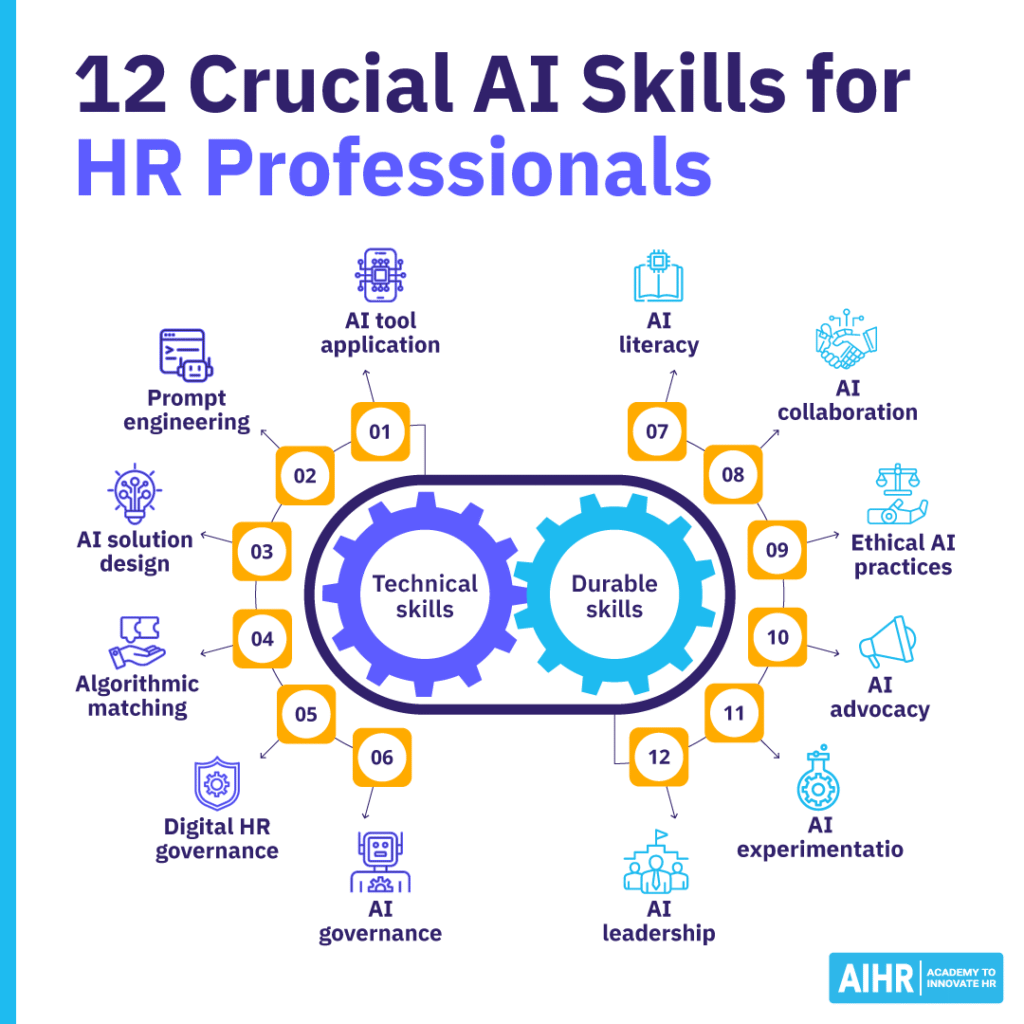
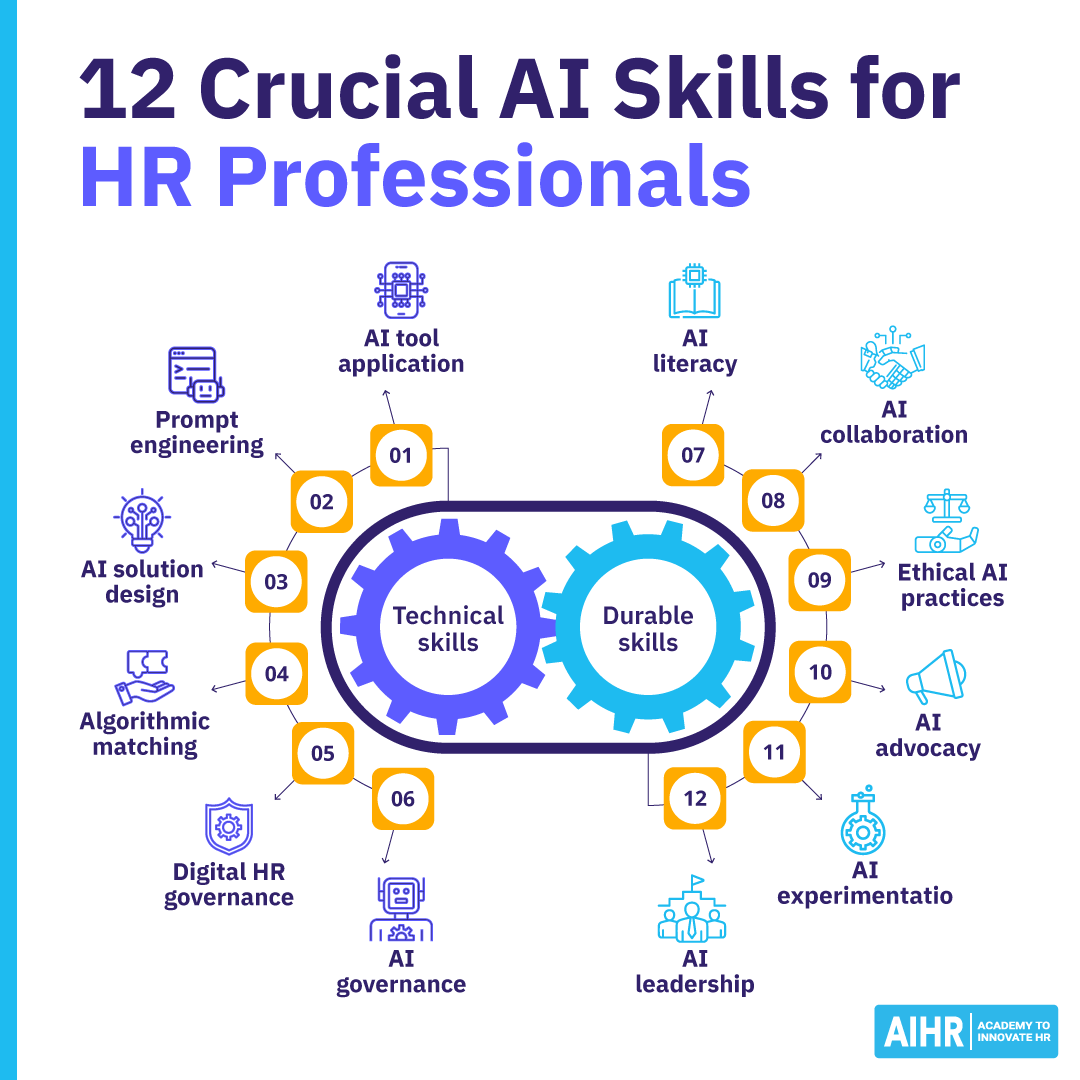
Image source: AIHR
Foundational AI Competencies (Skills 1–4)
These four skills form the non-negotiable baseline. Whether you're a recruiter, an HR generalist, or a newly minted CHRO, you cannot evaluate, critique, or direct AI-powered HR work without them.
1. AI Literacy & Foundational Knowledge
AI literacy means understanding, at a conceptual level, how machine learning (ML), natural language processing (NLP), and generative AI models produce outputs. You do not need to write code. You do need to understand why a large language model can hallucinate a candidate's credentials or why an ML classifier trained on historical promotion data will encode past biases into future recommendations.
HR application: When a vendor pitches an AI-powered performance management platform, an AI-literate HR leader can ask: "What training data was used, and how was it labeled?" That single question changes the vendor conversation entirely.
2. Prompt Engineering for HR
Prompt engineering for HR is the practice of crafting precise, context-rich instructions that direct tools like ChatGPT or Claude to produce usable outputs: job descriptions, policy drafts, engagement survey summaries, or onboarding scripts. The quality of the prompt determines the quality of the output, and skilled HR practitioners treat this as a repeatable, refinable process rather than a one-time query.
HR application: An HR business partner uses a structured prompt template, specifying role level, required competencies, inclusive language requirements, and company tone, to generate a compliant job description in under three minutes, then edits for final approval. This is ChatGPT for HR at its most practical.
Pro Tip: Maintain a shared prompt library for your HR team. Standardized prompts for common tasks (job postings, PIP drafts, onboarding FAQs) cut content creation time and ensure consistency across regions.
3. Data Analysis & Interpretation
AI tools generate outputs: attrition probability scores, engagement heatmaps, pay equity flags. The skill is not producing these outputs but reading them critically. HR professionals with strong data interpretation skills know the difference between a statistically significant trend and a dashboard artifact, and they can translate both into a business recommendation.
HR application: A talent manager reviews an AI-generated attrition risk report, notices that a high-risk score is clustering in one business unit, and connects that signal to a recent manager change, rather than assuming the model is infallible.
4. AI-Powered Recruitment & Candidate Screening
According to the Society for Human Resource Management (SHRM), nearly 79% of employers reported using some form of AI or automation in recruiting as of 2024. AI applicant tracking systems (ATS) can rank, screen, and schedule at scale. But AI-powered recruitment requires the human practitioner to actively monitor outputs for algorithmic bias in hiring, set appropriate scoring thresholds, and override when necessary.
HR application: An HR team deploys an AI ATS to screen 2,000 applications for a high-volume customer service role, reducing time-to-hire by 40%. They run a monthly bias audit comparing selection rates across demographic groups to catch disparate impact before it becomes a legal exposure.
Applied HR-Specific AI Skills (Skills 5–8)
These skills differentiate strategic HR business partners from administrative practitioners. Mastering them means moving from "I use AI tools" to "I design AI-augmented people strategies."
5. People Analytics & Workforce Insights
People analytics is the discipline of applying data science methods, including predictive modeling, to workforce decisions. HR professionals skilled in this area can interpret predictive attrition models, read cohort analyses, and use those insights to inform retention strategy, succession planning, and performance calibration. Knowing how predictive analytics drives strategic decisions is directly transferable to workforce modeling contexts.
HR application: Using a people analytics platform, an HRBP identifies that employees who haven't received a development conversation within six months have a 2.3x higher attrition probability, then builds a manager accountability metric around that finding.
6. AI-Driven Learning & Development
AI-powered L&D platforms analyze individual skill gaps, learning pace, and role requirements to generate personalized training pathways. HR professionals in this space need to configure these systems, interpret their recommendations, and evaluate whether the outputs align with organizational capability priorities. Explore purpose-built AI platforms for employee training to understand how this category has matured.
HR application: An L&D specialist uses an AI platform to identify that 34% of the sales team lacks negotiation training, then automatically assigns modular content and tracks completion alongside CRM performance metrics.
7. AI-Enabled Workforce Planning & Forecasting
Workforce planning AI models headcount scenarios against business growth projections, skills supply data, and external labor market signals. HR professionals need to input the right variables, interpret scenario outputs, and pressure-test assumptions with business leaders.
HR application: A workforce planning team runs a three-scenario model (base, growth, contraction) to forecast software engineering headcount needs 18 months out, factoring in internal promotion pipelines and external hiring lead times.
8. Ethical & Responsible AI Use
Ethical AI in HR is no longer a soft value statement. New York City's Local Law 144, which requires independent bias audits for AI hiring tools used with NYC candidates, is the clearest signal that ethical AI in HR is now a compliance obligation. HR professionals must understand algorithmic bias risks, diverse training data requirements, and the conditions under which AI decisions require human review.
Important: Any AI tool used in hiring, promotion, or performance decisions must be evaluated for disparate impact across protected classes. Skipping this step is not a values failure; it is a legal risk.
Governance, Technology & Leadership Skills (Skills 9–12)
Skills 9 through 12 are most critical for senior HR leaders and HRBPs accountable for AI rollout decisions. These are the skills that determine whether an AI implementation succeeds organizationally, not just technically.
9. AI Governance, Compliance & Data Privacy
HR data is among the most sensitive PII an organization holds. AI governance in HR means establishing clear protocols for how employee data enters AI systems, which vendors can access it, and how long it is retained. GDPR, CCPA, and emerging AI-specific regulations all intersect here. HR leaders must be able to evaluate vendor data processing agreements and escalate non-compliance before deployment, not after an incident.
10. HR Technology Proficiency & Tool Selection
The AI-powered HR tech market is crowded and fast-moving. Proficiency here means knowing how to run a structured evaluation: defining selection criteria, scoring vendors against HRIS integration requirements, conducting security reviews, and piloting before full deployment. HR professionals who can navigate this process reduce the risk of expensive mis-purchases.
11. Change Management for AI Adoption
AI rollouts fail at the human layer far more often than the technical one. HR professionals with change management skills can build communication plans that address employee fear of replacement, design manager enablement programs, and measure adoption rates to course-correct in real time.
HR application: Before launching an AI performance calibration tool, an HRBP runs a "myth-busting" town hall series, addressing specific employee concerns about how AI scores affect promotion decisions, which increases adoption by 60% compared to a silent rollout.
12. Strategic AI Implementation
The most senior skill on this list is the ability to align AI initiatives directly to business KPIs: reducing time-to-hire, improving 90-day retention, decreasing cost-per-hire, or accelerating succession pipeline velocity. Strategic AI implementation means starting with the business metric, selecting the AI intervention that moves it, and measuring the delta with rigor.
Note: These 12 skills are not equally urgent for every HR role. A recruiter's highest-leverage investment is skills 2 and 4. A CHRO's is skills 9 and 12. The next section maps skills to seniority levels to help you prioritize.
Collectively, these 12 capabilities represent the full spectrum of what it means to be an AI-ready HR professional in 2026, from understanding what a model actually does to owning the organizational accountability for its outcomes.
Which AI Skills Are Most Urgent for Your HR Role?
Knowing all 12 AI skills matters less than knowing which three or four to prioritize first. The urgency of each capability shifts dramatically depending on where you sit in the HR org chart, a Talent Acquisition Specialist burning time on manual screening has a different AI ROI than a CHRO accountable for board-level workforce strategy.
The matrix below maps each skill to six core HR roles using a High / Medium / Low priority framework (as of July 2026):
| AI Skill | HR Generalist | HR Business Partner | Talent Acquisition Specialist | L&D Manager | HR Director / CHRO | People Analytics Lead |
|---|---|---|---|---|---|---|
| 1. AI Literacy & Foundations | High | High | High | High | High | High |
| 2. Prompt Engineering | High | Medium | High | High | Medium | Medium |
| 3. AI-Assisted Recruiting | Medium | Low | High | Low | Medium | Medium |
| 4. Predictive Workforce Analytics | Low | High | Medium | Medium | High | High |
| 5. AI-Powered L&D Design | Low | Medium | Low | High | Medium | Low |
| 6. HR Process Automation | High | Medium | Medium | Medium | Medium | High |
| 7. Employee Experience AI | Medium | High | Medium | Medium | High | Medium |
| 8. Ethical AI & Bias Auditing | High | High | High | High | High | High |
| 9. AI Vendor Evaluation | Low | Medium | Low | Medium | High | High |
| 10. Data Interpretation | Medium | High | Medium | Medium | High | High |
| 11. Change Management for AI | Medium | High | Low | High | High | Medium |
| 12. AI Governance & Policy | Medium | High | Medium | Medium | High | High |
Two skills appear as High priority across every single role: AI Literacy and Foundations (Skill 1) and Ethical AI and Bias Auditing (Skill 8). These are non-negotiable baselines regardless of function, seniority, or industry sector. According to SHRM's 2025 AI in the Workplace research, 78% of HR professionals say they lack sufficient training to deploy AI responsibly, which makes literacy and ethics the logical starting point for any role-based AI upskilling plan.
For HR professionals seeking a role-agnostic certification that validates this baseline, SHRM's AI+HI (Artificial Intelligence + Human Intelligence) Specialty Credential is the most recognized pathway currently available. It covers both the technical literacy and the ethical governance dimensions that every HR function needs.
Pro Tip: Use this matrix to build your personal AI upskilling roadmap. Identify your two or three "High" priority skills, close those gaps first, then layer in "Medium" skills over the following two quarters. Check out this AI upskilling roadmap for a structured approach to sequencing your development.
For those weighing whether AI competency translates to income gains, the evidence is clear: high-income skills in 2026 increasingly require AI proficiency as a prerequisite, not a differentiator.
What Are the Biggest Risks of Using AI in HR, and How Do You Mitigate Them?
AI proficiency in HR is not just about what you can do with these tools, it's equally about what can go wrong when they are deployed carelessly. What HR pros need to know about AI in the workplace starts with a clear-eyed accounting of three failure modes that have already drawn regulatory scrutiny, legal liability, and real-world harm.
Algorithmic bias in hiring is the most documented risk. AI recruitment tools trained on historical hiring data can quietly encode systemic preferences, favoring candidates from certain universities, zip codes, or demographic backgrounds simply because those patterns appeared in past "successful" hires. New York City's Local Law 144, which mandates independent bias audits for any automated employment decision tool used in the city, is the clearest sign that regulators are no longer waiting for voluntary compliance. The EEOC has issued guidance confirming that employers remain liable for discriminatory outcomes even when an algorithm produces them. Lightcast research further highlights that blending internal hiring data with external labor market benchmarks, rather than relying solely on a company's own historical patterns, is one practical method for reducing this feedback-loop bias.
Data privacy and PII exposure is the second pressure point. HR datasets contain some of the most sensitive information an organization holds: salaries, performance reviews, disciplinary records, and in some cases health data. Inputting this material into consumer-facing AI tools like ChatGPT or Gemini without enterprise data agreements creates real legal exposure under GDPR, HIPAA, and state-level privacy statutes. Understanding these boundaries is a direct expression of responsible AI in HR governance, where cultural and contextual sensitivity shapes what data should ever enter an AI pipeline.
Over-reliance on AI outputs is subtler but equally dangerous. According to a 2024 IBM Institute for Business Value report, 42% of HR leaders admitted their teams lacked processes to review or override AI-generated recommendations. This is precisely why Skills 8 and 9 from the core list, ethical judgment and AI output verification, are not soft-skill add-ons. They are the professional backstop that prevents automation from becoming abdication.
Important: Never input employee PII, health records, or compensation data into a consumer AI tool unless your organization has a signed data processing agreement with the vendor explicitly covering HR use cases.
The skill of recognizing these risks, and acting on them, is itself one of the most valuable capabilities an HR professional can develop in 2026.
How Can HR Professionals Build AI Skills Quickly and Practically?
Recognizing AI risks is necessary, but it is only half the equation. The other half is building the skills to act on that recognition, methodically, without needing a computer science degree or a six-month sabbatical.
Step 1: Self-assess against the 12-skill framework. Before enrolling in any course, audit your current capabilities honestly. Identify two or three priority gaps, whether that is prompt engineering, bias auditing, or data interpretation. A focused gap analysis produces faster ROI than broad, unfocused learning.
Step 2: Start with no-code tools on real HR tasks. Fluency comes from doing, not reading. Use ChatGPT to draft job descriptions, generate interview question banks, or rewrite policy documents. Use Zapier to automate repetitive HR workflows, such as routing onboarding forms or triggering welcome emails, without writing a single line of code. Google's NotebookLM can summarize lengthy engagement survey reports in minutes. According to SHRM, 79% of HR professionals who experiment with AI tools on actual work tasks report faster skill development than those who study theory alone (2025 SHRM State of the Workplace report). For further context on workflow automation without coding, the best online automation courses offer structured entry points across several platforms.
Step 3: Pursue structured credentials. Two pathways stand out for HR specificity. AIHR's AI for HR course is self-paced and built around HR use cases, covering everything from predictive hiring to algorithmic performance tools. SHRM's AI+HI Specialty Credential is the most recognized signal in the field, combining AI literacy with human-centered HR judgment. Both are worthwhile; AIHR suits practitioners who want depth, while SHRM's credential carries more weight in executive conversations.
Step 4: Join peer learning communities. SHRM local chapters, HR Tech Conference sessions, and LinkedIn HR communities surface real-world AI use cases faster than any curriculum. Practitioners sharing what actually worked, and what failed, compress the learning curve significantly.
Step 5: Build internal AI governance literacy. Volunteer for your organization's AI review committee or ethics working group. This hands-on exposure to policy decisions, vendor assessments, and compliance reviews builds the kind of governance credibility that no certification alone can confer.
Pro Tip: For workforce insights specifically, platforms like Visier move beyond automation into predictive analytics. Tool choice should follow the skill being developed: ChatGPT and Zapier for workflow fluency, AI productivity tools for broader efficiency gains, and people analytics platforms for strategic workforce decisions.
The fastest path to AI competency in HR is not the most comprehensive one. It is the most deliberate one, anchored to your actual role and the decisions you make every week.
The Hidden AI Skill Gap: Why Technical Literacy Alone Won't Make HR Leaders Future-Ready
Deliberate skill-building gets HR professionals into the AI conversation. What keeps them there, and makes them credible, is something tool training cannot supply.
The current discourse around AI skills in HR is over-indexed on technical competencies: prompt engineering, data interpretation, platform fluency. These matter. But organizations that treat tool proficiency as the endpoint are producing HR professionals who generate technically correct AI outputs that are organizationally damaging. A model can recommend a candidate. Only a human with sharp interpersonal judgment can evaluate whether that recommendation reflects a genuine signal or a proxy for demographic bias.
According to Gartner research, HR leaders who combine technical AI fluency with strong interpersonal judgment consistently outperform peers who invest exclusively in tool training, particularly in change management and workforce planning contexts (Gartner, 2025). Mercer's 2025 Global Talent Trends report similarly found that human-centric AI skills, specifically critical thinking, empathy, and communication, ranked among the top capabilities HR organizations said they lacked most when deploying AI at scale.
This points to a structural gap. Critical thinking is what allows an HR professional to challenge a flawed attrition prediction rather than act on it. Emotional intelligence is what determines whether an AI-generated performance insight gets delivered in a way that motivates or demoralizes an employee. Communication skill is what lets an HR leader explain an AI-driven compensation decision to a skeptical workforce without eroding trust.
Important: AI augments HR judgment, it does not replace it. HR professionals who deprioritize emotional intelligence in practice in favor of tool mastery risk producing outputs that are statistically sound but humanly tone-deaf.
This is also the most precise answer to the question of what the top three skills an HR professional needs today actually are: the answer now always includes one AI-adjacent competency alongside critical thinking and empathy, because none of the three functions well without the others. Explore how AI fits alongside enduring human capabilities to understand why the soft skills floor is rising, not falling.
The HR professionals who will lead in the AI era are not the ones who know the most tools. They are the ones who know when not to trust them.
Last updated: July 2026
Frequently Asked Questions
Is AI eliminating HR jobs?
AI is automating repetitive HR tasks like resume screening, scheduling, and basic employee inquiries, but it is not eliminating HR jobs in 2026. Instead, it is shifting the role toward higher-value work that requires human judgment, empathy, and strategic thinking. HR professionals who build AI skills are becoming more valuable, not less, because organizations need people who can oversee, interpret, and apply AI outputs responsibly.
Which AI tool is best for HR professionals?
There is no single best AI tool for HR professionals, because the right choice depends on your specific function, company size, and existing tech stack. Popular options in 2026 include platforms like Workday AI, Eightfold, and Paradox for talent acquisition, while general-purpose tools like ChatGPT or Copilot are widely used for drafting communications, summarizing data, and building workflows. The most effective approach is to evaluate tools based on your team's most time-consuming pain points rather than chasing the most hyped platform.
What is ChatGPT for HR?
ChatGPT is a large language model that HR professionals use to draft job descriptions, create onboarding materials, write performance review templates, and summarize employee feedback. It can also help HR teams brainstorm policy language, generate interview questions, and respond to common employee inquiries at scale. While it is a powerful productivity tool, HR professionals should always review its outputs for accuracy, bias, and alignment with company policy before using them.
What are the basics of AI in HR?
The basics of AI in HR cover three core areas: automating administrative tasks, improving talent decisions through data analysis, and enhancing the employee experience through personalized tools like chatbots and recommendation engines. Understanding how algorithms make decisions, what data they rely on, and where they can produce biased outcomes is foundational knowledge every HR professional needs. You do not need to be a data scientist, but you do need enough fluency to ask the right questions and spot when an AI system is producing unreliable results.
How can HR professionals use AI practically in their day-to-day work?
HR professionals can start using AI immediately in practical ways such as automating interview scheduling, screening high volumes of applications, generating first drafts of HR communications, and analyzing engagement survey data for patterns. AI can also support workforce planning by identifying turnover risks and skills gaps before they become critical problems. The key is to begin with one high-impact, low-risk use case, build confidence with that tool, and then expand incrementally rather than trying to overhaul multiple processes at once.
Conclusion
The HR profession is at an inflection point, and the window to lead rather than follow is narrowing fast. As this comprehensive guide makes clear, the 12 must-have AI skills for HR professionals are no longer a competitive advantage reserved for early adopters. They are the new baseline for anyone who wants to remain relevant and influential in a rapidly shifting workplace.
Technical literacy matters, but it is only part of the equation. The HR professionals who will thrive are those who combine AI fluency with sound ethical judgment, strategic thinking, and deeply human capabilities that no algorithm can replicate.
Your next step is simple and concrete: audit your current skill set against the 12 skills covered in this guide and identify your top two gaps to address first. If you are ready to formalize that development, both SHRM's AI+HI Specialty Credential and AIHR offer structured, practical pathways to get there faster.
HR professionals who invest in these skills now will not just survive the AI era. They will define it.