

10 Jobs AI Won't Replace: Future-Proof Careers for the AI Era
Discover 10 jobs AI won't replace in 2025 and beyond. Learn which future-proof careers resist automation and why human skills still matter in the AI era.
Last updated: July 2026
The World Economic Forum's Future of Jobs Report 2025 projects 85 million jobs displaced by automation, yet simultaneously forecasts 97 million new roles created. That net gain tells you something critical about the 10 jobs AI won't replace and what future-proof careers in the AI era actually look like: the threat is real, but so is the opportunity hiding inside it.
AI is reshaping work, not erasing it. The roles most resistant to automation share a revealing common thread: they demand emotional intelligence, unpredictable physical presence, ethical accountability, or creative judgment that no algorithm can genuinely replicate. "Highly resistant" is the more accurate term here, not "immune," and that distinction matters when you're making long-term career decisions.
What separates a vulnerable job from a durable one comes down to a single question: can a machine be held responsible, feel empathy, or navigate true human complexity? In every career explored below, the answer is no.
TL;DR: With roughly 14% of OECD workers facing high automation risk, identifying the 10 jobs AI won't replace has become essential career planning for the AI era. Roles in healthcare, education, skilled trades, and crisis response remain structurally protected by four core human advantages: physical presence, ethical accountability, relational trust, and contextual judgment. These are qualities AI can simulate but not authentically deliver. As AI absorbs routine cognitive work, the World Economic Forum confirms that 44% of workers will need to reskill, making it critical to build capabilities around human complexity rather than knowledge alone.
Key Takeaways
- Roughly 14% of workers in OECD countries face high automation risk, but careers built around physical presence, ethical accountability, relational trust, and contextual judgment remain structurally difficult for AI to replace.
- The 10 most AI-resistant jobs share one defining trait: their core value is delivered through human complexity itself, not through knowledge or information that AI can replicate.
- The World Economic Forum projects that 44% of workers will need to reskill within the next five years, making proactive career repositioning toward high-human-skill roles an urgent priority rather than a long-term consideration.
- AI-disrupted industries still contain protected roles, meaning career safety is less about which industry you work in and more about whether your specific role requires irreducibly human judgment or trust.
- As AI absorbs routine cognitive tasks, distinctly human skills such as ethical reasoning, relational trust, and contextual judgment are becoming more scarce and more highly compensated, not less relevant.
- By 2030, the clearest career risk factor is being defined by what you know rather than what you are, since knowledge-based roles are far more vulnerable to displacement than roles grounded in human presence and accountability.
Why Can't AI Replace Certain Jobs? The 4 Core Human Advantages
Roughly 14% of workers across OECD countries face a high risk of automation, and a further 32% will see their roles significantly transformed by AI, according to the OECD Employment Outlook. Yet that same research consistently identifies a cluster of occupations where automation risk remains structurally low, not because technology hasn't advanced far enough, but because the work depends on capabilities that AI cannot authentically replicate.
Image source: Reddit
Tools like ChatGPT and other generative AI systems can summarize case law, draft therapy session notes, and generate architectural concepts. What they cannot do is be held legally liable for a misdiagnosis, earn a patient's trust over years of difficult sessions, or adapt in real time to a burst pipe inside a 100-year-old brownstone. The gap is not one of speed or knowledge volume. It is structural.
Four distinct barriers explain why certain jobs remain beyond AI's reach:
Emotional intelligence and therapeutic trust. AI can simulate empathy through natural language, but it cannot form a genuine therapeutic alliance, nor can it bear ethical accountability for patient outcomes. The emotional intelligence that underpins counseling, nursing, and leadership depends on lived vulnerability and reciprocal human connection, elements no model can authentically originate.
Physical dexterity in unpredictable environments. Industrial robots excel in controlled factory floors where every variable is predefined. Emergency surgery, plumbing repairs, and wildfire response occur in chaotic, non-repeating physical spaces where sensorimotor judgment must update continuously. Current robotics cannot match that adaptability at scale.
Ethical and licensed professional liability. Lawyers, physicians, and licensed therapists operate under regulatory frameworks that assign personal legal accountability for outcomes. An AI system cannot hold a medical license, face malpractice liability, or be disbarred. This accountability structure is a deliberate and durable automation barrier.
Original creative judgment. Generative AI recombines existing patterns. Human creativity draws on lived experience, cultural nuance, and subconscious intuition to produce work that is genuinely novel. McKinsey's The State of AI research consistently identifies creative and strategic judgment as among the hardest cognitive tasks to automate.
Note: These four barriers are not permanent ceilings, but they represent structural lags measured in decades, not years, giving workers in these roles a meaningful career planning horizon.
Understanding the skills that thrive in the AI era begins with recognizing which human capacities AI is architecturally designed to augment, not replace.
10 Jobs AI Won't Replace, and the Human Skills That Protect Them
Those four human advantages, physical presence, ethical accountability, relational trust, and contextual judgment, map directly onto specific occupations. The ten careers below share one defining characteristic: their core value is generated through human interaction, not information processing. AI can assist in each field, but it cannot perform the irreducible human work at the center of each role.
Healthcare and Mental Health Roles
Physical presence, therapeutic alliance, and licensed accountability make healthcare among the most automation-resistant sectors in the global labor market.
1. Registered Nurse / Bedside Care Nurse
AI-resistance rationale: Nursing requires continuous physical assessment, tactile judgment, and moment-to-moment emotional presence that no sensor array or remote interface can replicate at the bedside.
Protecting skill: Clinical empathy combined with hands-on assessment, medication administration, and real-time crisis response.
Labor market signal: According to the U.S. Bureau of Labor Statistics, registered nursing is projected to grow 6% through 2033, adding roughly 193,000 openings annually. Nursing automation limits are well-documented: patient handling, wound care, and emotional de-escalation require physical and relational capabilities current robots and AI systems cannot deliver reliably (as of July 2026).
2. Mental Health Therapist / Psychologist
AI-resistance rationale: The therapeutic relationship itself is the mechanism of change. Decades of psychotherapy research confirm that alliance quality, not technique, drives outcomes, and alliance requires a human on both sides.
Protecting skill: Therapeutic alliance built over time, active listening calibrated to micro-expressions and tone, and ethical licensure that creates binding accountability.
Labor market signal: The World Economic Forum's Future of Jobs Report 2025 lists counselling and mental health roles among the occupations with the fastest-growing demand through 2030. AI-powered chatbots such as Woebot have demonstrated utility for psychoeducation, but no jurisdiction licenses an AI system to provide diagnosis or ongoing therapy for complex conditions. Mental health therapists represent one of the clearest examples of jobs safe from AI displacement.
3. Physical Therapist
AI-resistance rationale: Effective PT depends on hands-on manual therapy, real-time reading of a patient's pain response, and motivational coaching that adapts mid-session to fatigue and emotion.
Protecting skill: Manual manipulation, tactile diagnostic skill, and motivational interviewing that combines physical and psychological coaching.
Labor market signal: The BLS projects physical therapy to grow 15% through 2033, well above the average for all occupations. Robotic rehabilitation devices assist PT but do not replace the licensed therapist directing care, adjusting resistance, and making clinical decisions based on non-verbal feedback.
Note: Telehealth has expanded PT's digital reach, but the highest-value interventions, manual therapy and gait correction, require in-person contact. Remote PT is supplemental, not substitutional.
Education, Social Services, and Human-Centered Roles
Emotional intelligence, relational trust, and individualized human judgment define this cluster. These are not soft skills; they are the primary service being delivered.
4. Early Childhood Educator
AI-resistance rationale: Children develop social-emotional regulation, attachment security, and language through co-regulated interactions with a trusted human adult. Screens and AI interfaces cannot model empathy, repair ruptures, or meet a distressed three-year-old with the physical comfort that drives healthy development.
Protecting skill: Social-emotional scaffolding, co-regulation, and responsive caregiving grounded in attachment theory.
Labor market signal: Research published by the National Institute for Early Education Research (NIEER) consistently finds that teacher-child relationship quality is the single strongest predictor of kindergarten readiness, a quality no AI system in 2026 replicates. This is one of the most human-centered, future-proof jobs available.
5. Social Worker
AI-resistance rationale: Social workers navigate complex family systems, cultural contexts, and crisis situations where misjudgment causes direct harm to vulnerable people. Licensed accountability cannot be delegated to an algorithm.
Protecting skill: Crisis judgment under ambiguity, cross-cultural competence, and ethical decision-making with legal consequences.
Labor market signal: Social and community service managers are projected to grow 9% through 2033 (BLS). Frontline child welfare, domestic violence intervention, and refugee resettlement work require exactly the discretionary human judgment that makes these automation-resistant careers.
6. Special Education Teacher
AI-resistance rationale: IEP development, behavioral intervention planning, and daily instructional adaptation demand real-time reading of a student's emotional state, a skill requiring human attunement that AI-powered adaptive learning tools still cannot match.
Protecting skill: Individualized behavioral adaptation, emotional attunement, and collaborative IEP authorship with families and therapists.
Labor market signal: Special education teaching positions are projected to remain in shortage through 2030 across the U.S. EU, and Australia, driven by rising diagnosis rates and a persistent gap between demand and qualified teachers. The question how AI and human learning approaches compare is well-studied, and the consensus is clear: for students with complex needs, human educators are irreplaceable.
7. Human Resources Business Partner
AI-resistance rationale: HR BPs handle terminations, harassment investigations, compensation disputes, and organizational restructuring, work that is legally sensitive, emotionally charged, and culturally specific in ways that require human discretion and accountability.
Protecting skill: Interpersonal conflict navigation, organizational culture literacy, and confidential personnel judgment.
Labor market signal: While AI tools now automate CV screening and onboarding workflows, AI platforms for employee training augment rather than replace the strategic HR function. The SHRM Foundation notes that HR leadership roles are expanding in scope as AI handles administrative tasks, freeing HR BPs to focus on the irreplaceable human work.
High-Autonomy and Creative Roles
8. Skilled Trades (Electrician, Plumber, HVAC Technician)
AI-resistance rationale: Every job site is physically unique. Diagnosing a fault in a 1960s electrical panel inside a flooded basement crawlspace requires spatial improvisation, sensory input, and judgment that no robot performs economically or reliably at scale.
Protecting skill: On-site problem-solving under unpredictable physical conditions, manual dexterity, and code compliance judgment.
Labor market signal: According to McKinsey's automation probability research, electricians face roughly a 15% automation probability, among the lowest of any trade role. Skilled trades automation remains technically constrained by the diversity of real-world environments. The BLS projects electrician employment to grow 11% through 2033.
9. Judge / Trial Lawyer
AI-resistance rationale: Courts require licensed human officers who carry legal and ethical liability for outcomes. AI can research precedent, but it cannot bear bar admission, exercise prosecutorial discretion, or preside over proceedings with constitutional authority.
Protecting skill: Legal reasoning under uncertainty, courtroom presence, and licensed accountability for consequential decisions affecting human rights and liberty.
Labor market signal: The legal profession will integrate AI heavily for document review and research, yet the WEF Future of Jobs Report 2025 lists legal professionals among roles with sustained demand through 2030, precisely because judicial and advisory functions require a licensed, accountable human.
10. Creative Director / Art Director
AI-resistance rationale: AI generates assets on command; it does not possess cultural intuition, brand memory, or the ability to construct a campaign narrative that resonates because a human understood the moment it was made in.
Protecting skill: Original strategic vision, cultural fluency, and the synthesis of audience psychology, brand history, and aesthetic judgment into coherent creative direction.
Labor market signal: Demand for senior creative roles has increased in advertising and media since 2023 precisely because AI-generated content has flooded channels, raising the premium on distinctive human creative vision. Understanding which AI graphic design tools augment creative work versus replace it is now a core competency for working art directors.
Pro Tip: In every field above, professionals who combine deep human skill with AI tool fluency command higher salaries and stronger job security than those who ignore AI entirely. The goal is augmentation, not avoidance.
The ten careers above are not immune to change, they will all be reshaped by AI. What they share is an irreducible human core that makes full automation structurally implausible within any realistic planning horizon.
How Do These 10 Careers Stack Up? Automation Risk Compared
Structural implausibility of automation is not uniform across these ten careers. Each role sits at a different intersection of physical, ethical, relational, and creative human capacity, and AI's augmentation role varies accordingly. Tools like ChatGPT, ambient clinical AI, and AI-assisted scheduling are already active in these fields, functioning as productivity aids that handle documentation, pattern recognition, and logistics, while the irreducible human work remains untouched. According to the U.S. Bureau of Labor Statistics, several of these roles rank among the fastest-growing occupations through 2033, reinforcing that AI advancement and job growth are not mutually exclusive.
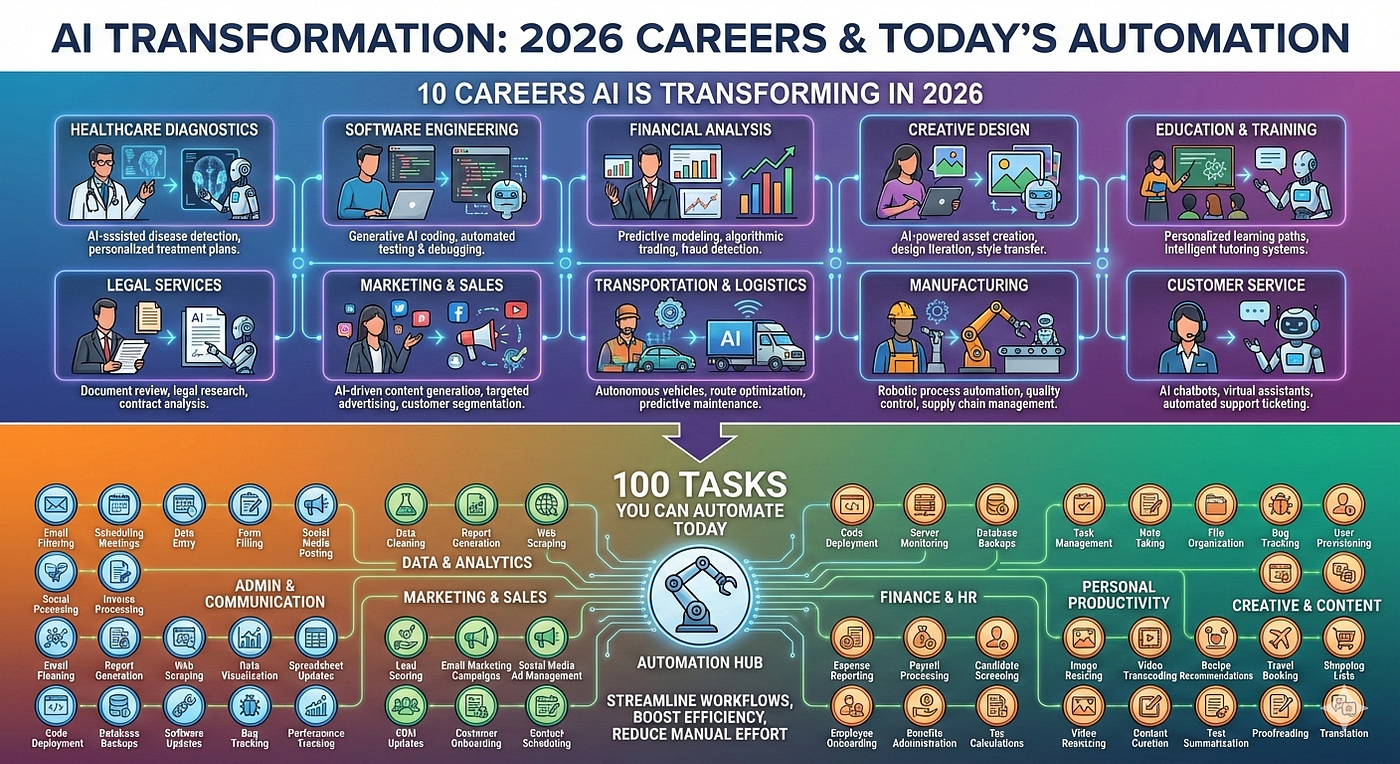
Image source: [Artificial Intelligence in Plain English](Artificial Intelligence in Plain English)
Understanding where to invest your career development means looking at AI productivity tools as allies, not threats.
| Career | Primary Human Advantage | Automation Risk | Projected Growth (BLS 2023–2033) | AI Augmentation Role |
|---|---|---|---|---|
| Registered Nurse | Physical presence, empathetic care | Very Low | +6% | Diagnostic alerts, documentation assist |
| Mental Health Therapist | Relational trust, emotional attunement | Very Low | +19% | Session note generation, scheduling |
| Surgeon | Tactile dexterity, intraoperative judgment | Low | +11% | Robotic guidance, imaging analysis |
| Social Worker | Contextual judgment, advocacy | Very Low | +7% | Case management software, risk flagging |
| Elementary School Teacher | Relational development, motivation | Very Low | +2% | Personalized learning dashboards |
| Electrician | Physical dexterity, on-site reasoning | Low | +11% | Load calculation tools, job scheduling |
| Plumber | Tactile problem-solving, site adaptability | Low | +6% | Diagnostic imaging, permit workflows |
| Trial Lawyer | Ethical accountability, persuasion | Low | +8% | Legal research, contract review |
| Creative Director | Aesthetic judgment, cultural interpretation | Low | +6% | Generative ideation tools, asset production |
| Clergy/Chaplain | Moral authority, spiritual presence | Very Low | +4% | Administrative logistics, research |
Note: Growth projections reflect BLS 2023–2033 occupational outlook data. "Low" automation risk indicates less than 30% task automation potential; "Very Low" indicates less than 15%, consistent with McKinsey Global Institute occupational analysis frameworks.
Across every row, the pattern is identical: AI handles information and administration while humans handle meaning, judgment, and trust. Careers with the lowest automation risk in 2026 are defined not by what they know, but by what they are.
What Jobs Will AI Replace by 2030, and What That Means for Career Planning
By what they are, not what they know. That distinction also explains which careers face genuine displacement risk in the years ahead.
The World Economic Forum's Future of Jobs Report 2025 projects that 85 million jobs could be displaced by automation by 2030, with displacement concentrating overwhelmingly in roles built around repetitive, rule-based cognitive tasks. The roles at highest risk are not difficult to identify:
- Data entry clerks, structured information processing is precisely what large language models do faster and cheaper
- Telemarketers, scripted outbound contact is already being automated at scale by voice AI systems
- Basic customer service agents, tier-one query resolution, password resets, and FAQ responses are nearly fully automatable
- Routine accounting tasks, transaction categorization, reconciliation, and standard reporting face near-total automation within this decade
- Content moderators, pattern-matching against policy violations is a classification task AI handles with high throughput
McKinsey's automation research estimates that up to 30% of current work hours across the U.S. economy could be automated by 2030, with clerical and data-processing roles absorbing the largest share of that displacement.
The pattern is precise: AI job displacement clusters around tasks that are cognitive but not contextual, and procedural but not relational. The ten careers featured in this article sit at the opposite pole, built around meaning, physical presence, ethical accountability, and relational trust.
Important: The real career planning risk is not picking the wrong industry. It is spending years in any industry without building the human skills that AI cannot replicate. A nurse who never develops clinical judgment, or a lawyer who cannot read a room, faces displacement risk regardless of their job title.
That shift in thinking, from industry selection to skill-building for the AI era, is where the most actionable career strategy lives. The question is not just what to do, but which capabilities to build, and how fast the demand for those capabilities is actually growing.
Which Human Skills Grow Fastest in Demand as AI Advances?
The question of which capabilities to build has a data-backed answer. As AI absorbs more routine cognitive work, the differentiating human layer does not shrink: it becomes more valuable, more scarce, and more highly compensated. According to the World Economic Forum's Future of Jobs Report, analytical thinking and creative ideation rank as the top two fastest-rising skill priorities for employers through 2030, with emotional intelligence and cross-cultural communication close behind (as of June 2026).
The five human skills with the steepest demand trajectory right now:
Emotional intelligence and empathy. AI can detect sentiment from text; it cannot authentically feel or respond to the weight of a patient's fear, a client's grief, or a team member's burnout. This is precisely why therapists, palliative care nurses, and senior HR leaders command premium salaries that resist compression.
Complex problem-solving in ambiguous situations. When a problem has no existing training data, AI produces confident-sounding guesses. Senior engineers, surgeons, and crisis managers are paid for the judgment they exercise exactly when the rulebook runs out.
Creative and critical thinking. Generative AI remixes patterns it has seen before. Original creative direction, genuinely novel strategy, and rigorous critical challenge of AI outputs all require a human evaluator. Creative directors at major agencies now earn more, not less, as AI floods the market with generic content.
Cross-cultural communication. Negotiating across geopolitical, linguistic, and social contexts requires real-time reading of subtext, power dynamics, and unstated norms. Machines optimise for stated preferences; they miss everything between the lines.
Ethical judgment and accountability. When a decision has legal, moral, or reputational consequences, someone must be accountable. AI can surface options; it cannot bear responsibility.
These skills are not soft extras. They are the scarcity premium built into the highest-paying roles AI cannot replace. Understanding the new skills students actually need in this environment reveals that academic institutions are restructuring curricula around exactly this cluster.
Pro Tip: When investing in professional development, prioritise skills that sit at the intersection of two or more of these categories. A senior engineer who combines complex problem-solving with ethical judgment, for example, occupies a position AI cannot approach at any capability level.
The skills AI cannot replicate are the same ones that define the ceiling of human earning potential, and AI's advance makes that ceiling rise, not fall.
The Hidden AI-Proof Career Layer: Roles Inside AI-Disrupted Industries
That rising ceiling is not reserved for professionals working in obviously "safe" industries like healthcare or education. A more powerful insight reshapes the entire framing: every AI-disrupted industry contains a protected human layer within it, and those embedded roles often benefit from the industry's growth while remaining structurally shielded by human complexity.
Watch: No job is entirely untouched by AI, but some roles have low ...
This is the inner layer strategy. Rather than fleeing sectors touched by automation, identify the human-centric roles nested inside them.
Consider finance, one of the most heavily automated industries in history. Algorithmic trading, fraud detection, and robo-advisory have transformed the sector, yet financial therapists and complex wealth advisors serving ultra-high-net-worth clients are growing precisely because money anxiety, family conflict, and legacy planning require emotional intelligence that no algorithm can replicate. According to the Financial Therapy Association, the field has grown its certified practitioner base by over 40% since 2020, with demand accelerating as AI handles the transactional layer.
The same pattern repeats across sectors:
- Retail (heavily disrupted): Visual merchandising directors and customer experience designers craft the physical and emotional environments that drive conversion. AI can optimize pricing and inventory; it cannot design an atmosphere that makes a person feel something.
- Technology (the industry building AI): The demand for AI ethicist careers, trust and safety specialists, and human-AI interaction designers has surged inside major tech firms. These roles assess how AI systems affect real human beings, which requires exactly the moral reasoning and lived experience that AI itself cannot supply.
- Media and entertainment: AI generates content at scale, yet showrunners, narrative directors, and cultural consultants who understand audience psychology command higher fees as the volume of undifferentiated AI content grows. Scarcity of genuine human voice increases its value.
- Legal services: Contract review is increasingly automated, yet mediators, restorative justice practitioners, and client-facing family law attorneys operate in territory where relationships and emotional stakes make AI assistance marginal at best.
Pro Tip: When evaluating a career pivot, do not ask "is this industry safe from AI?" Ask instead: "where is the human layer in this industry, and is it growing?" The answer is almost always yes, and often lucrative.
The most future-proof career strategy in 2026 is not about picking the right industry. It is about finding the role within any industry where human complexity is the product.
How to Future-Proof Your Career Against AI, 4 Actionable Steps
Finding that role where human complexity is the product does not happen by accident. According to the World Economic Forum, 44% of workers will need to reskill within the next five years as AI reshapes core job functions (as of June 2026). The four steps below turn that pressure into a concrete AI-proof career strategy.
Step 1: Audit your current role for automation exposure. List every task you perform in a typical week. Classify each as routine-cognitive (data entry, scheduling, drafting templated content) or relational-creative (coaching, negotiating, designing strategy). The first category is your vulnerability. The second is your moat. Protect and expand it deliberately.
Step 2: Invest in emotional intelligence as systematically as technical skills. EQ does not develop through passive experience. Pursue structured paths: formal coaching certification, therapeutic communication training, or conflict-resolution coursework. Treat upskilling emotional intelligence the same way a developer treats learning a new framework: scheduled, measured, and compounding.
Pro Tip: Use AI to eliminate low-value cognitive tasks entirely. Automate your reporting, drafting, and scheduling with tools like ChatGPT or AI-integrated workflows, then redirect that recovered time into high-EQ work that machines cannot perform.
Step 3: Position yourself as the human layer between AI outputs and real-world outcomes. Let AI draft. You own the strategy, the relationship, and the accountability. A marketer who uses AI to generate ten content variations but personally decides which resonates with a specific audience is not replaceable by the AI producing those drafts.
Step 4: Build domain authority and a personal brand. In an AI-saturated content environment, authentic human expertise is a scarce signal. Publish specific opinions, develop your writing craft, and make your reasoning publicly visible. Reputation built on demonstrated judgment compounds over time in ways that AI-generated content cannot replicate.
The professionals who become irreplaceable in the AI era are not those who avoid AI, they are those who use it to amplify the distinctly human work that AI cannot do alone.
Last updated: July 2026
Frequently Asked Questions
Will AI eventually replace all jobs if it keeps advancing?
Most experts agree that AI will automate specific tasks within jobs rather than eliminating entire professions wholesale. Roles requiring emotional intelligence, ethical judgment, physical dexterity in unpredictable environments, and creative originality are structurally difficult for AI to replicate, regardless of how powerful the technology becomes. The more likely outcome is a reshaping of job responsibilities rather than a complete elimination of human workers.
How can I tell if my current job is at high risk of AI automation?
Jobs with high automation risk tend to involve repetitive, rule-based tasks, predictable decision-making, and minimal need for human interaction or physical adaptability. A useful self-assessment is to ask whether your core daily responsibilities could be described as a clear set of logical steps that always produce the same output. If the answer is yes for most of what you do, building skills in areas like complex communication, hands-on problem-solving, or human-centered services is worth prioritizing now.
Are AI-proof careers still well-paying and in demand in 2026?
Yes, many of the careers least vulnerable to AI automation are also among the most financially rewarding and socially valued. Mental health professionals, surgeons, skilled tradespeople, and senior educators all command strong salaries and face persistent labor shortages in 2026. The combination of high demand and genuine difficulty of automation makes these roles some of the most stable career investments available today.
Do I need a four-year degree to pursue a future-proof career?
Not necessarily. Several of the most AI-resistant careers, including electricians, plumbers, and other skilled tradespeople, are accessed through apprenticeships or vocational training rather than traditional university degrees. What matters more than the credential pathway is whether the role requires human judgment, physical adaptability, or interpersonal trust, since those qualities are what create long-term protection against automation.
Is it too late to switch into an AI-proof career if I am already mid-career?
Mid-career transitions into AI-resistant fields are not only possible but increasingly common as workers respond to automation pressures. Many of the core skills that protect jobs from AI, such as empathy, leadership, ethical reasoning, and hands-on technical ability, are transferable from a wide range of professional backgrounds. Starting with a skills audit of what you already do well, then identifying which AI-resistant roles value those strengths most, is a practical and realistic place to begin.
Conclusion
The smartest career move in the AI era is not to avoid the technology but to build the qualities it cannot replicate. Across every role covered in this guide on 10 Jobs AI Won't Replace: Future-Proof Careers for the AI Era, one pattern holds: careers anchored in empathy, physical unpredictability, ethical accountability, and creative originality stay resilient precisely because those traits resist automation by their nature, not by accident.
The professionals who will thrive are those who treat AI as a collaboration partner, using it to handle repetitive tasks while they focus on the judgment, nuance, and human connection that machines consistently fail to deliver.
Your next step is specific and actionable: audit your current role against the four protective traits outlined in this article, emotional intelligence, physical unpredictability, ethical liability, and creative originality. Identify which trait is weakest in your work today, then commit to one concrete action this week to develop it further. That single habit, repeated consistently, is how future-proof careers are built.