

Best Online Automation Courses
Compare five top online automation courses — from RPA and Python DevOps to GenAI workflows and testing — to match skills with career goals.
Automation skills are in high demand, with over 22,768 job openings for Automation Engineers in the U.S. and a median entry-level salary of $126,720. Python proficiency, a cornerstone of automation, is listed in more than 530,000 job postings. Online courses offer an affordable and flexible way to learn these skills, with many programs starting at $39.99–$49 per month and including free trial periods.
Here’s a snapshot of the top courses:
- Upskillist Automation Fundamentals: Beginner-friendly, focuses on building software robots using Automation 360.
- Upskillist RPA Mastery: Covers UiPath and advanced RPA techniques for business automation.
- IT Automation with Python and DevOps: Advanced scripting, cloud management, and DevOps skills for IT professionals.
- Generative AI Automation Workflows: Combines AI tools like ChatGPT with no-code platforms for business solutions.
- Automation Testing with Selenium and GenAI: Teaches QA automation with tools like Selenium and AI-driven frameworks.
These courses cater to different career paths, from IT professionals to business analysts and QA testers, and provide certifications recognized by top employers. Whether you're a beginner or looking to level up, there's a course tailored to your goals.
1. Upskillist Automation Fundamentals

The Upskillist Automation Fundamentals course is tailored for beginners eager to dive into the world of automation. It introduces an "Automation Skill Stacking" method, which uses concise, exercise-focused videos to help you build practical skills step by step. Through this course, you'll learn to evaluate tasks suitable for automation and gain hands-on experience creating software robots using the Automation 360 platform. You'll also work with common tools like Browser, Recorder, Excel, and CSV/TXT packages.
Skill Level
This course is beginner-friendly, requiring no prior coding knowledge. It's a great entry point for those looking to automate repetitive tasks.
Key Topics Covered
The course focuses on a practical, hands-on learning experience. You'll explore how to spot automation opportunities, break down complex problems into manageable steps, and create functional robots with industry-standard tools. To cater to different learning styles, the course employs a "Compound Learning" strategy, combining videos, notes, and slides. The structure is designed for clarity and flexibility, ensuring learners can follow along at their own pace.
Duration
The course includes 20 to 32 hours of content, delivered through two interactive online sessions each week. Live sessions are held twice weekly, and learners have on-demand access to the materials, which remain available for a lifetime.
Pricing
You can start with a 7-day free trial. After that, the subscription costs $39.99 per month. Course materials and e-certificates are available for additional purchase. Many employers also offer reimbursement for continuing education, making it a cost-effective learning option.
Certifications
Completing this course earns you a university-certified diploma that is recognized worldwide. This credential not only strengthens your resume but also demonstrates your automation skills to potential employers. According to the Microsoft LinkedIn Work Trend Annual Index, 66% of executives avoid hiring candidates without AI and automation expertise, and professionals with these skills can earn a 28% higher salary.
One graduate, Dan S., shared his success story:
"One of the first things I did following the course was develop a workflow for our expense report program. It saved us $15,000 a year."
2. Upskillist Robotic Process Automation (RPA) Mastery
The RPA Mastery course takes your automation skills to the next level with a focus on UiPath. It covers everything from designing automation workflows to deploying them in real-world scenarios. This program is ideal for anyone aiming to become proficient in creating automation solutions that address real business needs.
Skill Level
This course is tailored for those switching careers, starting a business, or learning a new skill set. It’s structured to guide you from beginner concepts to advanced applications, making it approachable even for those new to the field. The emphasis is on practical, hands-on learning rather than just theoretical knowledge. By the end, you'll be equipped to tackle real-world RPA challenges with confidence.
Key Topics Covered
You’ll dive into UiPath Studio, mastering data manipulation and workflow creation to solve complex business problems. The course also teaches you how to manage variables, arguments, and collections effectively. These skills are essential for building comprehensive automation solutions that require in-depth technical knowledge.
Duration
The program offers two live online classes each week at set times. With lifetime access to course materials, you can revisit lessons and practice exercises whenever you need to reinforce your learning.
Pricing
A 7-day free trial is available.
Certifications
The course offers tiered certifications to validate your RPA expertise. The Essentials Automation Certification demonstrates your foundational knowledge of Intelligent Automation and the Automation 360 platform. The Advanced Automation Certification assesses your ability to design solutions for real-world business problems using UiPath's full suite of tools. At the highest level, the Certified Master RPA Professional credential requires you to build advanced bots and analyze case studies to address complex automation challenges.
3. Upskillist IT Automation with Python and DevOps
This course is designed to turn basic Python skills into tools for enterprise-level IT automation. You'll learn to create scripts for system administration, manage cloud infrastructure, and handle large-scale configuration management. Building on the foundations from the Automation Fundamentals course, this program equips IT professionals with advanced scripting and DevOps techniques, preparing them for roles like Systems Administrator or Automation Engineer.
Skill Level
The course starts with a Python crash course, making it accessible to beginners. However, the overall certification is categorized as advanced because it assumes a foundational understanding of IT. To get the most out of this program, you should already be familiar with operating systems, networking, and data management. If you're new to IT, completing the Google IT Support Professional Certificate first is recommended.
Key Topics Covered
The curriculum is divided into seven modules, covering Python fundamentals, version control, troubleshooting, configuration management, cloud resource management, DevOps basics, and API automation for real-world tasks. Highlights include:
- Configuration management using Puppet to automate deployments across multiple systems.
- Cloud resource management with Terraform, enabling scalable infrastructure solutions.
- DevOps essentials like Infrastructure as Code (IaC) and Continuous Integration (CI).
- Integration of Generative AI tools, such as Gemini, to refine Python scripts and boost efficiency.
The capstone module emphasizes hands-on learning, focusing on automating tasks with APIs and JSON. A remarkable 98% of participants have praised this practical component for its real-world relevance.
"The Google Career Certificate has opened new doors for me. I have brought automation ideas and best practices to multiple cross-functional departments... Now I have become the go-to person for system integrations." - Brandon, IT Automation with Python Certificate graduate
Duration
The program is flexible, requiring 3 to 6 months to complete with a commitment of about 10 hours per week. The self-paced structure allows learners to balance their studies with work or other responsibilities.
Pricing
You can start with a 7-day free trial, after which the subscription costs $49 USD per month. Most learners finish the program for under $300 USD. Financial aid is also available for those who qualify.
Certifications
Upon completion, you'll earn the Google IT Automation with Python Professional Certificate, a credential recognized by top employers. The American Council on Education (ACE®) recommends this program for 15 college credits, equivalent to five bachelor's degree-level courses. For European learners, it offers up to 7 ECTS credits. Additionally, passing the CompTIA A+ certification exams alongside this program awards a dual credential from both CompTIA and Google.
Graduates also gain access to the Google Career Certificates Employer Consortium, connecting them with over 150 U.S. companies, including Deloitte, Target, Verizon, and Ford. Next, we’ll explore the advantages and challenges of pursuing these advanced learning paths.
4. Upskillist Generative AI Automation Workflows
This course takes your existing automation skills and combines them with generative AI to create practical business solutions. It’s perfect for those looking to move beyond casual use of AI tools and start building automated workflows that address real-world challenges. If you're familiar with tools like ChatGPT or Claude but want to step up your game, this program shows you how to integrate AI with no-code platforms such as Make.com, Zapier, and n8n. By the end, you’ll know how to automate tasks like generating reports, managing sales pipelines, and syncing data across systems - skills that are increasingly sought after, with job postings requiring generative AI expertise growing by an astounding 15,625% between 2021 and 2024.
Skill Level
This course is tailored for intermediate learners, including business professionals, entrepreneurs, and consultants who frequently use AI but lack formal training in automation. You don’t need a background in coding or engineering, but you should already be comfortable using tools like ChatGPT or Claude. With this foundation, the course dives into advanced AI-driven automation techniques.
Key Topics Covered
The focus here is on practical, hands-on learning. You’ll explore AI agents and agentic processes, gaining insights into how tools like ChatGPT’s agent mode and Perplexity Comet differ from standard AI applications. The course also includes:
- Process mapping with Miro to pinpoint automation opportunities with the most impact.
- Ethical implementation strategies, addressing concerns like data privacy, API costs, and maintaining human oversight.
- Stakeholder engagement tactics to secure buy-in for automation projects.
A unique aspect of this program is its emphasis on algorithmic thinking, reinforced through real-world playbook projects that let you apply what you learn.
Duration
The course spans 5 weeks, with flexible on-demand modules and optional weekly live sessions. This setup allows you to fit learning into your schedule without disrupting work commitments.
Pricing
Enrollment costs $1,700 USD and includes some valuable extras: a 2-month ChatGPT Plus subscription and a 3-month Make.com Core subscription. Financial aid options may be available for eligible learners. To earn your certificate, you’ll need to complete all coursework, score at least 70% on assessments, and submit all required playbook projects.
Certifications
Graduates receive a university-issued certificate from respected institutions like the University of Denver College of Professional Studies or the University of South Florida. You can also request Continuing Education Units (CEUs) for professional development. The course has been highly rated, with a 4.6/5 score on Trustpilot from 1,645 reviews.
5. Upskillist Automation Testing with Selenium and GenAI
This program builds on advanced AI techniques to focus specifically on quality assurance and testing. By combining traditional test automation with generative AI, this course prepares you for a rapidly evolving field where 82% of professionals consider AI indispensable. With the automation testing market projected to grow at a CAGR of 19.6% from 2025 to 2029, you'll gain the skills to create test frameworks that adapt to application changes, reducing maintenance efforts and improving efficiency.
Skill Level
Designed for beginners, the course starts with Java programming basics, covering object-oriented programming, exception handling, and collections like ArrayList and HashMap. For those with prior experience in testing, advanced modules explore GenAI integration and framework design. Whether you're new to the field or looking to enhance your expertise with AI-powered testing, this course provides a comprehensive foundation.
Key Topics Covered
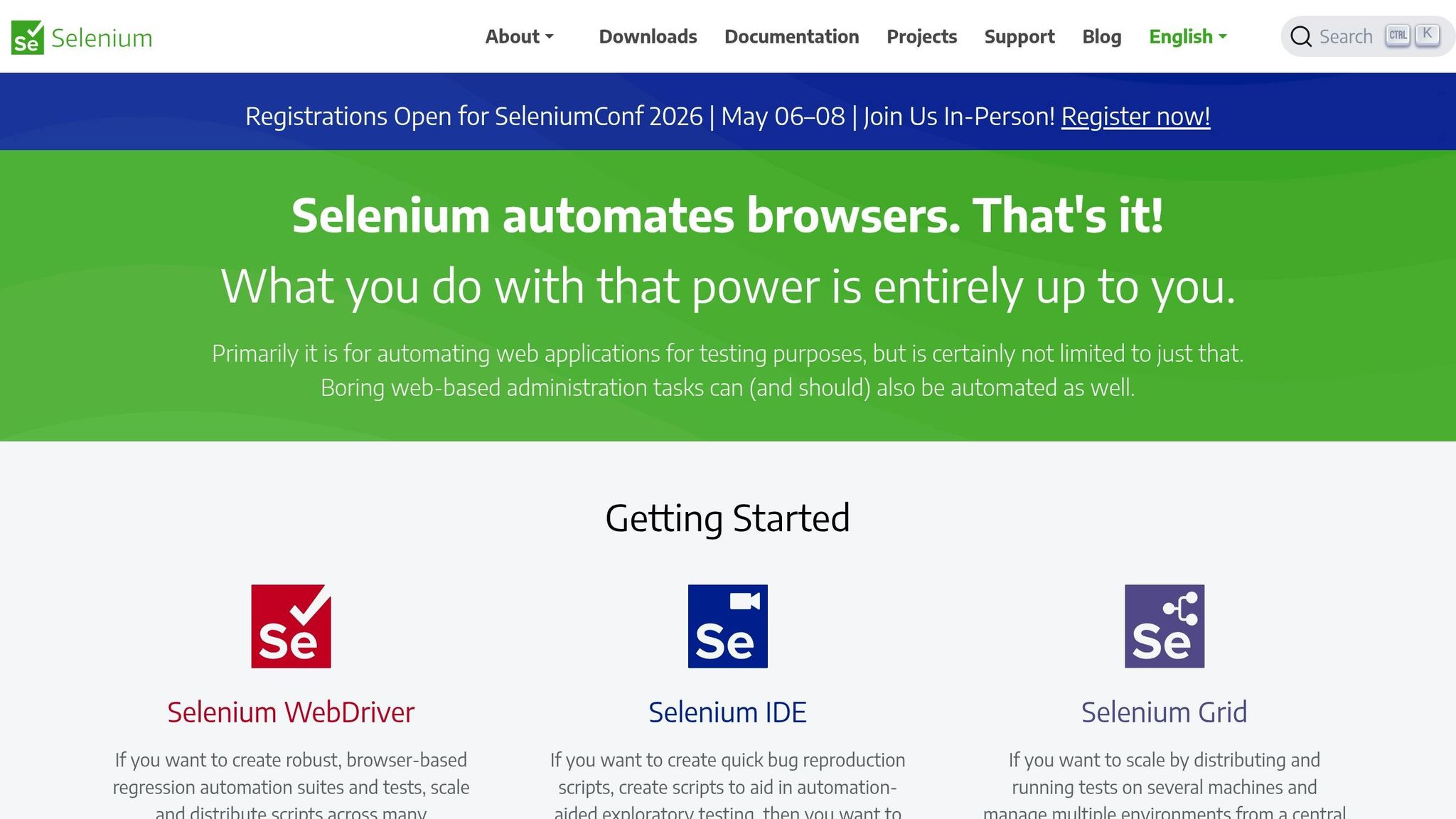
The curriculum dives into Selenium's tools - WebDriver, Grid, and IDE - and teaches how to implement frameworks like Data-Driven, Keyword-Driven, Hybrid, and BDD using Cucumber. The GenAI module focuses on automating tasks such as requirement analysis, test case creation, execution, and defect management through prompt engineering and LLM workflows. Hands-on projects include building QA stacks for healthcare and e-commerce platforms, integrating automation via Jenkins CI. You'll also work with tools like TestNG, JMeter, REST Assured, Postman, and ChatGPT to create workflows that generate synthetic data and enable predictive analytics. The course is structured to fit into your schedule, offering flexibility through live and on-demand sessions.
Duration
The program comprises 36–40 hours of live training delivered through interactive sessions. You can attend classes twice a week at times that suit you or access recordings on-demand, making it easier to balance learning with other responsibilities.
Pricing
The course costs $1,099 USD, with installment payment options available. This is a strategic investment in a field expected to reach $20.6 billion globally by 2026, with AI testing adoption projected to grow to 65% by 2030.
Certifications
Upon completing the program, you'll receive a certified diploma in collaboration with leading universities. You'll also be prepared for additional certifications, such as Microsoft Power Automate RPA Developer and Microsoft Azure AI Fundamentals. Programs like this typically earn ratings between 4.5/5 and 4.6/5, with graduates reporting salary increases ranging from 20% to 100%.
Pros and Cons
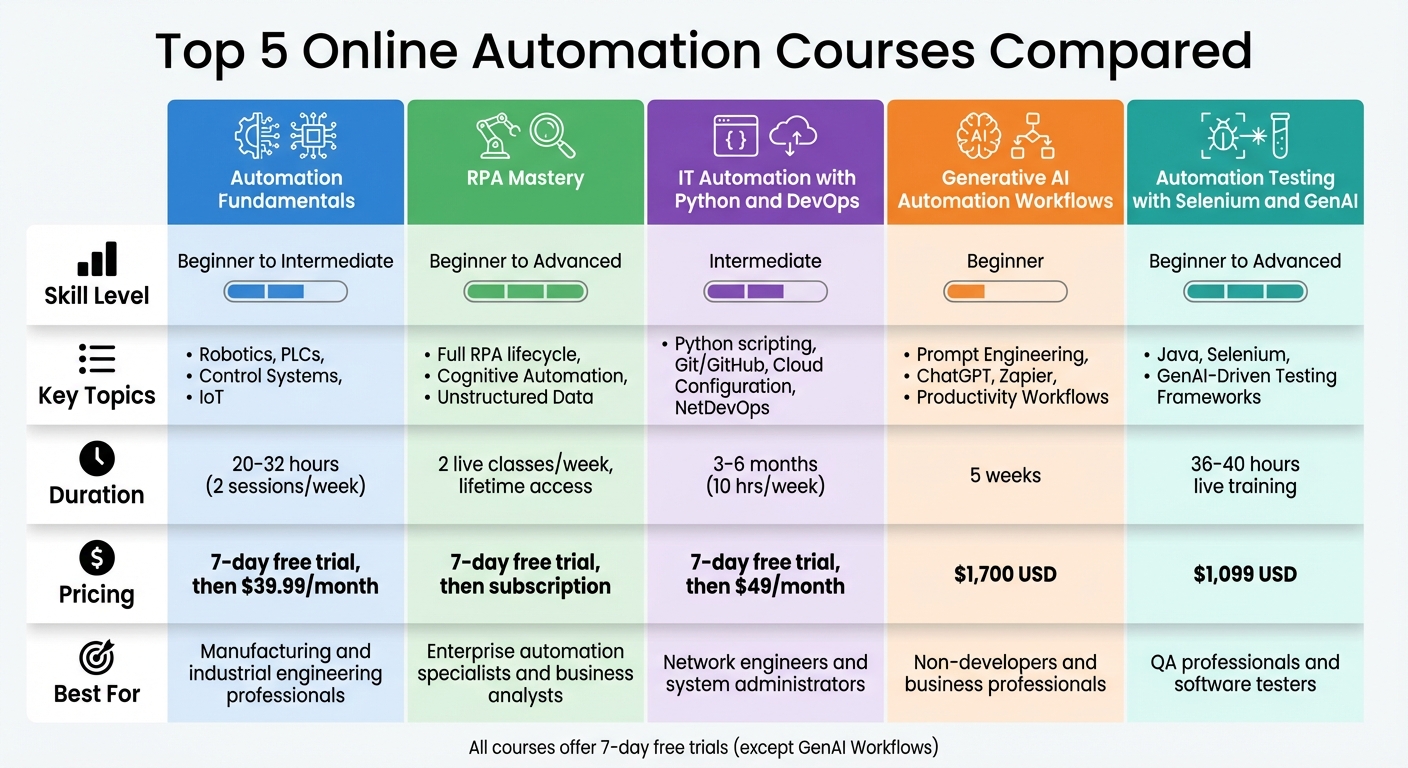
Comparison of Top 5 Online Automation Courses: Features, Pricing, and Best Use Cases
The following breakdown highlights how each program aligns with specific career goals, building on the detailed course features discussed earlier.
Automation Fundamentals is an excellent choice for those in manufacturing or industrial engineering. It dives into robotics, PLCs, control systems, and IoT, making it a strong fit for industrial applications. However, if your focus leans toward software or business process automation, this course might not fully meet your needs.
RPA Mastery provides a thorough overview of the robotic process automation lifecycle, from discovery to deployment. It also includes advanced modules on cognitive automation for handling unstructured data. This makes it ideal for professionals aiming for enterprise automation roles. That said, beginners might find the cognitive automation topics challenging without prior RPA knowledge.
IT Automation with Python and DevOps stands out for network engineers and system administrators. It emphasizes Python scripting, version control using Git/GitHub, and cloud configuration management, aligning with the NetDevOps trend. However, basic programming knowledge is required to fully benefit from this course.
Generative AI Automation Workflows simplifies automation for non-developers by focusing on prompt engineering and tools like ChatGPT and Zapier. Its low-code approach makes it accessible, especially for business professionals. However, those looking for advanced technical programming skills may need additional training down the line.
Automation Testing with Selenium and GenAI addresses a booming market. The global automation testing industry was valued at $25.43 billion in 2022 and is expected to grow to $92.45 billion by 2030, with a compound annual growth rate of 17.3%. Currently, 72% of QA professionals use AI tools like ChatGPT for test generation, and 82% anticipate AI becoming critical in software testing within the next three to five years. This course equips learners with cutting-edge skills but demands a significant time and financial commitment due to its rigorous curriculum.
Here’s a side-by-side comparison of the key details:
| Course | Skill Level | Key Topics | Duration | Pricing | Best For |
|---|---|---|---|---|---|
| Automation Fundamentals | Beginner to Intermediate | Robotics, PLCs, Control Systems, IoT | Varies | 7-day free trial, then subscription | Manufacturing and industrial engineering professionals |
| RPA Mastery | Beginner to Advanced | Full RPA lifecycle, Cognitive Automation, Unstructured Data | Varies | 7-day free trial, then subscription | Enterprise automation specialists and business analysts |
| IT Automation with Python and DevOps | Intermediate | Python scripting, Git/GitHub, Cloud Configuration, NetDevOps with Ansible | 6-course certificate | 7-day free trial, then subscription | Network engineers and system administrators |
| Generative AI Automation Workflows | Beginner | Prompt Engineering, ChatGPT, Zapier, Productivity Workflows | 4–12 weeks | 7-day free trial, then subscription | Non-developers and business professionals |
| Automation Testing with Selenium and GenAI | Beginner to Advanced | Java, Selenium, GenAI-Driven Testing Frameworks | 6-month program (130+ hours live) | 7-day free trial, then subscription | QA professionals and software testers |
To maximize your learning experience, consider building foundational skills in Python, Java, or SQL if you’re aiming for advanced automation frameworks. Beginners might find it helpful to start with introductory courses to grasp basic testing logic and scripting before moving on to professional certifications. Earning a recognized credential can also significantly enhance your job prospects, as recruiters value verified expertise in key frameworks.
Conclusion
Choosing the right automation course depends on your career aspirations and current expertise. If you're in IT and aiming for roles like Systems Administrator or DevOps Engineer, the IT Automation with Python and DevOps course from Upskillist is a great option. According to their data, 75% of graduates see career advancements within six months.
For professionals in finance, accounting, or logistics, the RPA Mastery course prepares you for roles such as Junior RPA Developer or Business Analyst. Marketing and content specialists can benefit from the Generative AI Automation Workflows course, which focuses on improving productivity using low-code tools. QA professionals and test automation engineers will find value in the Automation Testing with Selenium and GenAI course, which provides hands-on training with essential tools for software testing and quality assurance. Meanwhile, manufacturing and industrial engineering professionals may find the Automation Fundamentals course most aligned with their field.
"Knowing how to write code to solve problems and automate solutions is a crucial skill for anybody in IT." - Google Career Certificates
Matching your course selection to your career path is essential. Beginners should look for programs that require no prior experience, while those with programming knowledge can explore more advanced topics. With a median entry-level salary for Automation Engineers at $126,720 and over 22,768 job openings currently available in the U.S., now is the time to invest in automation skills that align with your goals.
FAQs
Which course should I start with if I’m a complete beginner?
If you're just starting out, "Automate the Boring Stuff with Python" by Al Sweigart is a fantastic choice. This book breaks down the basics of automation with Python in a straightforward and easy-to-follow manner. It's an ideal pick for anyone new to programming and looking to learn automation skills without feeling overwhelmed.
Do I need coding skills (Python or Java) before enrolling?
No, you don’t need to know coding languages like Python or Java. Plenty of courses are tailored for beginners with zero programming experience, making automation learning approachable for everyone.
Which course fits my career path (IT, business, QA, or manufacturing)?
The ideal course for you will depend on your specific career goals:
- IT Professionals: Build your skills in scripting and system management with the Google IT Automation with Python Professional Certificate.
- Business Enthusiasts: Optimize workflows and processes by diving into Microsoft's Automate Processes with RPA and Power Automate.
- Quality Assurance (QA) Specialists: Hone your expertise in automation testing through the UiPath Automation Developer Associate program.
- Manufacturing Experts: Gain insights into robotics and control systems with the Fundamentals of Robotics & Industrial Automation course.