

udemy alternatives
Compare top Udemy alternatives—Coursera, edX, Skillshare, LinkedIn Learning, Udacity, Pluralsight, and MasterClass—to match your goals, budget, and learning style.
If you're exploring online learning options beyond Udemy, here’s what you need to know upfront:
- Coursera and edX are ideal for those seeking certificates from top universities and institutions. They offer accredited credentials and structured programs, including degrees.
- Skillshare focuses on short, hands-on courses for artistic or hobby-related skills but lacks accreditation.
- LinkedIn Learning provides career-focused, professional skill-building courses with certificates that integrate directly into your LinkedIn profile.
- Udacity and Pluralsight are tailored for tech professionals, offering specialized programs in fields like AI, data science, and cybersecurity.
- MasterClass delivers polished, celebrity-led courses for personal enrichment, without formal credentials.
Quick Comparison Table
| Platform | Focus | Credential Type | Pricing (USD) | Best For |
|---|---|---|---|---|
| Coursera | Academic, Business | Accredited | $59/month or $399/year | University-level learning |
| edX | STEM, Humanities | Accredited | $50–$300 per certificate | Affordable academic credentials |
| Skillshare | Arts, Design | Non-accredited | $168/year ($14/month) | Artistic skills and hobbies |
| LinkedIn Learning | Business, Tech | Professional | $29.99/month or $239.88/year | Workplace skill development |
| Udacity | Tech, AI | Industry-recognized | $249–$399/month | In-depth tech training |
| Pluralsight | IT, Cybersecurity | Skill-based | $29/month or $252/year | Tech certifications and skills |
| MasterClass | Lifestyle, Arts | Non-accredited | $120/year | Personal growth and inspiration |
Each platform serves specific needs, whether you're after career growth, academic credentials, or personal interests. Choose based on your goals, budget, and preferred learning style.
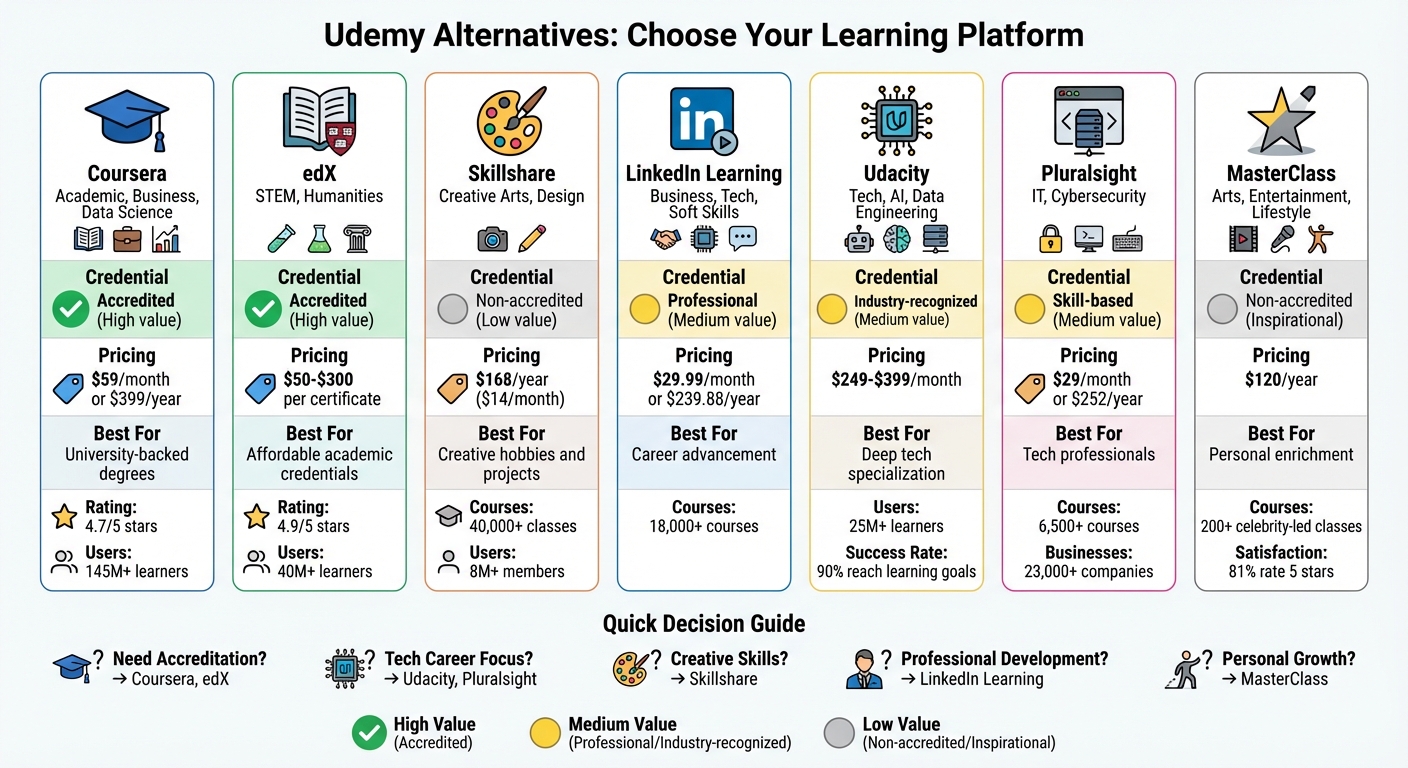
Udemy Alternatives Comparison: Features, Pricing, and Best Use Cases
Top 5 Online Learning Platforms 2025 | Review of Coursera / SkillShare / Udemy / EdX / LinkedIn

1. Upskillist
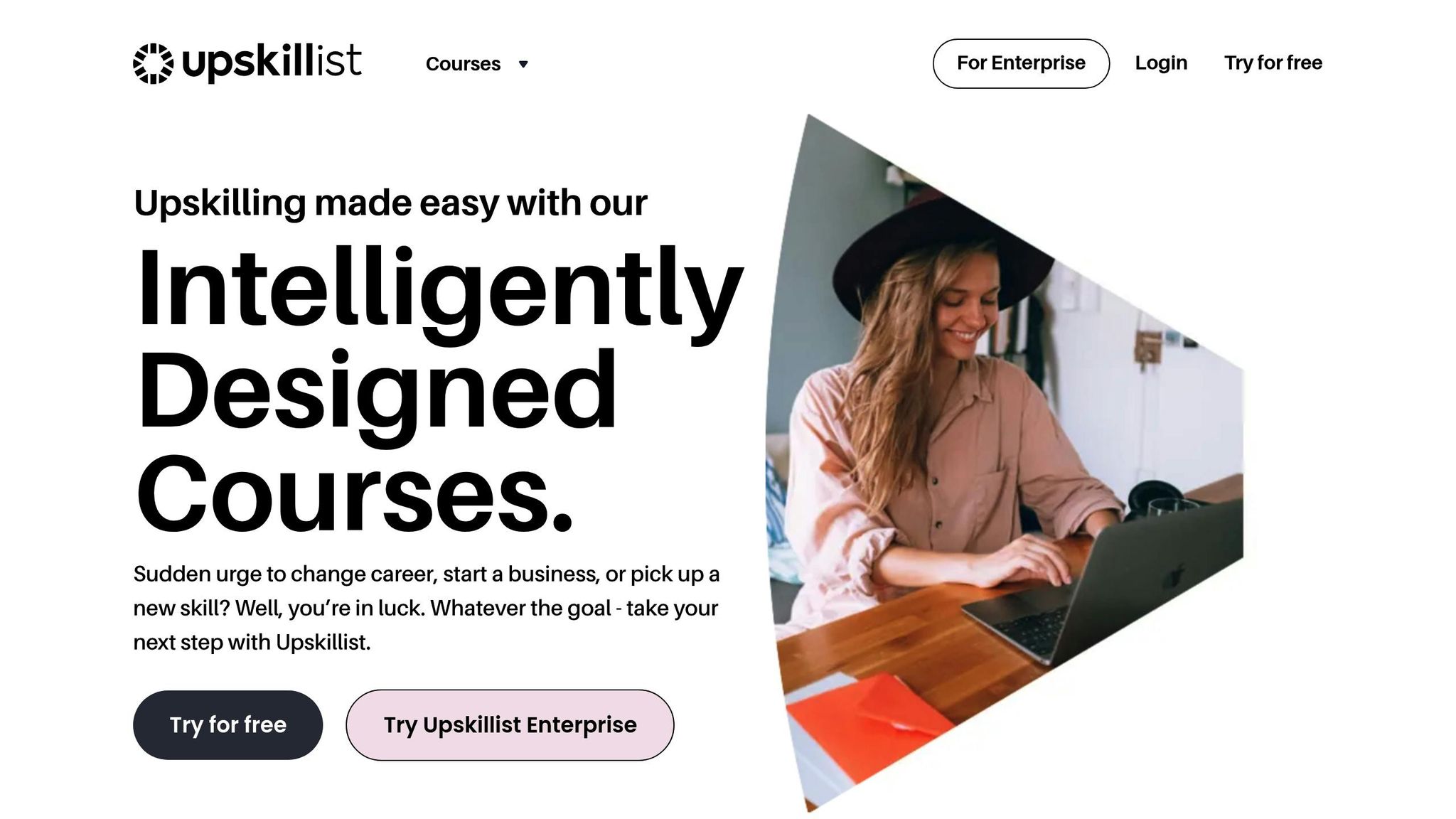
Upskillist offers courses designed to help you develop practical skills for business, career, and personal growth. With content created by industry experts and over 100 subjects to choose from, the platform ensures a high standard of quality and consistency, making it a focused learning hub.
Course Focus
The platform structures its courses around four main goals: business growth, personal development, career advancement, and hobby exploration. This clear framework helps learners pick courses that align with their specific objectives.
Credential Value
Upskillist awards certifications that are recognized globally. These credentials can enhance your resume and LinkedIn profile by showcasing skills that are relevant to your industry.
Learning Format
Upskillist combines live webinars with on-demand content, providing both flexibility and interactive learning. Live sessions are available in multiple time slots to accommodate different time zones, and you’ll have lifetime access to course materials for ongoing reference.
Pricing
Upskillist operates on a subscription model. You can start with a 7-day free trial, which gives unlimited access to premium courses and personalized learning paths powered by AI. After the trial, you can subscribe monthly to access the full course library and ongoing assessments.
2. Coursera
Coursera collaborates with over 350 universities and companies - including Stanford, Yale, Google, IBM, Microsoft, and Meta - to provide a vast selection of courses. With over 145 million learners worldwide, the platform boasts an impressive average course rating of 4.7 out of 5 stars.
Course Options
Coursera offers a variety of learning paths to suit different needs. You can choose from short 1–2 hour Guided Projects, 4–12 hour individual courses, month-long Specializations, and Professional Certificates designed for entry-level roles in high-demand fields like cybersecurity, UX design, and data analytics. For those aiming higher, Coursera also provides full university degrees that take 2–4 years to complete.
If you're looking to learn without committing to assignments or certificates, Coursera allows free auditing for thousands of courses. This option gives access to video lectures and readings, making it ideal for personal growth and lifelong learning.
Credential Recognition
Coursera credentials carry weight in the professional world since they are issued by accredited universities and leading corporations. Their Professional Certificates are specifically tailored to prepare learners for the job market and are widely accepted as proof of expertise. In fact, 91% of learners reported career advancements - such as promotions or new job opportunities - after completing their programs.
"My level of confidence about the subject has increased tremendously... Today I have a formal certification from a great university and I am actively taking on new work projects." - Suprita J., University of Illinois Instructional Design MasterTrack Certificate
Some Professional Certificates can even be converted into college credit, and MasterTrack Certificates count toward full Master's degrees if you're later admitted into the program. Online degrees earned through Coursera are fully accredited and hold the same value as on-campus counterparts. This comprehensive credential system enhances the platform's flexible course offerings.
Learning Experience
Coursera's courses are self-paced, featuring video lectures, peer-reviewed assignments, and hands-on Guided Projects. This structure balances flexibility with the discipline of set deadlines, making it easier to fit learning into a busy schedule.
Pricing
Coursera's pricing starts at $9.99 for Guided Projects, while individual courses and Specializations range from $49–$79 per month. For those seeking broader access, Coursera Plus is available at $59 per month or $399 per year, with promotional pricing of $199/year as of January 2026. MasterTrack Certificates begin at $2,000, and full online degrees start at $9,000. Additionally, financial aid is offered for many programs.
3. edX
Founded by Harvard and MIT, edX brings university-level education to learners around the globe. With partnerships spanning over 250 institutions - including Google, IBM, Stanford, and the London School of Economics - edX offers courses in a wide range of fields such as Artificial Intelligence, Data Science, Business Management, Healthcare, Engineering, and Humanities. Boasting an impressive 4.9 out of 5 average rating and a community of more than 40 million learners worldwide, the platform is recognized for its focus on academic rigor and credibility.
Course Focus
edX provides a variety of flexible course formats to suit different learning needs. Options include short 2–6 week individual courses, 8–12 week certificate programs, 6–20+ week Executive Education courses, and full online degrees that can take 1.5–3 years to complete. Popular offerings cover trending topics like Generative AI Engineering, Digital Transformation Strategy, Business Sustainability Management, and Net Zero Emissions. For those interested in personal growth, edX also features courses in social sciences and humanities, such as the engaging "The Science of Happiness."
"I was so pleased to learn that so many institutions around the world offer versions of their courses online. I thought The Analytics Edge [course] had a terrific range of topics." - Curt Frye, edX Learner
This structured approach ensures learners can choose programs that align with their goals, whether they’re seeking career advancement or personal enrichment.
Credential Value
edX offers a range of credentials, including Verified Certificates, Professional Certificates, MicroBachelors, MicroMasters, and even full Bachelor's and Master's degrees. Issued by top universities and industry leaders, these credentials hold significant value. Many MicroMasters and MicroBachelors programs can be applied toward full degree programs at participating institutions. Additionally, financial assistance is available for eligible learners, providing discounts of up to 90% on certificate costs. These credentials not only enhance resumes but also cater to diverse learning objectives.
Learning Format
Most edX courses are self-paced, allowing learners to progress on their own schedules. Some advanced programs, however, include proctored exams or cohort-based elements. While thousands of courses can be audited for free - offering access to video lectures and readings - verified certificates and graded assignments require payment. edX also supports learning on the go with a mobile-friendly app that enables both online and offline study.
Pricing
Auditing courses comes at no cost, while verified certificates are priced between $90 and $300. Professional programs, MicroMasters, and online degrees range from several thousand dollars to around $9,000. As of January 9, 2026, edX is offering up to 15% off with the promo code "TOASTNY2026" (valid through January 13, 2026), along with a 14-day money-back guarantee.
4. Skillshare
Skillshare stands out with its creative, project-oriented approach, focusing on topics like graphic design, illustration, photography, writing, web development, and productivity. With over 40,000 short classes, it primarily appeals to creative professionals, freelancers, and hobbyists. The platform has grown to include a community of around 8 million users. Its emphasis on immediate creative output sets it apart from other learning platforms.
Course Focus
Skillshare classes are designed to be quick and actionable, with most courses lasting just 30 to 40 minutes. Every class includes a hands-on project - whether that's designing in Illustrator, creating a social media strategy, or sketching - ensuring students can directly apply what they learn. The platform encourages community engagement by allowing students to share their projects in galleries and receive feedback from peers and instructors [3, 28].
"There's nothing better than seeing my passion for a subject spark creativity in others." - Ira Marcks, Skillshare Teacher
Credential Value
Unlike platforms tied to universities, Skillshare does not provide formal certificates or accredited credentials. Completing a course is more about personal growth and skill-building than adding qualifications to a résumé [3, 13].
Learning Format
Courses on Skillshare are delivered in short, self-paced modules, making it easy to fit learning into a busy schedule. Premium members can download classes for offline viewing, offering flexibility for on-the-go learning. The platform also includes live sessions and one-on-one interactions for real-time engagement [31, 33]. Students can track their progress by marking completed units and working through interactive project steps.
Pricing
Skillshare uses a subscription model, granting unlimited access to its entire course library. Membership costs $32 per month, or $168 annually (around $14 per month when billed yearly). New users can take advantage of a 1-month free trial before committing to a subscription. For those experiencing financial hardship, Skillshare offers scholarships that cover 50% to 100% of membership fees. Teams can subscribe for approximately $245 per user annually. This all-access approach is especially appealing for learners interested in exploring multiple creative fields without the need to purchase individual courses. Skillshare’s focus on hands-on artistic skills offers a unique option for those looking to develop their creativity.
5. LinkedIn Learning
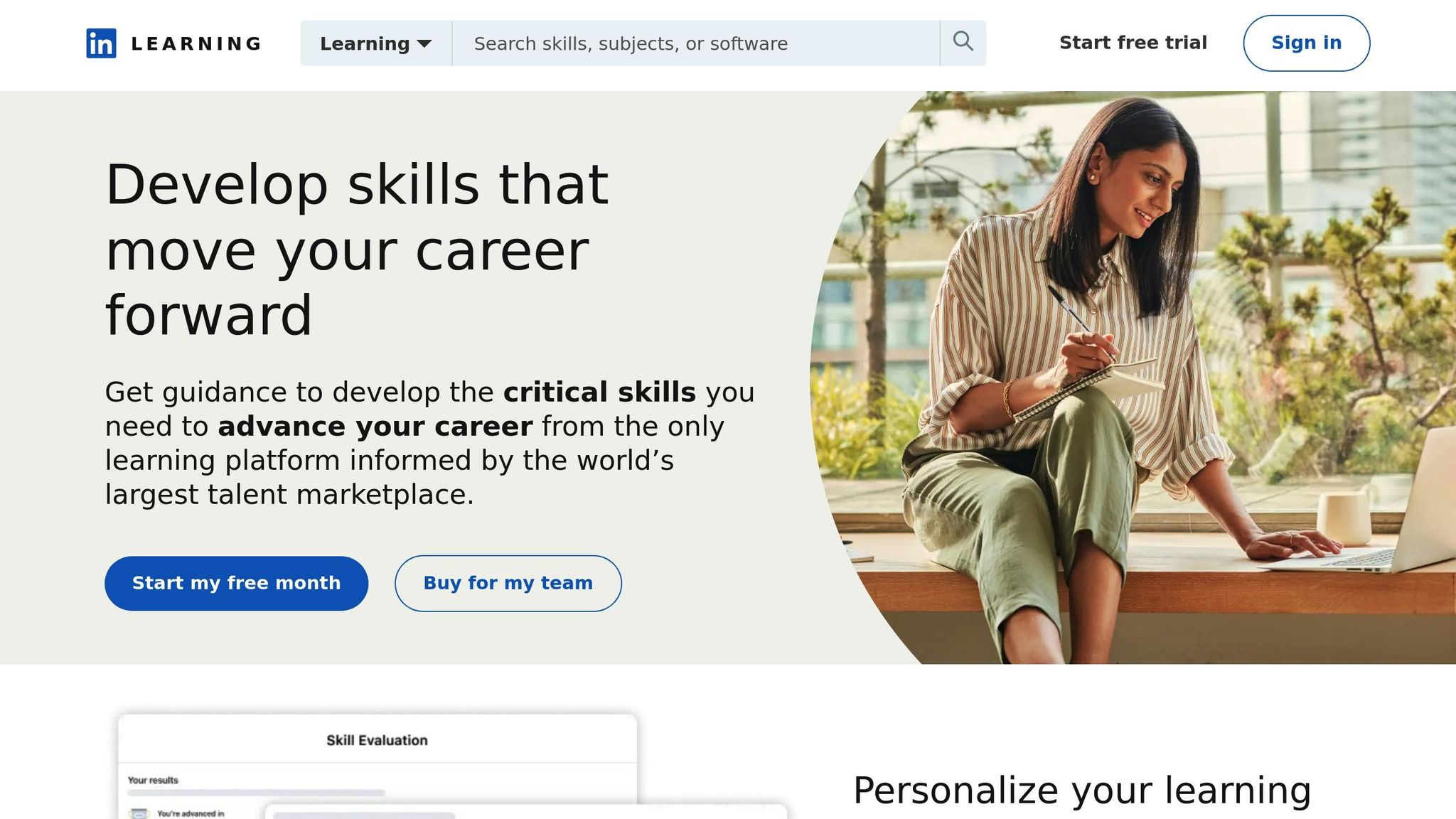
LinkedIn Learning takes a career-focused approach, catering to professionals aiming to sharpen their skills for workplace success. With a library of over 18,000 expert-led courses in Business, Technology, and Creative fields, it’s designed for those who want to advance their careers quickly and effectively. Topics range from project management and HTML coding to SQL, Photoshop, and leadership training. Many courses are structured to be completed in under 4 hours, making it a practical choice for busy professionals.
Course Focus
LinkedIn Learning organizes its courses into Learning Paths, which are tailored to specific career goals or certification prep. Instead of prioritizing academic credentials, the platform zeroes in on skills you can immediately apply in your job. Whether it’s graphic design or software development, the courses are aimed at providing practical tools you can use right away. This structure also allows learners to earn credentials that can enhance their professional profiles.
Credential Value
One of the standout features of LinkedIn Learning is how seamlessly its certificates integrate with your LinkedIn profile. This not only increases your visibility to recruiters but also acts as instant proof of your skills. The platform also offers Continuing Education Units (CEUs), which can help maintain certain professional certifications. While these certificates aren’t equivalent to university degrees, they still serve as credible evidence of your professional development.
Learning Format
Courses are delivered through short video lessons, usually lasting 1 to 5 minutes, which makes them ideal for quick learning sessions. The platform also supports offline viewing via its mobile app, and most courses come with transcripts to improve accessibility. That said, the learning experience is fairly passive, as there are no interactive assignments or homework submissions available.
Pricing
LinkedIn Learning uses a subscription model, offering unlimited access to its course library. Monthly plans cost $29.99, while annual billing reduces the price to $19.99 per month (approximately $239.88 per year). Additionally, some individual courses can be purchased separately for $20 to $40. New users can take advantage of a one-month free trial, and LinkedIn Premium subscribers get access to the platform at no extra cost.
6. Udacity

Udacity is all about helping people advance their tech careers by focusing on fields that are in high demand. With over 25 million learners worldwide, the platform organizes its courses into specialized Schools, covering areas like Artificial Intelligence, Data Science, Programming, Business, Cloud Computing, Autonomous Systems, Cybersecurity, and Product Management. Instead of trying to cover everything, Udacity zeroes in on cutting-edge technologies like Generative AI, Agentic AI (which involves engineering teams of AI agents), and AI for Trading.
Course Focus
At the heart of Udacity's offerings are its Nanodegree Programs, which are intensive, job-oriented credentials developed in collaboration with industry giants like Google, AWS, and IBM. These programs center on a "learning by building" philosophy, where students tackle real-world projects that reflect actual industry challenges. This hands-on approach not only helps learners master new skills but also allows them to build a professional portfolio. Companies like Siemens and FPT Software have even partnered with Udacity to train their employees using these industry-relevant projects.
Credential Value
While Udacity's Nanodegrees aren't traditionally accredited, they’re highly regarded in the tech world. Why? Because of their mentor-graded projects and strong industry ties. Each project gets personalized feedback from experienced professionals, ensuring students gain practical, validated skills. According to Udacity, 90% of students report reaching their learning goals. Programs like the Generative AI Nanodegree and Data Analyst program are particularly well-received, earning ratings of 4.9/5 and 4.8/5, respectively. Beyond Nanodegrees, Udacity also offers an accredited Master's in AI, providing a flexible and affordable alternative to traditional on-campus degrees.
Learning Format
Udacity's approach to learning is all about doing. Instead of relying on static video lectures, the platform emphasizes hands-on projects that let students apply their knowledge immediately. Throughout their programs, learners are paired with industry mentors who provide guidance and support. The self-paced format allows students to fit their studies around their schedules, and for those who want to test the waters before committing, Udacity offers access to over 200 free courses covering various technical skills. This project-driven, flexible model is paired with a subscription-based pricing structure aimed at dedicated learners.
Pricing
Nanodegree programs are priced at approximately $399 per month. Udacity also offers discounts and a 7-day free trial for new users. Plus, those 200+ free courses make it easier for curious learners to get started without any upfront cost.
7. Pluralsight
Pluralsight is a go-to platform for professionals looking to sharpen their technical skills. Known for its advanced tech training, it offers a vast library of over 6,500 courses spanning areas like software development, AI, cloud computing, cybersecurity, data science, and IT operations. Trusted by more than 23,000 businesses - including numerous Fortune 500 companies - Pluralsight plays a key role in helping teams stay ahead in the rapidly changing tech landscape. What sets it apart is its commitment to quality, with only 5.5% of applicants accepted into its author network, 91% of whom bring over a decade of experience.
Course Focus
Pluralsight tailors its courses around more than 150 industry certification paths, including popular ones like AWS, Microsoft Azure, CompTIA, and Cisco. Instead of offering general education, it hones in on vendor-specific certifications and practical IT skills. To make learning more effective, the platform uses "Skill IQ" assessments to identify knowledge gaps and create customized learning paths. As Winston S., a Cloud Architect, puts it:
Pluralsight helped transform my career.
Learning Format
The platform goes beyond traditional video tutorials with over 3,500 interactive labs and sandboxes. These tools let users practice on cloud platforms like AWS and Google Cloud without risking real-world infrastructure. An AI assistant named Iris provides instant guidance and tailored course recommendations. For those in cloud computing, the "Cloud+" and "Complete" plans include access to the full A Cloud Guru library, adding even more depth to the training options. These interactive tools and resources are designed to create an engaging and practical learning experience.
Pricing
Pluralsight uses a subscription-based model with flexible options:
- Core Tech Plan: $30/month or $252/year (billed annually), offering access to 3,900+ foundational courses.
- Specialized Plans (AI+, Cloud+, Data+, Security+): $35/month or $294/year (billed annually), which include advanced content and domain-specific sandboxes.
- Complete Plan: $55/month or $468/year (billed annually), unlocking the entire library of 6,500+ courses and all lab features.
A 10-day free trial is available for all individual plans, giving users a chance to explore the platform before committing.
8. MasterClass
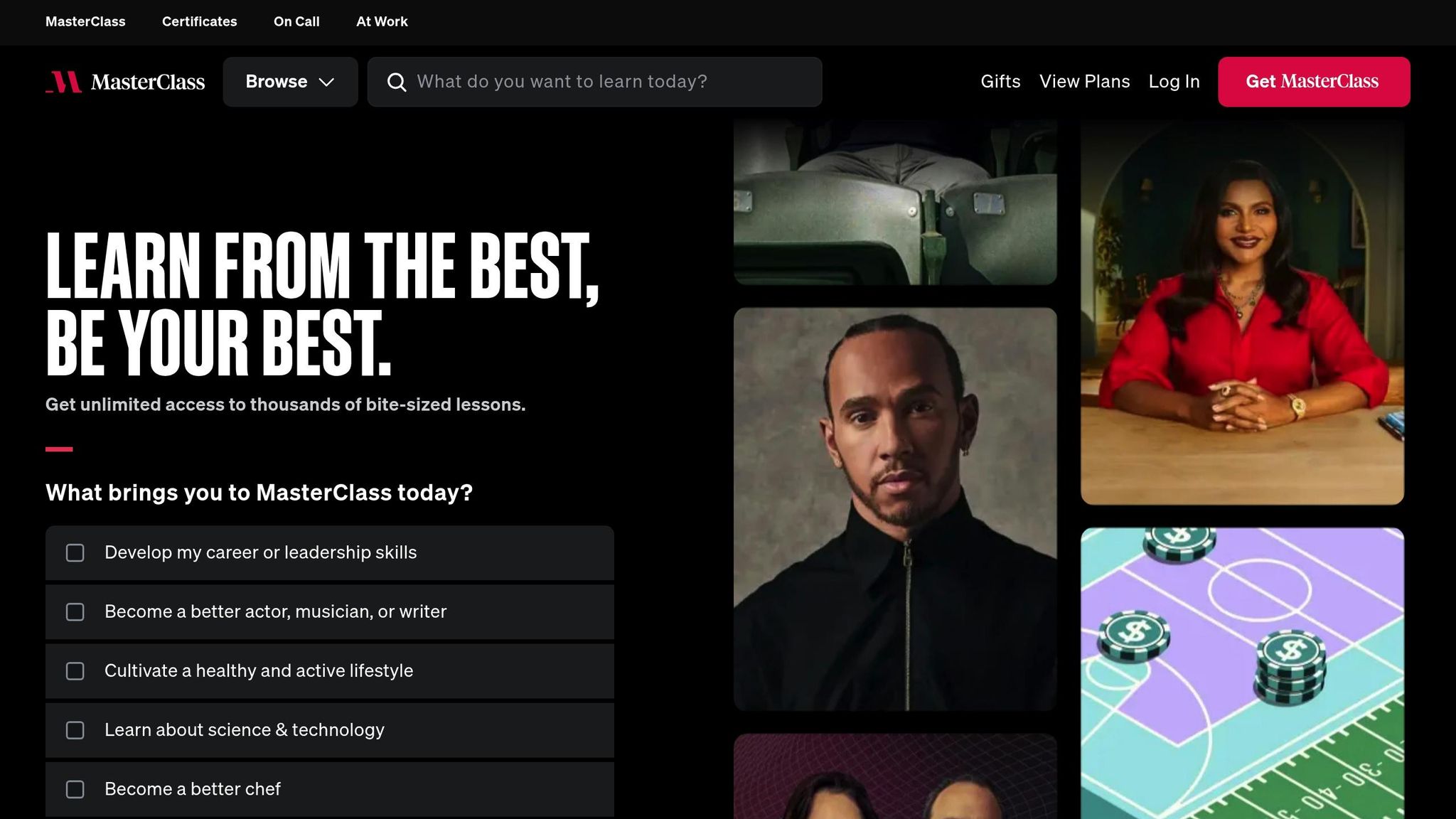
MasterClass is all about sparking creativity and offering inspiration, rather than focusing on career certifications. The platform boasts a collection of over 200 classes, all taught by top-tier celebrities and globally recognized experts like Gordon Ramsay, Margaret Atwood, and Steph Curry. Unlike platforms where anyone can teach, MasterClass carefully selects its instructors, resulting in a polished library spanning 11 categories, including Acting and Performing Arts, Business and Entrepreneurship, Food and Drink, and Science and Technology.
Course Focus
MasterClass offers more than 100 courses, with an emphasis on creative arts, lifestyle, and leadership. Each course typically includes 18 or more lessons, with video sessions ranging from 6 to 20 minutes. These classes dive deep into the "why" behind a craft, providing a unique perspective. Recently, MasterClass has ventured into more practical topics, offering certificates developed in collaboration with organizations like Microsoft, Nvidia, and the Navy SEAL Foundation. These tracks incorporate interactive quizzes and assignments graded by AI.
Credential Value
MasterClass isn’t an accredited institution, so its certificates aren’t formal professional credentials. Instead, these certificates serve as personal milestones, showcasing your commitment to learning. The platform is ideal for those seeking personal growth or creative exploration rather than career-focused training. As PCMag contributor Jill Duffy pointed out:
The question I kept asking myself was, 'Could I find this content online for free if I really wanted it?' and the answer was 'no.'
Learning Format
MasterClass takes the learning experience to the next level with its exceptional production quality. Think of it as learning through a mini-movie - each video is shot with the kind of high-end production you’d expect from a TED Talk or a premium TV show. Additional tools like PDF workbooks, in-video notes, and curated playlists help enrich the experience further. Whether you’re using a desktop, mobile device, or TV, the platform is designed for flexibility. Plus, the Plus and Premium plans allow up to six household members to create individual profiles, each with their own watchlist and progress tracking.
Pricing
MasterClass offers annual subscription plans. The Standard Plan is $120/year and allows streaming on one device. The Plus Plan, at $180/year, supports streaming on two devices with offline viewing. For larger households, the Premium Plan costs $240/year and accommodates up to six devices. A 30-day satisfaction guarantee is included, and 81% of users have rated the platform 5 stars.
Platform Comparison: Advantages and Disadvantages
Based on the detailed platform reviews above, here's a streamlined comparison of the key strengths and weaknesses of the top platforms, helping you align your learning goals with the right choice.
Coursera and edX stand out for offering accredited credentials from prestigious institutions like Harvard, MIT, and Stanford. While edX provides more budget-friendly verified certificates, Coursera's subscription model may appeal to those seeking broader access. Both platforms follow traditional academic formats, including graded assignments and proctored exams, making them ideal for those pursuing structured academic paths. These features address gaps seen in platforms like Udemy, particularly in terms of formal accreditation and academic rigor.
For tech professionals, Udacity and Pluralsight deliver hands-on, specialized training in high-demand fields like AI, cybersecurity, and data science. Udacity offers its Nanodegree programs, which range from $249 to $399 per month and include mentor-guided projects, making it a solid choice for in-depth learning. Pluralsight, on the other hand, provides skill assessments and hands-on labs at a more affordable $29/month, catering to those looking for flexible, skill-based learning. However, Udacity's pricing can make it a more costly option overall.
Creative learners often gravitate toward Skillshare, which offers project-based courses for $168 annually ($14/month). While it lacks formal accreditation, its focus on creativity and design makes it a popular choice for hobbyists and aspiring artists. LinkedIn Learning, priced at $39.99/month or $323.88/year, is tailored for professionals seeking career advancement through concise, actionable video lessons. While it doesn't provide academic credentials, its focus on practical skills is highly regarded.
Finally, MasterClass offers a unique experience with its cinematic, celebrity-led courses starting at $120/year. While not designed for career growth or formal education, its focus on personal enrichment and high production quality makes it an engaging option for those seeking inspiration and creative growth.
| Platform | Primary Focus | Credential Value | Pricing | Best For |
|---|---|---|---|---|
| Coursera | Academic, Business, Data Science | High (Accredited) | $59/month or $399/year | University-backed degrees |
| edX | STEM, Humanities | High (Accredited) | $50–$300 per certificate | Affordable academic credentials |
| Skillshare | Creative Arts, Design | Low (Non-accredited) | $168/year ($14/month) | Creative hobbies and projects |
| LinkedIn Learning | Business, Tech, Soft Skills | Medium (Professional) | $39.99/month or $323.88/year | Career advancement |
| Udacity | Tech, AI, Data Engineering | Medium (Industry-recognized) | $249–$399/month | Deep tech specialization |
| Pluralsight | IT, Cybersecurity | Medium (Skill-based) | $29/month | Tech professionals |
| MasterClass | Arts, Entertainment, Cooking | Low (Inspirational) | $120/year | Personal enrichment |
This comparison highlights how each platform caters to distinct learning needs, from academic pursuits and professional development to creative exploration and personal growth.
Conclusion
Our review sheds light on the strengths of various online learning platforms, catering to a range of educational and professional needs. If you're looking to earn academic credentials or make a career shift, Coursera and edX stand out with certificates backed by prestigious universities like Harvard, MIT, and Stanford. For those pursuing tech careers, Udacity offers Nanodegree programs with mentor support, while Pluralsight delivers skill assessments and hands-on labs to sharpen practical expertise.
For creative pursuits, Skillshare provides access to a community-driven library featuring over 25,000 classes. On the other hand, MasterClass offers polished, high-quality courses focused on personal growth, available through an annual subscription. Meanwhile, LinkedIn Learning combines a robust catalog of over 18,000 courses with the ability to showcase new skills directly on your LinkedIn profile.
Cost is a crucial factor. Platforms like edX and Coursera allow free course auditing, making them accessible to budget-conscious learners. Premium options like Udacity and MasterClass cater to those ready to invest for specialized content and unique experiences.
Ultimately, your choice depends on your goals - whether it’s earning a degree, building a tech portfolio, or acquiring new skills for career advancement. The key is to align the platform's features with your learning objectives, budget, and preferred style. Pick the one that fits your path and start learning!
FAQs
How do Coursera and edX differ in offering academic credentials?
Coursera and edX both partner with top universities, but they take different approaches when it comes to the credentials they offer. Coursera stands out by providing accredited certificates that can contribute to professional certifications or even full degree programs. These include options like Professional Certificates, MasterTrack programs, and fully online degrees. For added flexibility, Coursera offers a subscription plan called Coursera Plus, which gives unlimited access to most courses for $59 per month or $399 annually.
edX, by contrast, focuses on non-accredited credentials. These include course completion certificates and MicroMasters programs, which may require extra steps if you’re looking for formal recognition. Unlike Coursera, edX doesn’t have a subscription option; instead, individual courses generally start at around $50.
To sum it up, Coursera is better suited for those seeking accredited credentials and a subscription-based learning model, while edX appeals to learners who prefer non-accredited, university-level courses without the commitment of a subscription.
How does Skillshare’s focus on creativity differ from platforms that offer professional certifications?
Skillshare is all about sparking creativity. It offers video-based classes in areas like art, design, photography, and even cooking. The platform emphasizes hands-on learning, encouraging users to dive into optional projects and engage with community feedback. Instead of chasing formal credentials, learners can focus on building a portfolio that showcases their skills.
On the other hand, platforms like Upskillist cater to those seeking professional certifications. Their courses are often structured and backed by universities or industry experts, leading to recognized certificates or credits. This makes them a great choice for anyone looking to advance their career. While Skillshare thrives in the realm of creative exploration, certification-driven platforms place a stronger emphasis on formal validation and career-oriented achievements.
What makes Udacity a better choice than Pluralsight for tech-related courses?
Udacity sets itself apart with its project-based learning approach, developed in partnership with leading tech companies. This method ensures students gain practical, real-world experience they can showcase in a professional portfolio - a valuable asset when pursuing career opportunities.
What’s more, Udacity provides personalized mentorship and feedback from seasoned industry experts. This tailored guidance helps learners stay on track and achieve their specific goals, making the process more effective and supportive.
The platform’s self-paced, flexible programs are designed to deliver clear, measurable results. This makes Udacity a smart choice for anyone eager to build or refine in-demand tech skills while maintaining control over their learning schedule. If advancing your tech career is the goal, Udacity offers a solid path forward.