

types of assessments for online learning
Use formative quizzes, automated tests, essays, projects, peer review, and self-assessments to align online assessments with learning goals and boost retention.
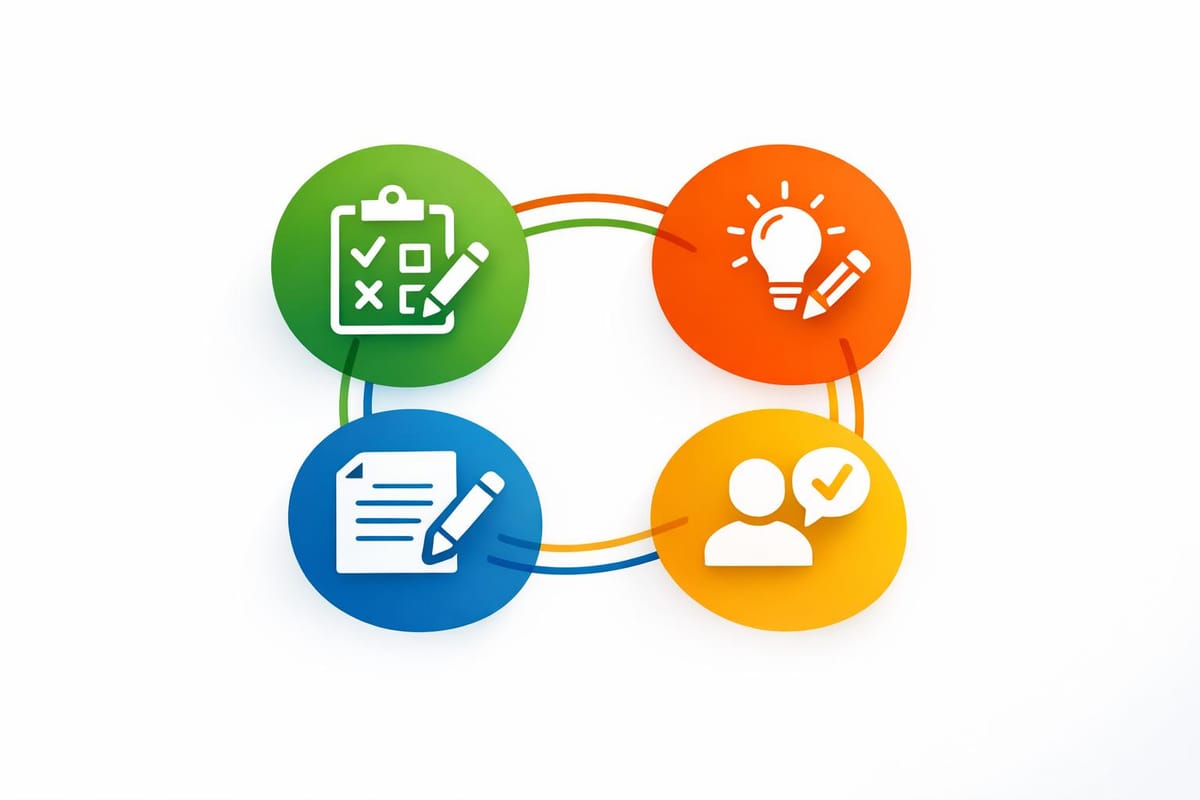
- Formative Assessments: Ongoing, low-pressure activities like quizzes and peer reviews that guide learning in real time.
- Summative Assessments: End-of-course evaluations such as final exams or projects that measure overall understanding.
- Quizzes and Automated Tests: Efficient, instant-feedback tools for knowledge checks and retention.
- Open-Ended Questions: Essays and reflective tasks that encourage deeper thinking and analysis.
- Project-Based Assessments: Real-world tasks like case studies or portfolios that demonstrate applied skills.
- Peer Reviews and Self-Assessments: Collaborative and reflective tools to improve critical thinking and self-awareness.
Pro Tip: Match assessment types to your learning goals. For example, use quizzes for recall and essays for analytical skills. Combining formative and summative methods creates a balanced, effective learning experience.
Online teaching tips: Assessment types
Quizzes and Automated Tests
Quizzes and automated tests have become essential in online learning, offering a scalable and efficient way to assess knowledge. Unlike traditional paper-based tests that require manual grading, automated assessments provide instant feedback, helping students identify and correct mistakes right away. This immediate feedback helps prevent misunderstandings from taking root.
Quizzes also promote active retrieval by encouraging learners to recall and apply what they’ve learned. When used frequently in low-pressure settings, they motivate students to space out their study sessions, a proven method for improving long-term retention compared to last-minute cramming.
As NC State University explains: "Quizzes and tests should be viewed as a means of promoting learning".
Common Quiz Formats for Online Learning
Multiple-choice questions are the go-to format for online assessments. They allow instructors to cover a wide range of topics efficiently and help address misconceptions quickly. To maximize their effectiveness, these questions should focus on application and analysis rather than rote memorization. For example, instead of asking, "What is photosynthesis?" a better question might present a real-world scenario and require students to identify the process at work.
True/false questions are great for reinforcing core concepts and checking for basic factual understanding. Fill-in-the-blank questions, on the other hand, demand active recall, making them particularly useful for testing vocabulary or key definitions. Hotspot questions, where students select specific areas within an image, are ideal for subjects like anatomy or geography. Finally, matching questions help students solidify their understanding by linking terms with their corresponding definitions or concepts.
For online multiple-choice quizzes, a 60-second time limit per question generally works well for students who are prepared.
These formats are not just about testing knowledge - they also create opportunities for intelligent, automated feedback that enhances the learning experience.
How Automated Feedback Helps Learners
One of the standout features of automated assessments is their ability to provide detailed feedback for each question. By explaining why an answer is right or wrong, these systems turn quizzes into learning tools, allowing students to track their progress and pinpoint areas where they need to improve.
"Provide feedback to learners early and often so they feel they are supported", recommends MIT's Digital Learning Toolkit.
Automated systems also encourage mastery learning by allowing multiple attempts on self-tests. This not only helps reduce test anxiety but also gives students a chance to familiarize themselves with the exam format. For instructors, tools like item analysis highlight which concepts might need extra attention in future lessons.
To ensure fairness and maintain the integrity of assessments, it’s a good idea to use your Learning Management System (LMS) to create randomized question banks. This shuffles both the questions and their answer choices for each student. While concerns about online cheating persist, research shows that it’s no more common than in traditional classrooms, especially when such precautions are in place.
Open-Ended Questions and Essays
Building on the strengths of automated quizzes, open-ended questions and essay assignments take learning to the next level by encouraging students to engage in deeper, more analytical thinking. These types of assessments challenge learners to organize their thoughts, construct arguments, and express ideas in ways that go beyond simple memorization or recall . They're especially useful in courses like history, literature, or leadership, where critical analysis and reflective thinking are central.
Essays, in particular, test a student’s ability to communicate effectively in writing. They require a structured approach, clarity of thought, and the ability to demonstrate skills like application, analysis, evaluation, and even creativity.
Measuring Critical Thinking and Creativity
Open-ended questions are designed to assess how well students can apply and adapt what they’ve learned rather than just repeat it. For instance, reflective writing tasks ask students to describe their learning journey and the reasoning behind their decisions, moving beyond a simple summary of content. Similarly, well-crafted questions that resist easy online answers push students to think critically and apply course concepts in new or unfamiliar contexts.
Prompts such as “What would happen if…” or “Why do these two researchers disagree about…” encourage students to explore complex ideas, analyze differing viewpoints, and connect theoretical knowledge to practical scenarios.
Because these tasks demand deeper cognitive engagement, grading them often requires a thoughtful and detailed approach.
Grading Challenges and Solutions
Grading open-ended responses is undeniably more time-intensive than automated quizzes . However, there are strategies to make the process more manageable and fair. One effective approach is to use clear, detailed rubrics for subjective assessments. These rubrics should outline specific performance criteria, include a rating scale (an even number of levels works best), and provide clear quality indicators .
Setting word count ranges helps clarify expectations for students, while requiring incremental drafts for longer assignments allows instructors to monitor progress and provide constructive feedback along the way . These practices not only streamline the grading process but also ensure a consistent and equitable evaluation of student work.
Project-Based and Performance Assessments
Project-based and performance assessments push learners to tackle real-world problems, produce meaningful deliverables, or carry out tasks directly tied to their future careers. Picture this: a law student diving into a case study or a biology student compiling a detailed lab report. These tasks mirror the kind of work they'll actually do in their fields.
What sets these assessments apart is their practical nature. Instead of just memorizing facts, students apply what they've learned to hands-on scenarios, demonstrating specific skills and competencies. This method not only reinforces knowledge but also hones higher-level abilities that employers value.
Common Project-Based Assessment Types
By focusing on tasks that feel real and relevant, project-based assessments can be customized to fit different learning goals. For instance, lab reports or case studies work well for objectives centered on analysis. If the goal is critique, editorials or peer reviews make sense. And for defending a position, debates or research papers are excellent choices.
Some popular examples include capstone projects that bring together everything learned in a course, presentations where students explain their findings, and ePortfolios that showcase skill development over time. Industry simulations are another favorite, as they mimic workplace scenarios and challenges. A practical way to design these projects is through backward planning: start with the learning goals, then decide how students can best demonstrate their understanding. To keep big projects manageable, breaking them into smaller steps - like proposals, drafts, and final versions - allows for consistent feedback and helps students stay on track.
Why Performance Assessments Work
These thoughtfully designed projects pave the way for performance assessments that feel like real professional challenges. Performance assessments immerse students in decision-making and problem-solving, making the evaluation process more relevant and meaningful. When students document their reasoning - whether through videos, podcasts, or annotated notes - it promotes deeper understanding rather than just focusing on the final result.
Another benefit? Flexibility. Students can choose the format that plays to their strengths or fits their technical resources. Whether it's a video, podcast, or written report, they have options. As the American Association for Higher Education and Accreditation highlights:
Assessments work best when they are conducted with a clear, explicitly stated purpose.
When that purpose is to prepare students for the demands of their chosen careers, project-based and performance assessments deliver results that resonate far beyond the classroom.
Peer Reviews and Self-Assessments
Projects can showcase what students are capable of, but peer reviews and self-assessments offer a deeper look into how they learn and grow. These methods shift feedback from being solely instructor-driven to a more collaborative and reflective approach. Students actively engage in evaluating their own work and that of their peers, fostering an environment of shared learning and self-improvement.
Using Peer Reviews for Collaborative Learning
Peer reviews create a two-way learning experience. The student giving feedback hones their critical thinking and analytical skills, while the one receiving feedback benefits from fresh perspectives they might not have considered before. This dynamic reduces the sense of isolation often associated with online learning and builds meaningful connections among students.
By exposing students to different approaches and explanations, peer reviews encourage them to value diverse viewpoints. This process also helps them develop the ability to provide constructive feedback - an essential life skill. Platforms like Canvas and Moodle simplify the peer review process with built-in features, while tools like Turnitin's PeerMark are specifically designed to streamline and even grade these assignments. To ensure meaningful feedback, instructors should provide clear rubrics so students know how to offer critiques that go beyond vague comments.
Self-Assessments for Reflection
Self-assessments complement peer reviews by encouraging students to reflect on their learning journey. They promote accountability and help students take charge of their progress. The MIT Digital Learning Toolkit highlights this by stating:
Teaching them techniques for self-assessment will allow them to chart their own growth throughout the course and take more ownership of their learning.
Low-pressure, formative self-assessments allow students to identify their weaknesses without fear of judgment. Simple strategies, such as "one-minute papers" at the end of a lesson, help capture immediate insights and unresolved questions. Another effective method is the 3-2-1 Countdown, where students list three things they learned, two that surprised them, and one they want to apply.
Reflective tools like journals, blogs, video posts, and interactive resources such as H5P flashcards connect course material to real-world scenarios. These tools provide instant feedback and encourage students to identify both their strengths and areas for improvement. Balancing constructive criticism with recognition of their achievements ensures feedback feels encouraging rather than discouraging.
Together, peer reviews and self-assessments create a learning environment focused on continuous growth and reflection, making online education more engaging and effective.
How to Choose the Right Assessment Type
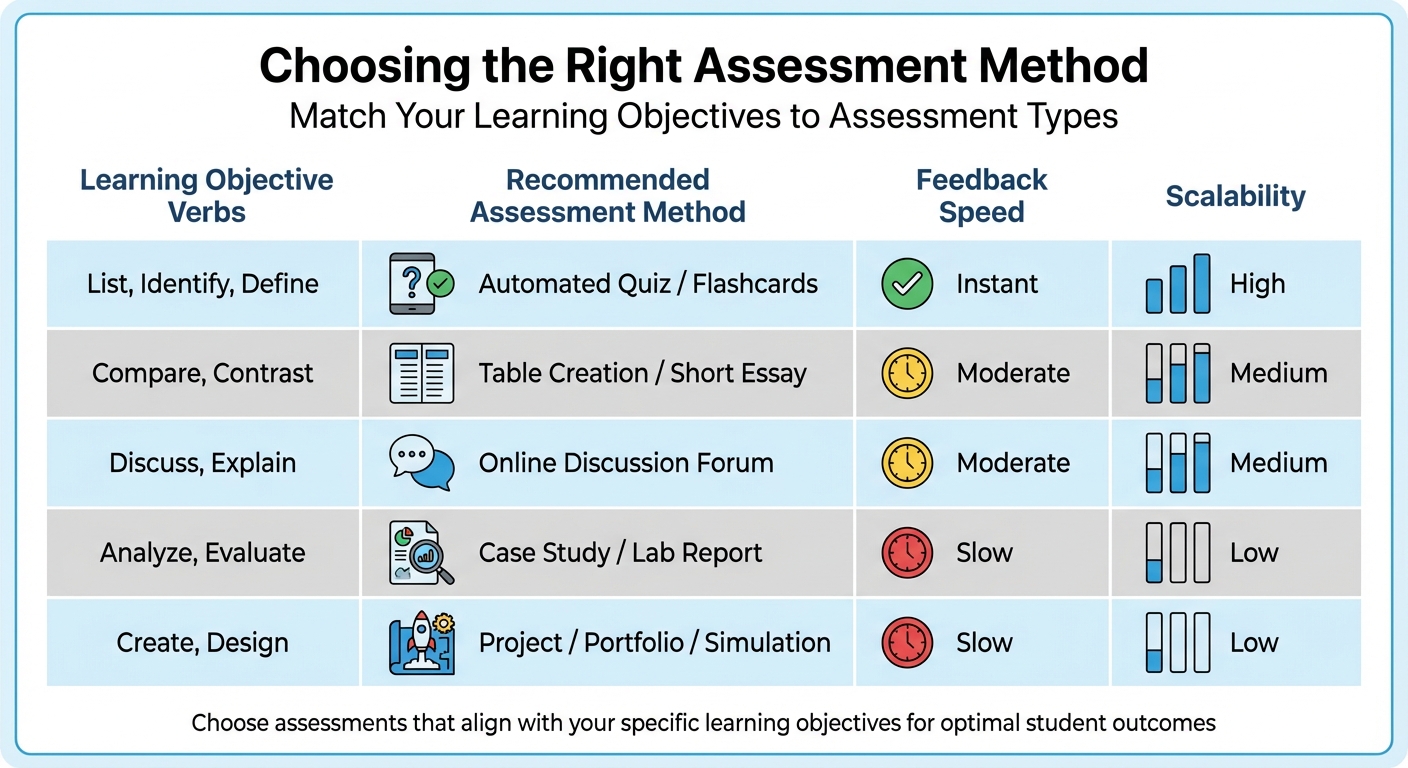
Comparison of Online Assessment Types: Methods, Feedback Speed, and Scalability
Selecting the right type of assessment is crucial for creating a focused and effective online learning experience. Building on the variety of assessment methods we've explored, this section focuses on how to align assessment types with your specific learning goals.
Start by defining clear learning objectives. Your chosen assessment methods should directly measure these objectives. As NC State University notes:
Online assessment does not necessarily need to follow the assessment methods you would use for the face-to-face version of the course.
This flexibility allows for assessments tailored to measure what truly matters.
Matching Assessments to Learning Objectives
The action verbs in your learning objectives can guide your choice of assessment. For example, if students are expected to "list" or "identify" concepts, automated quizzes are a great fit - they provide instant feedback and are easy to scale. However, if the goal is to "analyze" or "evaluate", more in-depth methods like case studies or lab reports are better suited to encourage critical thinking.
Break complex skills into smaller steps. By dividing a complex skill into incremental milestones - such as outlining, drafting, peer reviewing, and finalizing - you can provide timely feedback at each stage.
Using a mix of formative and summative assessments can help reduce stress while still measuring mastery. For instance, formative tasks like weekly quizzes or reflective exercises allow students to track their progress without added pressure. Meanwhile, summative assessments, such as final projects, evaluate their overall understanding. Even low-stakes formative tasks should contribute to the grade to encourage participation.
Once your objectives are set, compare assessment methods to determine which provides the right balance of feedback speed and scalability.
Assessment Methods Compared
Each type of assessment serves a different purpose, and understanding their strengths and limitations can help you design a balanced course. Automated quizzes are excellent for testing basic recall in large classes due to their scalability and instant feedback. On the other hand, essays and open-ended questions are better for evaluating critical thinking and creativity, though they require more time to grade. Projects and portfolios are ideal for assessing real-world application and synthesis but need clear rubrics and structured guidance to be effective.
| Learning Objective Verb | Recommended Assessment Method | Feedback Speed | Scalability |
|---|---|---|---|
| List, Identify, Define | Automated Quiz / Flashcards | Instant | High |
| Compare, Contrast | Table Creation / Short Essay | Moderate | Medium |
| Discuss, Explain | Online Discussion Forum | Moderate | Medium |
| Analyze, Evaluate | Case Study / Lab Report | Slow | Low |
| Create, Design | Project / Portfolio / Simulation | Slow | Low |
For high-stakes assessments - those that count for more than 20% of the final grade - consider whether proctoring is necessary or if an open-book format might better align with your learning objectives. Open-book assessments can emphasize application over rote memorization. Always provide students with rubrics in advance so they know exactly what is expected for success.
Conclusion
Choose a thoughtful combination of assessments that align directly with your learning goals. Research shows that spaced assessments can significantly improve long-term retention. Incorporating a mix of formative quizzes and summative projects provides learners with varied, low-pressure opportunities to build and demonstrate their understanding.
The trend toward learning-centered assessments has proven effective. Students tend to engage more when assessments reflect the kinds of challenges they'll face in their future careers. Whether it's automated quizzes offering instant feedback on foundational concepts or portfolio projects showcasing applied skills, each type of assessment brings unique value to the learning process.
FAQs
How do I choose the best assessment type for my online course?
To select the best assessment type, start by pinpointing your course objectives and identifying the specific skills or knowledge you want students to showcase. Align these goals with assessment methods that best capture evidence of learning. For instance, quizzes work well for testing factual recall, projects are great for demonstrating the application of concepts, and peer reviews can highlight collaboration and critical thinking abilities.
Practical considerations are just as important. Decide whether the assessment should be completed live (synchronously) or at the student's convenience (asynchronously). Factor in grading time and ensure your learning platform has the necessary tools to support the assessment. Features like randomized questions or plagiarism detection can help maintain academic integrity. And don’t forget - meaningful feedback is crucial for helping students understand their progress and areas for improvement. Running a small-scale trial of your assessment can also help you fine-tune it before rolling it out across the entire course.
What are the advantages of using automated quizzes in online learning?
Automated quizzes offer instant feedback, helping learners quickly grasp what they’ve mastered and where they need improvement. This quick response not only clarifies misunderstandings but also reinforces important concepts, making it easier to retain information over time.
For educators, these quizzes are a huge time-saver, removing the hassle of manual grading. This means teachers can dedicate more energy to teaching while efficiently managing assessments for larger groups without losing accuracy or fairness. Plus, the data gathered from these quizzes provides valuable insights - tracking progress, spotting patterns, and fine-tuning course materials based on real needs.
Frequent, low-pressure quizzes also play a key role in keeping learners motivated. By giving them regular chances to see their progress, these quizzes encourage active participation and keep learners engaged in their studies.
How do peer reviews and self-assessments improve online learning?
Peer reviews open the door to collaboration and sharpen critical thinking by encouraging students to evaluate each other’s work and share constructive feedback. This not only deepens their grasp of the subject matter but also hones practical skills, such as giving and receiving feedback - abilities that are invaluable in any career setting.
Self-assessments, on the other hand, give students the tools to monitor their own progress, pinpoint areas that need work, and set personal goals. By reflecting on their learning journey, they take charge of their development and maintain motivation throughout the course.
Together, these approaches promote active participation, thoughtful analysis, and a sense of independence, making online learning more engaging and meaningful.