

Top AI Search Visibility Solutions Used in the US in 2027
A buyer in Chicago asks ChatGPT which project management tool suits a 20-person agency. A shopper in Austin reads a Google AI Overview before clicking a single link.
Neither of them sees a list of ten blue results first, and neither tells your analytics which brands the AI recommended.
That gap is now a mainstream problem. In a February 2026 Pew Research Center survey, 60% of US adults said they read the AI summaries at the top of search results, and about half of US adults now use AI chatbots.
If your brand is missing from those answers, or described inaccurately, rankings alone will not show it. AI search visibility tools exist to close that blind spot.
Key Takeaways
- AI search visibility tools run real prompts through engines such as ChatGPT, Google AI Overviews, Google AI Mode, Gemini and Perplexity, then record which brands are mentioned, which pages are cited and how each brand is described.
- Semrush is a search visibility platform that pairs AI visibility tracking with a full SEO toolkit, built on 317M+ AI prompts and 43 trillion backlinks, which makes it the strongest all-in-one pick for US marketing teams.
- Profound and Scrunch suit enterprise brands that want monitoring plus execution features, while Peec AI, SE Visible and OtterlyAI offer lower-cost, monitoring-first entry points.
- Mentions, citations and visits are different metrics. Track them separately, and use Google Search Console and GA4 alongside any paid tool.
- Pricing models vary widely, from per-prompt plans to per-engine add-ons and credit systems, so compare cost at the prompt volume you actually need.
What Is AI Search Channel Visibility?
AI search channel visibility is how often, how prominently and how accurately your brand appears in AI-generated answers. A traditional rank tracker tells you where a page sits on a results page. An AI visibility tool tells you whether ChatGPT or Gemini names your brand when a buyer asks a category question, which sources it cites, and whether the tone is positive, neutral or negative.
Each AI engine is its own channel. Google AI Overviews and Google AI Mode draw on Google's index. ChatGPT and Perplexity pull in live web results when they search. The same prompt can produce a different shortlist on each one, which is why most teams track several engines at once rather than relying on one.
Four metrics show up in nearly every tool:
- Brand mentions: how often your brand name appears in AI answer text.
- Citations: how often an answer links to your pages as a source.
- Share of voice: your share of mentions or citations compared with competitors for the same prompt set.
- Sentiment: whether the AI describes your brand positively, neutrally or negatively.
How We Chose These AI Search Visibility Solutions
We focused on platforms that US marketing teams actively buy and use, and checked every price, plan limit and engine list against each vendor's own pricing or product pages in November 2026. We did not rely on third-party roundups for any feature or price.
Each tool was assessed on four criteria:
- Engine coverage: which AI platforms it tracks, with priority on ChatGPT, Google AI Overviews, Google AI Mode, Gemini and Perplexity.
- Metric depth: mentions, citations, share of voice, sentiment and source analysis.
- Actionability: whether the tool helps you fix gaps (audits, content guidance, SEO data) or only reports them.
- Pricing transparency: whether a team can see what it will pay before booking a demo.
AI Search Visibility Tools Compared
1. Semrush
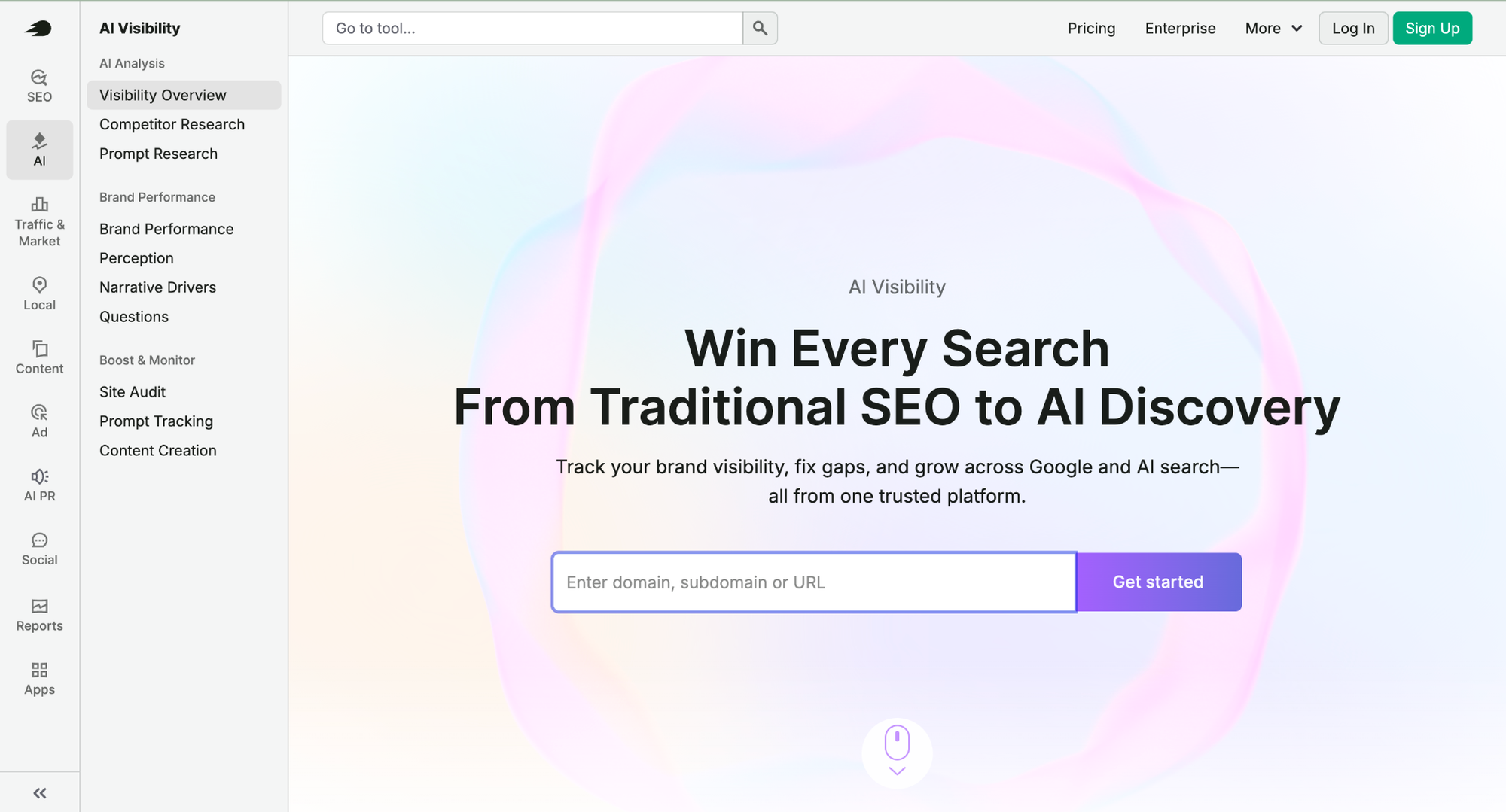
Semrush is a search visibility platform covering SEO, content, competitive intelligence, PPC and AI visibility. Its AI Visibility Toolkit shows where a brand appears in ChatGPT, Google AI Overviews, Google AI Mode, Gemini and Perplexity answers, next to the keyword and backlink data teams already use.
Best for: US marketing teams and agencies that want one source of truth for rankings and AI answers.
Key strengths:
- Scale of data: 317M+ AI prompts, 28B+ keywords, 43 trillion backlinks and 808M+ domain profiles.
- Local precision: Prompt Tracking runs daily across 220+ countries and territories, and Brand Performance offers 68,000+ location options, including cities and regions.
- Competitive and sentiment insight: Share of voice, sentiment and narrative drivers, plus prompts where rivals are cited and you are not.
- Enterprise AIO: For multi-brand, multi-market organizations, the enterprise tier adds custom large-scale prompt tracking, multi-brand AI visibility and API access.
Teams comparing options can see how Semrush brings AI visibility into the same workflow as rank tracking and an AI-ready Site Audit that checks whether AI crawlers can reach your pages. Semrush research also found the average AI search visitor is worth 4.4 times a traditional organic visitor, based on conversion rates.
Limitations: Daily prompt volume is tied to plan tier, with Starter covering 50 prompts, so teams tracking hundreds need the Advanced plan or Enterprise.
Pricing: Semrush SEO + AI Search plans start at USD 139 per month; the Starter plan tracks 50 prompts daily, and a seven-day free trial is available. See current plans and pricing.
2. Profound
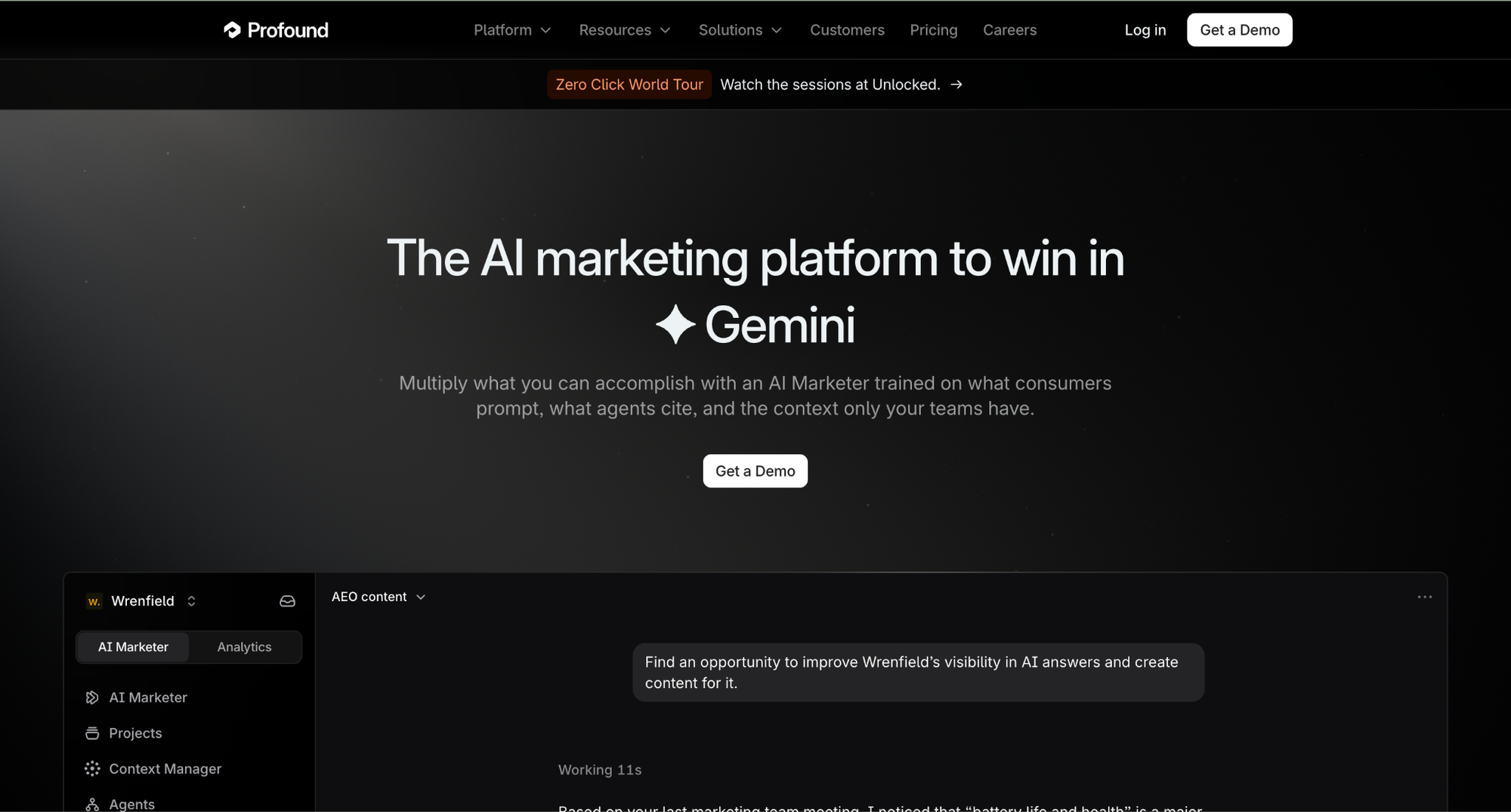
Profound is a New York-based answer engine optimization platform built for large brands that want monitoring and execution in one place. It tracks up to 10 answer engines, including ChatGPT, Perplexity, Google AI Mode, Google AI Overviews, Gemini, Claude and DeepSeek.
Best for: Enterprise marketing teams with budget for a dedicated AI search platform and staff to run it.
Profound's pitch is that measurement alone is not enough. Its platform is designed to show what AI engines say about a brand and then help teams change it, which is why it leans toward large organizations with content and engineering resources.
Key strengths:
- Execution layer: Profound Agents turn visibility data into marketing tasks, such as drafting content, rather than leaving teams with a report alone.
- Commerce coverage: The Enterprise plan includes ChatGPT Shopping visibility, useful for US retail and ecommerce brands.
- Enterprise controls: Unlimited seats and domains, SSO/SAML, SOC 2 compliance, API access and CSV or JSON exports.
- Backing: Founded in August 2024, Profound raised a USD 180 million Series D at a USD 1.8 billion valuation in September 2026.
Limitations: Profound retired its self-serve Starter and Growth plans in September 2026, so pricing is now custom only. It also has no keyword or backlink toolkit, so SEO work needs a separate platform.
Pricing: Custom Enterprise packages, available through a demo request.
3. Ahrefs Brand Radar
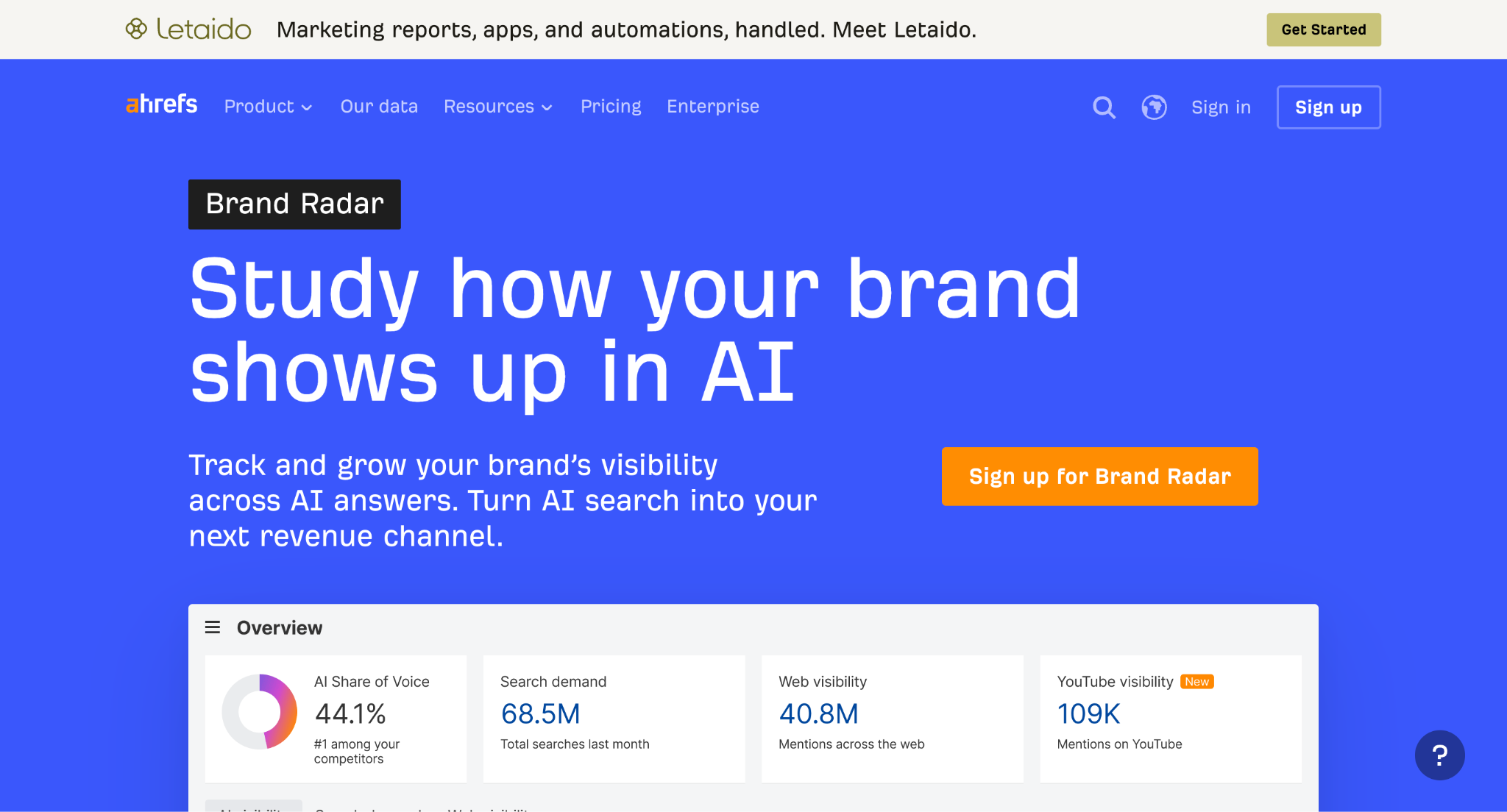
Ahrefs Brand Radar measures how brands appear across AI Overviews, AI Mode, ChatGPT, Copilot, Gemini and Perplexity. Its AI Visibility Index runs more than 500 million search-backed prompts, each modeled from real searches in Ahrefs' keyword database.
Best for: SEO teams that want to check any brand's AI visibility instantly, with no prompt setup.
Because the index is pre-built, Brand Radar is useful for competitive research on day one. You can benchmark a rival you have never tracked before, then move your most important buyer questions into Custom Prompts for daily monitoring.
Key strengths:
- No-setup research: Enter any brand and see its mentions, citations and AI share of voice across the index straight away.
- Search-weighted metrics: Estimated impressions weight visibility by the real search volume behind each prompt.
- Custom Prompts: Track your own buyer questions daily, with Claude available for custom prompts.
- Competitive context: Comparing a brand with rivals leads from an overview down to individual answers and the pages behind them.
Limitations: The AI Visibility Index is priced per AI index, so full coverage across all models runs around USD 699 per month. Brand Radar is sold separately from the wider Ahrefs SEO suite, so costs stack for teams that need both.
Pricing: Custom Prompts start at USD 50 per month, and the AI Visibility Index starts at USD 199 per month per index.
4. Peec AI
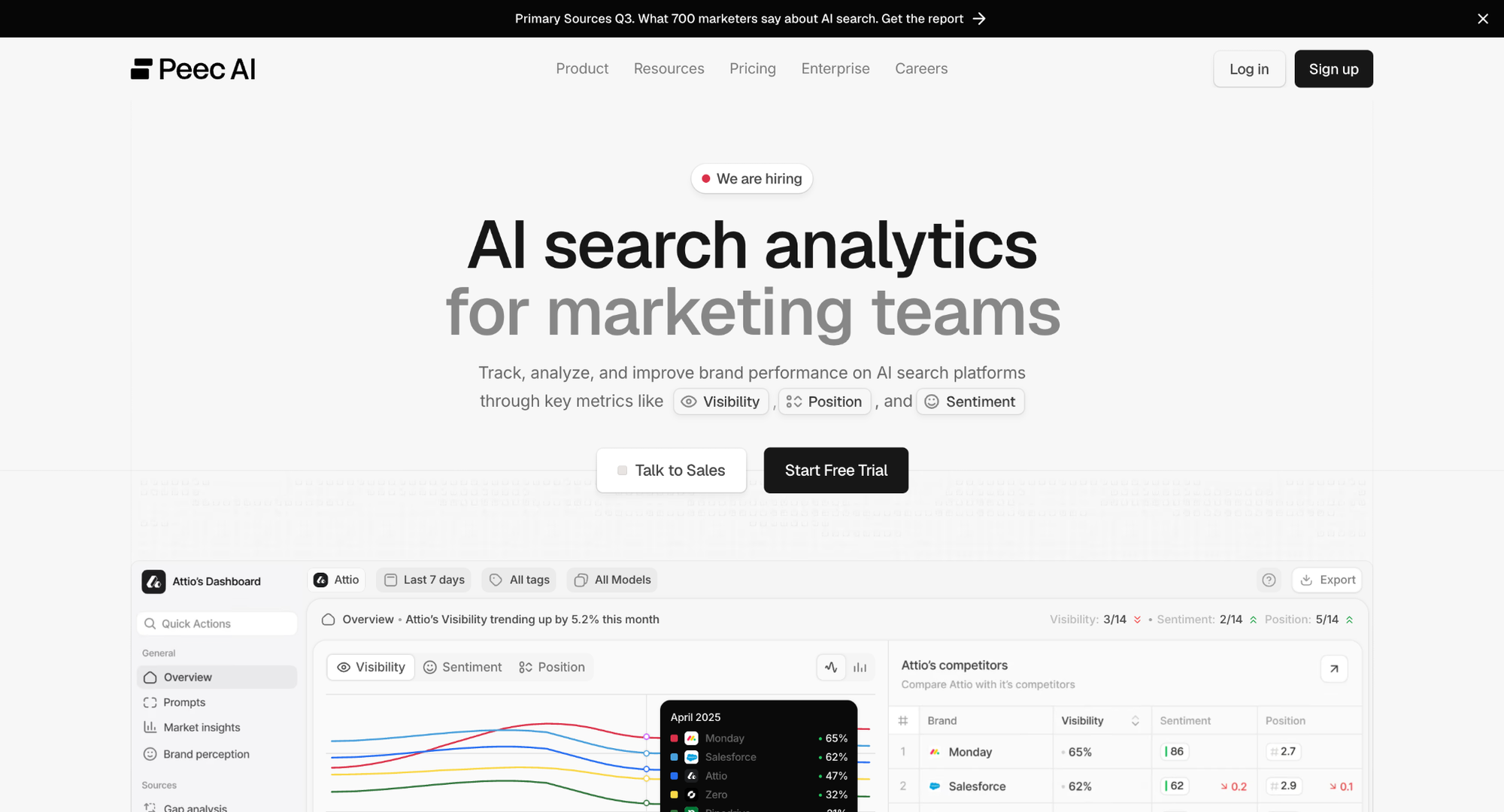
Peec AI is an AI search analytics platform that tracks visibility, position, sentiment and cited sources. Founded in Berlin, it raised a USD 21 million Series A in November 2025 and announced plans to open a New York office.
Best for: Agencies and in-house teams that need many people in the dashboard without per-seat fees.
Peec AI says it focuses on product design and data precision, with a narrow focus on AI search analytics. That makes it simple to roll out across a team, though it means pairing it with a separate SEO platform for keyword and technical work.
Key strengths:
- Unlimited seats on every plan, plus unlimited languages.
- Daily tracking on all self-serve plans, with Starter producing about 4,500 AI answers per month.
- Flexible engine choice: Pick 3 of 8 models, including ChatGPT, Perplexity, AI Overviews, AI Mode, Gemini and Bing AI Mode.
- Enterprise breadth: Enterprise plans can track up to 26 models, adding Claude, DeepSeek, Mistral and Grok.
Limitations: Self-serve plans are capped at three models, with each extra model costing USD 30 to 140 per month depending on plan. Peec AI is analytics-focused, with no keyword research or site auditing.
Pricing: Starter at USD 95 per month (50 prompts) and Pro at USD 245 per month (150 prompts), with 15% off annual billing.
5. Scrunch
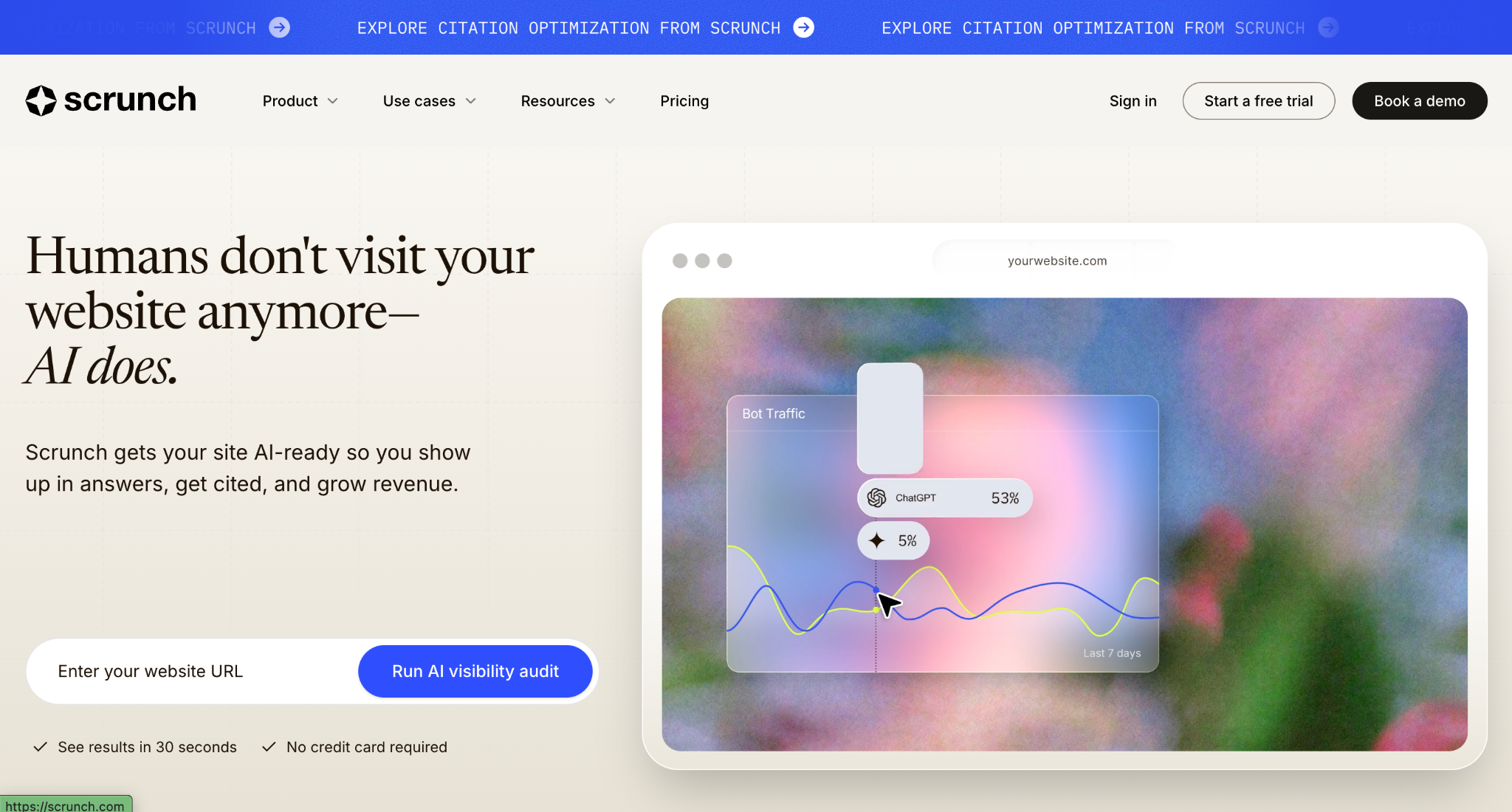
Scrunch is a Salt Lake City-based AI customer experience platform, acquired by Sitecore in June 2026. It monitors eight platforms: ChatGPT, Perplexity, Gemini, Google AI Overviews, Google AI Mode, Microsoft Copilot, Grok and Meta AI.
Best for: Enterprise brands that want to shape what AI agents read, not only measure what they say.
Scrunch stands out for treating AI crawlers as a distinct audience. Instead of only reporting on answers, it focuses on the content those crawlers receive, an approach that fits brands already invested in a digital experience platform.
Key strengths:
- Agent Experience Platform (AXP): Serves a machine-readable version of your site to AI crawlers and agents without changing the human-facing site.
- Optimization built in: The Core plan includes 15,000 AI responses, 10 citation targets and 10 pages optimized per month.
- Integrations: Data exports and MCP on Core, with API access and Data Studio on Enterprise.
- Standalone or integrated: Sitecore has said existing customers can keep using Scrunch as a standalone product.
Limitations: AXP Agent Pages and Claude tracking are Enterprise-only, and Core is limited to one brand and five seats.
Pricing: Core starts at USD 250 per month with a seven-day free trial. Enterprise pricing is custom.
6. AthenaHQ
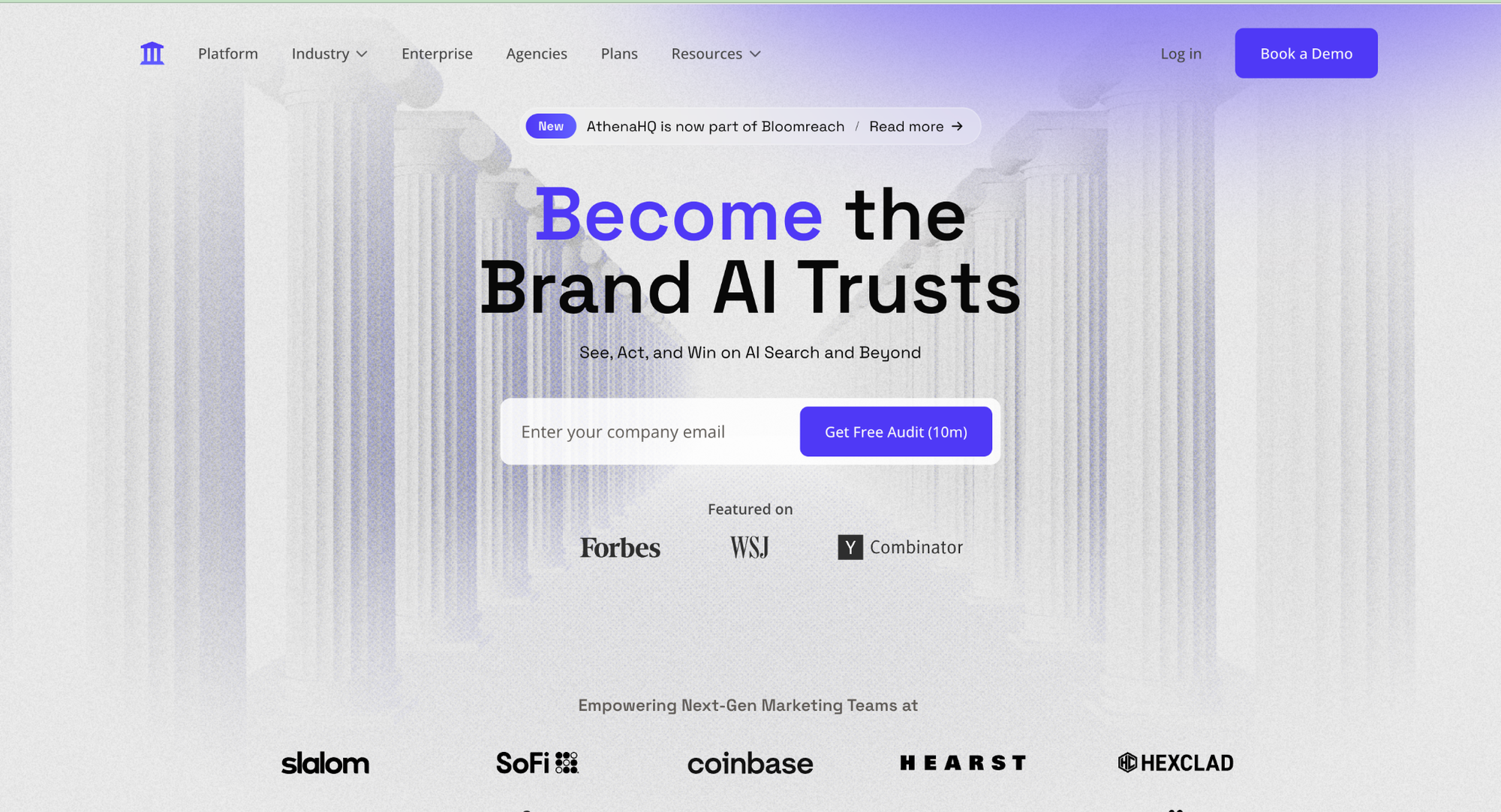
AthenaHQ is a generative engine optimization platform that combines tracking with content recommendations. Its Starter plan covers 11 models: ChatGPT, Perplexity, AI Overviews, AI Mode, Gemini, Claude, Copilot, Grok, DeepSeek, Meta AI and Mistral.
Best for: Content-led teams that want tracking and guidance on what to publish next.
AthenaHQ has one of the widest model lists among self-serve tools, which matters for brands whose audiences use newer assistants such as Grok, DeepSeek or Meta AI. The free tier also lets teams test the workflow before committing budget.
Key strengths:
- Free entry point: The Essential plan is free and includes 300 credits across five engines.
- No caps on scope: Starter includes unlimited topics, prompts and competitors, plus country-level support.
- Action tools: A content optimization agent and on-page and off-page actions turn gaps into tasks.
- Enterprise extras: The Athena Citation Engine, multi-region support, SSO and a two-hour SLA.
Limitations: Pricing is credit-based, where one credit equals one AI response, so tracking many prompts daily across 11 models uses credits quickly. API access costs extra.
Pricing: Free Essential plan; Starter at USD 295 per month with 3,600 credits; 17% off annual billing.
7. SE Visible
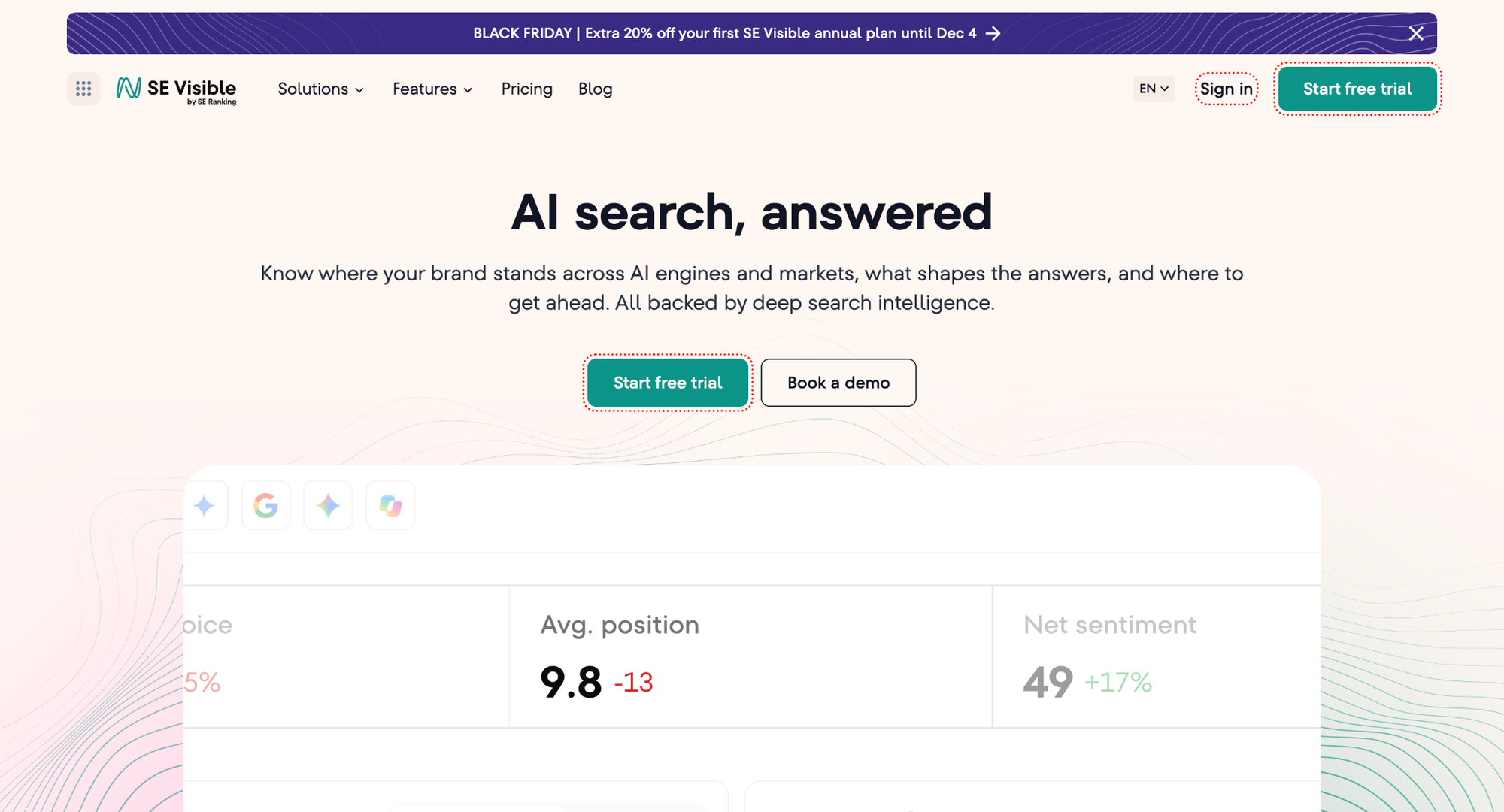
SE Visible is the AI visibility platform from SE Ranking. It tracks ChatGPT, Gemini, Google AI Overviews, Google AI Mode and Copilot, and links every metric to the unedited AI answer behind it.
Best for: Teams that need to show stakeholders the exact AI answers behind every number.
That answer-level transparency helps when leadership questions a sudden dip in visibility. Teams already using SE Ranking for traditional SEO can keep both views close together, since the products come from the same company.
Key strengths:
- Core metrics: Visibility, share of voice, average position and net sentiment in one dashboard.
- Source analysis: Shows which domains and URLs AI engines cite, ranks pages citing competitors but not you, and adds traffic and backlink data.
- Data access: API on all plans, a Data Studio connector and an MCP integration.
- Low-risk trial: A 14-day free trial on every paid plan.
Limitations: Claude tracking is limited to the Agency plan, and local AI visibility and query fan-out analysis are still listed as coming soon.
Pricing: Basic is listed at USD 71 to 89 per month depending on billing term (75 prompts), Core at USD 151 to 189 (200 prompts) and Agency at USD 319 to 399 (1,000 prompts).
8. OtterlyAI
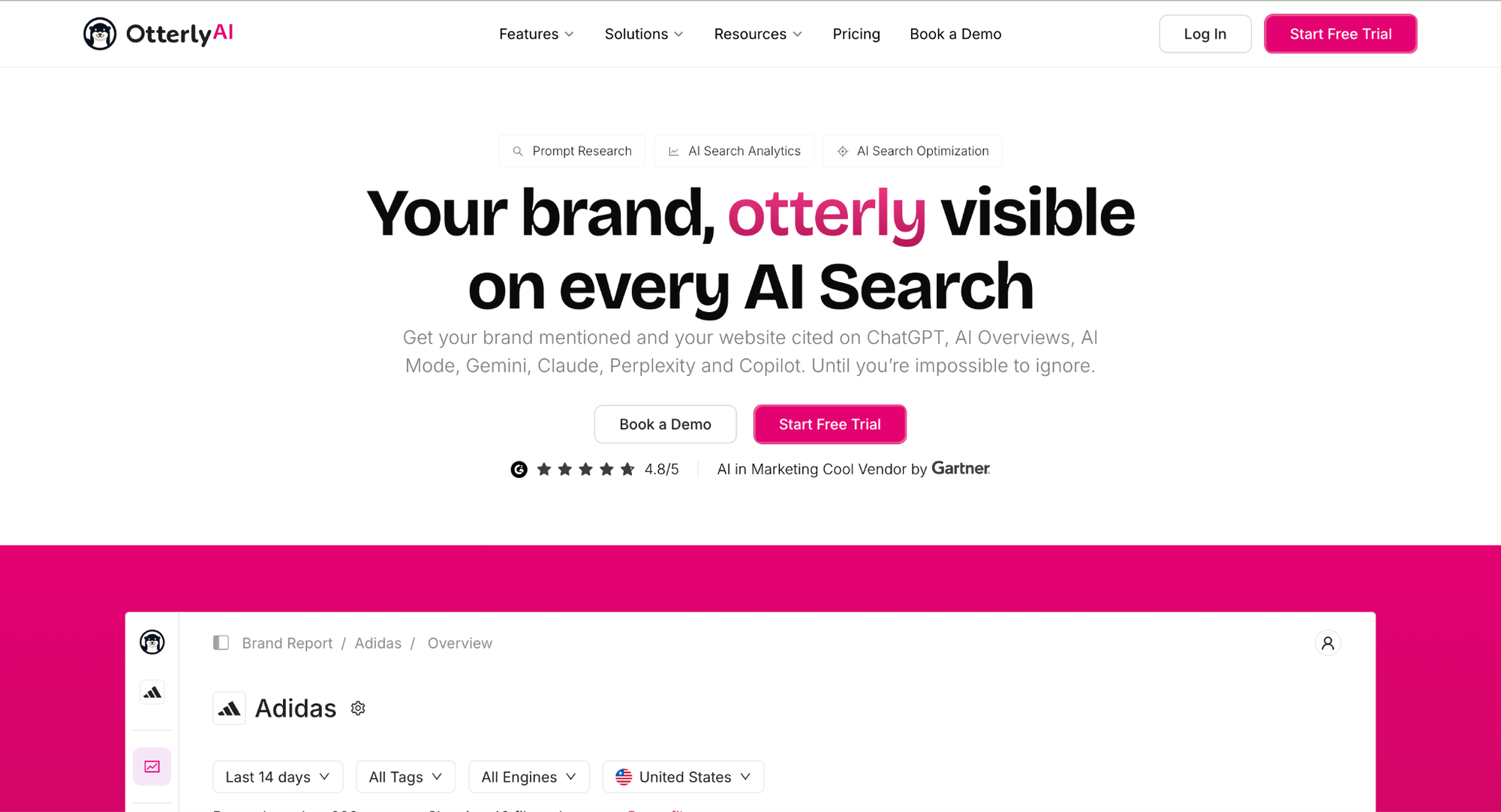
OtterlyAI is a monitoring-first tool for brand mentions and citations across seven engines: ChatGPT, Google AI Overviews, Google AI Mode, Gemini, Perplexity, Microsoft Copilot and Claude.
Best for: Small businesses and solo marketers who want a low-cost start.
OtterlyAI works well as a first step into AI visibility tracking. A small team can monitor its core prompts, learn how mentions and citations behave on each engine, and decide later whether it needs a larger platform.
Key strengths:
- Low entry price: The Lite plan has the lowest paid entry price on this list.
- Daily tracking on every self-serve plan.
- Broad engine list, including Claude and Copilot, which some entry tools skip.
- Free trial on Lite, Standard and Premium.
Limitations: It runs on credits, and each Claude answer counts as three credits. Lite covers only 16 prompts, and the platform offers no keyword research or backlink data.
Pricing: Lite at EUR 29 per month (16 prompts), Standard at EUR 189 (120 prompts) and Premium at EUR 489 (403 prompts). Prices are listed in euros.
How Do You Choose the Right AI Search Visibility Solution?
Start with the job, not the dashboard. Teams that already run SEO in one platform usually get the most from a tool that adds AI visibility to existing keyword and backlink work. Teams with large AI budgets and dedicated staff may prefer a specialist platform with execution features.
Ask these questions before subscribing:
- Which engines matter to your buyers? Most US teams should cover ChatGPT, Google AI Overviews and Google AI Mode at a minimum.
- How many prompts do you need? A focused set of 50 to 100 prompts covers most single-brand programs. Agencies need far more.
- How is each metric defined? A percentage of sampled answers that mention a brand is not the same as visits to its website.
- Can you act on the data? Look for source analysis, content guidance or site audits, not just charts.
- What does it cost at your real volume? Per-engine pricing and credit systems can double the sticker price.
Acting on the data is a skills job as much as a technical one. AI engines favor pages that answer a question directly, in clear paragraphs with specific facts, and building that habit across a team takes deliberate practice. This guide to personal development covers goal-setting and habit-building methods that help marketers grow those skills. A team that writes structured, factual pages will see more benefit from any of these tools.
How Should You Measure AI Search Results?
Keep three numbers separate. A mention means the AI named you. A citation means it linked to your page. A visit means someone clicked. Paid tools measure the first two well, but they do not see your traffic.
Google now covers part of that gap for free. It announced dedicated Generative AI performance reports in Search Console on June 3, 2026, and rolled them out to all websites worldwide as of August 31, 2026.
The reports show impressions in AI Overviews and AI Mode by page, country, device and date, though they do not include click data.
For visits, use the Traffic acquisition report in GA4 and filter by session source to isolate referrals from ChatGPT, Perplexity and other AI services. Then check conversions separately to see whether those visitors took the action you wanted.
Finally, keep a dated log of page edits. AI answers shift from week to week, so compare the same prompts, engines and settings over time before drawing conclusions.
Conclusion
AI answers are now a real discovery channel for US buyers, and every tool on this list helps you see it more clearly. The right choice depends on whether you need an all-in-one platform, an enterprise execution suite or a simple monitor.
For most US marketing teams, the deciding factor is whether AI visibility data sits next to the SEO data they already act on every day. Start with a focused prompt set, measure mentions, citations and visits separately, and review the trend monthly.
Frequently Asked Questions
What is the difference between a brand mention and a citation in AI search?
A mention is your brand name appearing in the AI answer text, while a citation is a clickable link to your page as a source.
Which AI search visibility tool includes a full SEO toolkit?
Semrush combines AI visibility tracking with keyword research, backlink analysis, rank tracking, site audits and PPC tools in one platform.
Can I track AI search visibility for free?
Yes, partly. Google Search Console's Generative AI performance reports show impressions in AI Overviews and AI Mode at no cost, and Semrush and AthenaHQ both offer free plans with limited AI visibility features.
Do AI visibility tools show how much traffic ChatGPT sends me?
No. They track mentions and citations, so use GA4's Traffic acquisition report to measure actual visits from AI services.
How often should I check my AI search visibility?
Most tools update daily, but reviewing trends weekly or monthly gives a more reliable picture, because individual AI answers change often.