

SEO Scout Review 2026: Features, SEO Testing & Is It Worth It?
SEO Scout combines keyword research, content optimization, rank tracking and SEO testing in one platform. Explore how it works, its key features and whether it fits your SEO workflow in 2026.
SEO tools are very good at giving us more data.
Rankings. Impressions. Clicks. Search volume. CTR. Keyword difficulty. Content scores.
The harder part is knowing what to do with all of it.
You might know that an article has dropped from position 6 to position 12. But why? Should you rewrite it? Change the title? Add internal links? Target additional keywords? Or is another page on your own website competing with it?
That's the problem SEO Scout is designed to help solve.
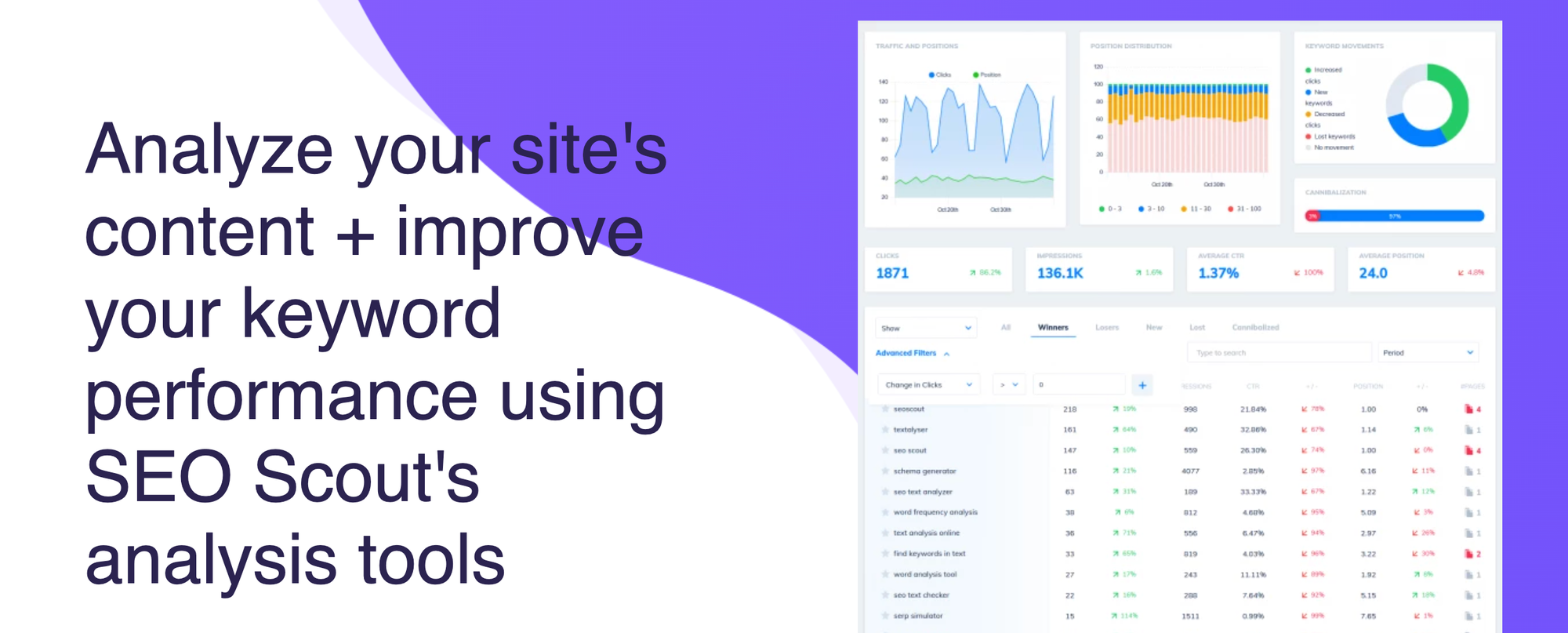
SEO Scout is an SEO analysis and optimization platform that combines keyword research, content optimization, rank tracking, internal-link analysis, keyword cannibalization detection and SEO testing. By connecting with Google Search Console, it can also work with your website's actual search-performance data rather than relying entirely on estimated keyword metrics.
The result is a platform designed not just to tell you what is happening with your SEO, but to help you identify what might be worth improving next.
TL;DR: SEO Scout is best suited to marketers, SEO professionals, content teams and website owners who already have organic search data and want to systematically improve existing performance. Its biggest differentiator is the combination of Google Search Console data, content optimization and SEO testing, allowing teams to identify opportunities, make changes and then measure whether those changes actually worked.
Key Takeaways
- SEO Scout combines research and optimization in one workflow. Keyword research, content optimization, rank tracking, internal linking and SEO testing can all be managed within the same platform.
- Google Search Console integration is central to the platform. SEO Scout can use real impressions, clicks, positions and queries from your website to identify opportunities.
- SEO testing is one of its most interesting features. Teams can test changes to titles, meta descriptions and page elements and monitor their impact on organic performance.
- It is particularly useful for improving existing content. Rather than constantly searching for new keywords, SEO Scout can help uncover pages and queries where your site already has visibility but may have room to improve.
- SEO Scout won't replace SEO judgement. Its recommendations can highlight gaps and opportunities, but marketers still need to understand search intent, audience needs and business priorities.
What Is SEO Scout?
SEO Scout is an SEO platform designed to help marketers research keywords, optimize content, monitor organic performance and test SEO changes.
Its feature set covers several stages of the SEO process:
| SEO Area | What SEO Scout Does |
|---|---|
| Keyword Research | Finds keyword ideas, questions and long-tail opportunities |
| Topic Research | Identifies related topics, entities and questions |
| Content Optimization | Compares content against competing pages |
| Rank Tracking | Tracks keyword performance through Search Console |
| SEO Testing | Measures the impact of SEO changes |
| Keyword Cannibalization | Finds queries where multiple URLs may be competing |
| Internal Linking | Identifies internal-linking opportunities |
| Performance Reporting | Highlights new, lost, rising and falling keywords |
SEO Scout connects with Google Search Console for several of its performance features, allowing users to analyse the search queries their website is actually appearing for.
That changes the conversation slightly.
Instead of only asking:
"What should we try to rank for?"
you can start asking:
"Where are we already getting visibility, and how can we turn more of that visibility into traffic?"
For an established website, that can be a much more useful place to start.
Why Does an SEO Tool Like SEO Scout Matter in 2026?
SEO has changed considerably from simply putting a target keyword into a title, heading and first paragraph.
Search results are more competitive. Search intent matters more. Content libraries are getting larger. AI has made producing content considerably faster, while Google and other discovery platforms have become better at evaluating whether that content genuinely answers what people are looking for.
That creates a different problem for marketers.
Publishing more isn't necessarily the answer.
Sometimes the better opportunity is sitting inside the content you already have.
An article ranking in positions 8–15 may need an update.
A page receiving thousands of impressions but few clicks may need a better title.
Two articles might be competing for the same search intent.
An important page may barely have any internal links pointing toward it.
SEO Scout is designed to surface these kinds of opportunities using a combination of site analysis and Search Console data.
Key takeaway: Modern SEO isn't only about finding more keywords. Increasingly, it's about understanding where your existing search visibility is underperforming and deciding what to improve.
What Are SEO Scout's Best Features?
SEO Scout covers a fairly broad SEO workflow, but not every feature will matter equally to every user.
Here are the areas where it becomes particularly useful.
1. SEO Testing
One of SEO Scout's more distinctive capabilities is its SEO testing functionality.
Think about how SEO changes normally happen.
You notice that a page isn't performing.
You change the title.
Three weeks later, you vaguely remember making the change but aren't entirely sure whether performance improved because of it.
SEO Scout tries to make that process more measurable.
Users can test changes to elements including:
- Page titles
- Meta descriptions
- Heading tags
- Page content
- Structured markup
- Other on-page elements
SEO Scout then monitors Search Console performance following the change.
Best for: SEO teams that regularly optimize existing pages and want evidence about whether their changes actually helped.
2. Keyword Rank Tracking
Most rank trackers begin by asking:
Which keywords do you want to track?
That sounds reasonable until you realise your website might appear for thousands of long-tail variations you never thought to add.
SEO Scout takes a Search Console-led approach.
By connecting Google Search Console, users can monitor a much broader range of keywords their website actually appears for and group related search terms together.
That means you can monitor:
- New keywords
- Lost keywords
- Rising keywords
- Falling keywords
- Changes in clicks
- Changes in impressions
- Changes in CTR
- Changes in average position
You can also group related phrases together.
This matters because modern SEO performance isn't always captured by one exact keyword.
Best for: Content-heavy websites that rank for large numbers of long-tail search queries.
3. Content Optimization
Content optimization can go wrong very quickly.
We've all seen articles where the "SEO strategy" appears to have been repeating the same keyword every few paragraphs.
That's not particularly useful for readers.
SEO Scout's content editor takes a broader approach.
It analyses pages already ranking for a target search and identifies relevant topics, concepts, entities and terms that appear across competing content.
You can then compare your own content against that landscape.
The useful question becomes:
"What have I failed to cover?"
rather than:
"How many more times should I mention my keyword?"
Best for: Writers and SEO teams that want more comprehensive content without relying on keyword stuffing.
4. Topic and Keyword Research
Keyword research sounds simple until you open a tool and receive 5,000 suggestions.
More data doesn't automatically make the decision easier.
SEO Scout's topic research combines traditional keyword suggestions with related questions and entities.
It can surface questions from sources including Google's People Also Ask and Google Suggest, helping marketers understand what people actually want to know around a topic.
Those ideas can then be organized into content plans and topic clusters.
That allows you to move from:
One keyword → one article
toward:
Core topic → supporting questions → related articles → internal links → topic authority
Best for: Content strategists building topic clusters and long-term organic content plans.
5. Keyword Cannibalization Detection
This problem tends to appear as websites grow.
Imagine you've published:
Best AI Marketing Tools
Six months later:
Top AI Tools for Marketers
And later:
Best AI Marketing Software
Each article seemed reasonable when it was created.
But Google may now see three pages competing for very similar search intent.
That's keyword cannibalization.
SEO Scout can identify search queries where multiple pages from the same website are appearing.
Once you've found them, you can investigate whether the pages should:
- Target different search intent
- Be consolidated
- Be redirected
- Be differentiated more clearly
- Use stronger internal linking
This is becoming increasingly important as AI makes producing large amounts of content easier.
Publishing faster can also mean accidentally publishing the same idea several different ways.
Best for: Established blogs and websites with large content libraries.
6. Internal Linking Analysis
Internal linking is one of those SEO jobs that sounds easy when your website has 30 pages.
At 3,000 pages, things become different.
You publish a new article and think:
"I'm sure we wrote something two years ago that should link to this."
Now you just have to find it.
SEO Scout's internal-link analysis helps identify pages that may be poorly linked and opportunities to connect related content.
This benefits both users and search engines.
Readers discover useful supporting information.
Search engines get clearer signals about how different pages and topics on your website relate to one another.
And important pages don't end up sitting somewhere on your site with almost nothing pointing toward them.
Best for: Publishers, ecommerce sites and content teams managing large websites.
Who Should Use SEO Scout?
SEO Scout is likely to provide the most value when your website already has enough organic visibility to analyse. SEO Professionals, Content Marketers, Bloggers and Publishers, Agencies and Ecommerce Teams
Who May Not Need SEO Scout?
Not every website needs another SEO platform.
If you've just launched a five-page website and have almost no Search Console data, many of SEO Scout's performance features won't have much information to work with yet.
Likewise, if your only requirement is occasionally finding keyword ideas, simpler free tools may be enough.
SEO Scout becomes more valuable when you have:
Existing content + existing search visibility + a need to systematically improve performance.
It is less compelling when you're starting completely from zero.
What Are the Pros and Cons of SEO Scout?
| Google Search Console | SEO Scout |
|---|---|
| Provides raw Google search-performance data | Organizes search data around SEO opportunities |
| Shows queries and pages | Helps identify gains, losses and optimization opportunities |
| Shows CTR | Helps identify underperforming pages and supports testing changes |
| Shows ranking queries | Adds keyword grouping and broader performance analysis |
| Doesn't provide content optimization | Includes topic and content-analysis tools |
| Doesn't provide SEO testing workflows | Includes dedicated SEO testing |
The important point is that SEO Scout isn't trying to make SEO completely automatic.
Nor should it. The strongest SEO decisions still require context.
A tool can tell you that two pages rank for the same keyword.
It can't automatically understand whether those pages serve genuinely different business purposes.
That's where human judgement still matters.
Is SEO Scout Good for Content SEO?
Yes, particularly for websites that already have a significant amount of published content.
Its combination of topic research, content optimization, Search Console analysis, cannibalization detection and internal-link analysis makes it especially relevant to content-led SEO strategies.
Consider the lifecycle of an article:
Research → Write → Publish → Rank → Analyse → Update → Test → Improve
Many SEO tools concentrate heavily on the first three stages.
SEO Scout becomes particularly interesting in the later stages.
What happened after publishing?
What queries appeared?
What did the page lose?
What new opportunities emerged?
Is another article competing with it?
Would changing the title improve CTR?
Those questions become increasingly important as a content library matures.
Final Verdict: Should You Use SEO Scout?
SEO Scout makes the most sense for marketers who have moved beyond asking:
"How do I get started with SEO?"
and are now asking:
"How do I make our existing SEO perform better?"
Its Search Console integration, content optimization, rank tracking, internal-link analysis, cannibalization detection and SEO testing create a useful workflow for finding and improving organic-search opportunities.
But the tool shouldn't make every decision for you.
That's not really the point.
The better way to use SEO Scout is as a diagnostic system.
It shows you where to look.
It gives you evidence.
It helps you measure what happened after you made a change.
You still decide what is worth changing and why.
And in 2026, when marketers have access to more SEO data and can create more content than ever before, knowing what deserves your attention may be more valuable than simply having another dashboard full of numbers.
Frequently Asked Questions About SEO Scout
What is SEO Scout used for?
SEO Scout is used for SEO research, content optimization, keyword tracking, internal-link analysis, keyword cannibalization detection and SEO testing. It also integrates with Google Search Console to analyse real organic-search performance.
Does SEO Scout replace Google Search Console?
No. SEO Scout uses Search Console data for several of its features. Search Console remains the underlying source of important Google search-performance data, while SEO Scout adds analysis, organization, optimization and testing capabilities around that information.
Can SEO Scout track keyword rankings?
Yes. SEO Scout's rank-tracking functionality uses Google Search Console data and allows users to monitor individual keywords as well as groups of related search terms.
Can you run SEO tests with SEO Scout?
Yes. SEO Scout allows users to test changes including titles, meta descriptions and other page elements and then monitor Search Console performance following those changes.
Does SEO Scout help with keyword cannibalization?
Yes. SEO Scout can identify keywords where multiple pages from the same website are appearing, helping marketers investigate potential keyword cannibalization.
Is SEO Scout useful for content writers?
It can be. Its topic-research and content-optimization tools identify relevant topics, entities, questions and terms found across competing content. Writers can use these insights to identify gaps while retaining editorial control over what belongs in the article.
Is SEO Scout suitable for small businesses?
It can be, particularly if the business already receives organic-search traffic and regularly produces content. Very small or new websites with little Search Console data may not immediately benefit from all of its analysis features.