

Best Online AI MBA Courses
Compare top online AI MBA programs by format, tuition, curriculum, and career outcomes to find the best fit for working professionals.
Artificial intelligence is reshaping how businesses operate, and MBA programs are evolving to meet this demand. AI-focused online MBA programs offer working professionals the chance to gain leadership skills tailored to AI-driven industries. These programs balance business strategy with AI knowledge, often providing flexible learning options and no GMAT requirements. Here's a quick look at some top programs:
- Carnegie Mellon (Tepper): Hybrid format with live classes and in-person weekends, offering a STEM-designated curriculum. Average graduate salary: $159,183.
- Northwestern (Kellogg): A 15-month program blending business and engineering, with a median total compensation of $212,500 for graduates.
- Arizona State (W.P. Carey): Fully online with an AI concentration, flexible start dates, and scholarships available. Tuition: $74,000.
- University of Delaware: Focused on generative AI applications, no technical background required. Tuition: $42,408.
- Villanova University: Offers a specialization in applied AI/ML, using low-code platforms. Tuition guarantees available for fast-track options.
- Northeastern University: Combines business and AI coursework with corporate residencies. Average graduate salary: $97,840.
Quick Comparison
| Program | Format | Tuition | Average Salary | Key Feature |
|---|---|---|---|---|
| Carnegie Mellon (Tepper) | Hybrid | High | $159,183 | STEM-designated, flexible hybrid structure |
| Northwestern (Kellogg) | Full-time | High | $212,500 | Business-engineering blend, 15 months |
| Arizona State (W.P. Carey) | Fully online | $74,000 | N/A | Flexible start dates, scholarships available |
| University of Delaware | Fully online | $42,408 | $103,820 | Generative AI focus, no coding required |
| Villanova University | Online | Varies | N/A | Low-code AI/ML specialization |
| Northeastern University | Full-time/Online | Varies | $97,840 | Corporate residency for hands-on experience |
These programs cater to various needs, from technical depth to business leadership. Choose based on your career goals, budget, and preferred learning style.
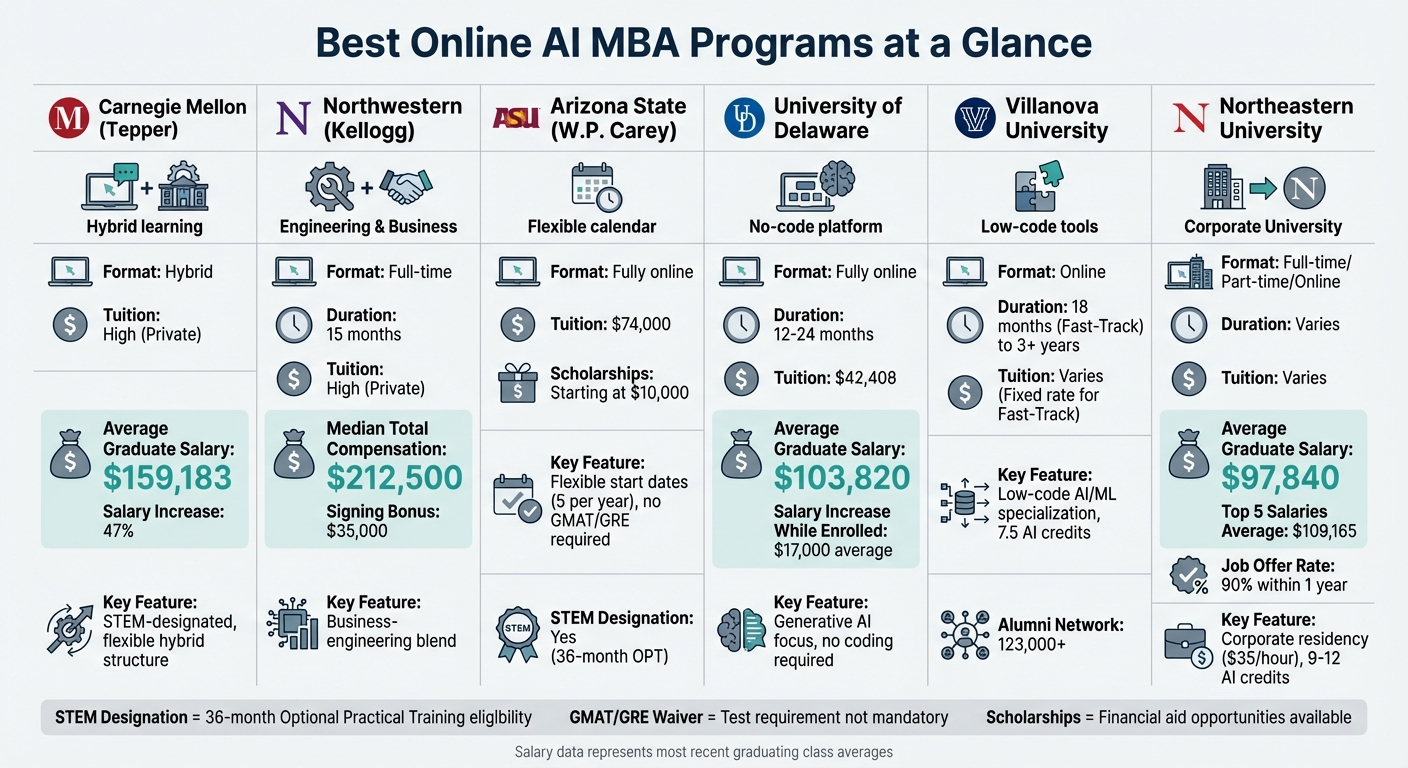
Top Online AI MBA Programs Comparison: Tuition, Salary, and Key Features
Master of Management in Artificial Intelligence - Program Overview | November 20, 2025
1. Carnegie Mellon University – Tepper School of Business
Carnegie Mellon's Tepper School of Business, ranked No. 2 by U.S. News & World Report and the Financial Times, brings the university's renowned computer science expertise into its business programs.
Program Format
The Online Hybrid MBA combines flexibility with structure. Students attend live classes twice a week in the evenings, paired with asynchronous coursework. Additionally, the program includes in-person Access Weekends held in Pittsburgh and other select U.S. cities. Amarachi Ude, an MBA candidate and Industrial Engineer at FedEx Ground, highlights this unique approach:
"Tepper's responsiveness during the application process enhances its online community feel."
This STEM-designated program also offers an accelerated option for those with recent undergraduate business coursework, allowing participants to complete the degree one semester faster.
Curriculum Depth
The AI in Business concentration is a standout feature, requiring students to complete electives on topics like machine learning applications, AI ethics, and product design. These courses integrate technical expertise with strategic thinking across areas such as marketing, finance, and operations. The program wraps up with the Management Game, a dynamic capstone project where teams manage a simulated international manufacturing company.
Career Outcomes
Graduates see impressive results, with an average exit salary of $159,183 - a 47% increase from their starting point. Students also benefit from personalized coaching through the Accelerate Leadership Center. Alumni frequently move into roles such as AI product management, fintech, consulting, and marketing analytics, often at top technology and healthcare organizations.
The combination of a cutting-edge curriculum and strong career support underscores Tepper's ability to prepare leaders at the intersection of AI and business.
2. Northwestern University – Kellogg School of Management
Kellogg, ranked #8 by QS Global Rankings, offers a standout approach to merging AI expertise with business acumen.
Program Format
The MBAi program is a 15-month joint degree offered in partnership with the McCormick School of Engineering. It spans five quarters and includes a required 10-week summer internship. For working professionals, the Evening & Weekend MBA - set to launch in Fall 2025 - provides an AI and machine learning curriculum with flexible scheduling options.
This structure allows students to balance technical precision with essential business skills, offering a seamless blend of both worlds.
Curriculum Depth
Kellogg’s curriculum has been thoughtfully redesigned to meet the demands of AI-driven roles. Core courses such as Business Analytics, Financial Accounting, and Marketing Management now incorporate technical depth. The program is structured around three main components:
- MBA Core: Focuses on foundational business principles.
- Technical Core: Includes hands-on courses like "Computational Thinking for Business Leaders."
- Integrated Core: Emphasizes experiential learning and ethical decision-making.
Students also complete a Capstone Product Lab, collaborating with Master of Science in Artificial Intelligence students to tackle real-world challenges. Past projects have involved companies like Accenture, Adobe, Google, Microsoft, and Walgreens. For instance, in 2023, Lincoln Holt worked on a capstone project for John Deere, applying AI solutions to agricultural issues, which led directly to a full-time role.
Career Outcomes
Graduates of the MBAi program report impressive outcomes, with a median total compensation of $212,500, including a $35,000 signing bonus. The program equips leaders to bridge the gap between the C-suite and technical teams.
Take Amna Mahmud, a 2023 graduate, who transitioned from consulting to a role at Amazon by leveraging the program’s emphasis on cross-functional communication. Other alumni have landed roles such as Senior Product Manager, Technical Product Manager, and Director of Technical Oversight at top companies like Amazon, Bain & Company, Boston Consulting Group, NVIDIA, and ServiceNow. These results highlight Kellogg’s dedication to preparing professionals for leadership roles in the AI-driven business world.
3. Arizona State University – W.P. Carey School of Business
Arizona State University's W.P. Carey School of Business is embracing the transformative power of AI with a curriculum designed to prepare future business leaders. Ranked No. 8 by U.S. News & World Report, the W.P. Carey Online MBA has consistently placed in the top 10 for over a decade (2012–2026). In a bold move four years ago, ASU mandated AI integration across all programs, making W.P. Carey one of the first to introduce an AI concentration and a dedicated master's degree.
Program Format
The Online MBA with an AI concentration spans 24 months and is fully asynchronous, making it ideal for working professionals who need flexibility. With five annual start dates (August, September, January, February, May), students can start when it best fits their schedule. The program costs approximately $74,000, with scholarships starting at $10,000 to help offset expenses. Additionally, no GMAT or GRE scores are required for admission.
For a more technical focus, ASU offers the Master of Science in Artificial Intelligence in Business (MS-AIB). This standalone program costs $44,500 and can be completed in as little as 9 months or as long as 16 months, depending on the student's pace.
Curriculum Depth
The AI concentration builds on core business disciplines - such as accounting, finance, marketing, and supply chain management - while weaving in technical and ethical insights. Courses like "Decision Making with Data Analytics" train students to identify patterns in data and manage analytics-heavy environments. The curriculum also tackles topics like AI infrastructure management and the broader societal effects of AI adoption.
"With a concentration in AI, you'll harness data-driven insights, optimize decision-making processes, and innovate business models." - W. P. Carey School of Business
Full-time MBA students also benefit from a required summer internship between their first and second years, giving them valuable hands-on experience with potential employers. This practical approach complements the program's academic rigor, setting up graduates for success.
Career Outcomes
Graduates of this program are well-equipped to thrive in AI-focused business roles. Thanks to its STEM designation, international students on student visas can qualify for an Optional Practical Training (OPT) extension of up to 36 months. Alumni join a thriving network of over 130,000 W.P. Carey graduates and more than 650,000 ASU alumni worldwide.
The Career Services Center supports students with tools like the "Career Blueprint", offering personalized coaching and ongoing professional development. Full-time MBA students also gain access to the Executive Connections program, which pairs them with senior executive mentors. Megan Hucek, a full-time MBA graduate, reflected on her experience:
"Executive Connections was a huge part of my journey... I met with 4 to 6 different Executive Connections mentors throughout my first year alone. I think that gave me a leg up and allowed me to fine tune my resume, enhance my interviewing skills, and ultimately secure the internship I wanted."
Career opportunities for graduates with an AI concentration include roles like AI Project Manager, Business Transformation Consultant, AI Strategy Lead, and AI Entrepreneur.
4. University of Delaware – Online MBA in Artificial Intelligence
The University of Delaware's Lerner College of Business offers an Online MBA with a concentration in Artificial Intelligence, blending accessibility with a focus on practical applications of generative AI. Ranked #26 among Best Online MBA Programs by U.S. News & World Report, this AACSB-accredited program emphasizes real-world skills in AI without requiring a technical background.
Program Format
This 38-credit program can be completed in as little as 12 months for full-time students or up to two years for part-time students. The AI concentration consists of three targeted courses - Introduction to Generative AI (MISY 670), Generative AI for Business Analytics (BUAD 651), and Generative AI for Data Visualization (ECON 626) - totaling 9 credits.
Tuition is $1,116 per credit hour for the 2025–2026 academic year, bringing the total cost to approximately $42,408. The program operates on an academic calendar with five 7-week sessions and a 5-week winter session, offering multiple start dates throughout the year. Notably, GMAT or GRE scores are not required for admission, adding to its accessibility.
Curriculum Overview
What sets this program apart is its focus on practical AI applications, designed for students without prior technical experience. Participants learn to develop Large Language Model applications using low-code platforms and create media with diffusion models, gaining hands-on skills that are immediately applicable in business contexts.
"Become a leader in the use of generative AI to make business processes easier, faster and more efficient. No prior technical expertise is required, making the concentration ideal for working professionals."
- University of Delaware Lerner College
The AI concentration is built on a 29-credit core curriculum covering essential business areas like corporate strategy, financial management, marketing, and ethical leadership. This approach prepares students to strategically apply AI in business settings rather than focusing on complex coding.
Flexibility
This program is tailored for working professionals, with 94% of students employed during enrollment. Its asynchronous format allows students to access recorded lectures whenever it suits their schedules. The program also boasts a 100% one-year retention rate for new students, reflecting its supportive and flexible structure.
Career Outcomes
The program delivers measurable career benefits. Graduates from the class of 2024 reported an average salary increase of $17,000 while still enrolled, with those receiving raises seeing an average boost of $24,000. Lerner MBA graduates earn an average salary of $103,820, and 61% of students experienced a career change, promotion, or raise during the program.
Students also benefit from one-on-one career coaching, executive mentorship, and access to a global alumni network. Additionally, the university's location near major hubs like Washington, D.C., Philadelphia, and New York City provides valuable networking opportunities for those pursuing leadership roles in AI-focused industries.
5. Villanova University – Online Professional MBA in Applied Artificial Intelligence and Machine Learning
Villanova University's Villanova School of Business offers an Online Professional MBA program with a specialization in Applied Artificial Intelligence and Machine Learning. This 48-credit program takes a business-first approach, making AI more accessible to professionals by utilizing low-code/no-code platforms like Orange Data Mining, Dataiku, and IBM Watson.
Program Format
To earn the AI/ML specialization, students complete 7.5 credits of AI-focused courses within the 48-credit MBA program. The program offers three start dates annually - fall, spring, and summer - and provides flexible completion timelines. Students can choose the Fast-Track option, finishing in as little as 18 months, or take three or more years for a more gradual pace. The Fast-Track option also features a Fixed Tuition Guarantee, ensuring tuition rates remain steady throughout the 18-month period.
The online format blends live one-hour synchronous sessions with asynchronous assignments, giving students the flexibility to balance coursework with professional responsibilities. While the program is primarily online, students can opt for limited on-campus sessions at Villanova's designated locations.
Curriculum Depth
The curriculum is designed for practical, business-focused applications of AI. Students complete five core AI courses totaling 7.5 credits: AI Trends and the Future of Work, AI and ML Applications, Business Problems in AI/ML, Generative AI for Business Practitioners, and AI Ethics and Bias. A standout feature is the Business Problems in AI/ML course, where students create functional prototypes to solve real-world business challenges.
"Using low-code no-code platforms helped me better understand how AI/ML could be used to solve real-world business problems and learn how to fine-tune models to provide effective results." - Kara Skarda, Consultant, Business Analysis, Fidelity Investments
The curriculum follows the industry's trend toward making AI more accessible and integrates AI concepts into its "Future of Work" curriculum pillar. This includes courses in Data & Analytics, Emerging Technologies, and Innovation. Students also gain hands-on experience through the Social Enterprise Consulting Practicum and the Global Practicum, tackling challenges for nonprofits and multinational organizations.
Flexibility
This program is tailored for working professionals, offering asynchronous coursework alongside evening live sessions. Admissions are test-optional, meaning no GMAT or GRE scores are required.
"The Professional MBA is an MBA designed for working professionals that empowers you to personalize your learning." - Villanova University
Graduates earn a digital credential badge at no extra cost, which can be displayed on platforms like LinkedIn. They also join the "Nova Network", connecting with over 123,000 alumni worldwide.
Career Outcomes
With its specialized curriculum and adaptable format, this program equips graduates for a variety of roles in AI-driven business environments. Graduates gain skills in ethical AI leadership and hands-on application, preparing them for positions such as AI/ML project manager, data analyst, data scientist, researcher, and engineer. The AI Ethics and Bias course ensures students are well-versed in issues like algorithmic discrimination, legal challenges, and transparency in AI systems.
"The AI/ML specialization at Villanova has been instrumental in equipping me with the knowledge and skills to navigate the rapidly changing technological landscape in the business world. It has enabled me to bring data-driven insights and automation into my professional endeavors, setting me apart from my peers." - Raul M. Gutierrez, Business Development Manager, PepsiCo - Frito Lay North America
Graduates leave the program ready to build business cases for AI initiatives, measure outcomes, and promote "AI thinking" within their organizations - skills that are in high demand across industries.
6. Northeastern University – MBA x Artificial Intelligence Concentration
Northeastern University's D'Amore-McKim School of Business offers an MBA x Artificial Intelligence concentration, blending AI-focused coursework with its MBA programs. This program, created in partnership with the Khoury College of Computer Sciences, requires 9–12 credit hours of AI-specific studies and is available in Full-Time, Part-Time, and Online formats.
Program Format
This concentration is designed with a strong technical foundation, covering areas like heuristic search, game trees, natural language processing (NLP), and machine learning. For students without a computer science background, the program includes 16 bridge credits to build essential skills in coding and mathematics. This ensures every participant is well-prepared for the advanced coursework ahead.
"AI and machine learning are invaluable in business today, and I wanted to master their underlying math and concepts." - Javier Rosas-Ruiz, MBA'22
A standout feature is the Corporate Residency, where full-time students gain hands-on experience in MBA-level roles for 3 to 12 months. Partner companies include Amazon, Biogen, Cigna, Dell Technologies, and the Federal Reserve Bank of Boston. Students earn an average of $35 per hour during these residencies.
This combination of academic and practical learning ensures students are ready to apply advanced AI tools and concepts in real-world scenarios.
Curriculum Depth
The program emphasizes the mathematical principles behind AI algorithms, equipping students to turn data into actionable business solutions. A key component is the AI Strategic Hub Research Practicum, where students tackle real-world client challenges using data-driven approaches. This hands-on experience prepares graduates to handle AI governance, ethics, and large-scale deployment - skills that are increasingly in demand.
Career Outcomes
Northeastern graduates benefit from a mix of practical training, integrated industry modules, and corporate residencies, making them highly sought after by employers. Graduates often step into roles like business intelligence manager, senior data analyst, AI product manager, and solutions architect. Impressively, 90% of full-time MBA graduates received job offers within a year, with an average salary of $97,840. The top five salaries for the 2024 class averaged $109,165. With the World Economic Forum predicting 11 million new jobs in AI and data processing by 2030, Northeastern graduates are well-positioned for these opportunities.
"With Northeastern residents, we already know the quality of their work and the caliber of their education. We've challenged them, pressure-tested them, and given them tough assignments over six months on corporate residency... It just makes so much sense to hire them." - Raytheon
Pros and Cons
Every program has its own set of strengths and challenges, depending on factors like your career aspirations, budget, and preferred learning approach. Northwestern's Kellogg MBAi program combines business and engineering seamlessly, leading to impressive financial outcomes - $212,500 median compensation plus a $35,000 signing bonus. However, its full-time, five-quarter structure can be a hurdle for those needing more flexibility.
On the other hand, Nexford University stands out with its affordability - $300 per month, totaling approximately $2,700 for nine months. It emphasizes hands-on projects but lacks the brand recognition and alumni network of more established institutions. Meanwhile, Boston University's Questrom School of Business offers a well-rounded, business-centric curriculum at $25,000, focusing on strategic leadership. However, it may not dive as deeply into technical subjects as programs with an engineering emphasis.
Arizona State University's W.P. Carey program offers a blend of technical and business education. It costs $44,500 but provides competitive scholarships starting at $5,000 and does not require GMAT or GRE scores. While this flexibility appeals to many, the higher price tag might deter some prospective students.
Here’s a quick comparison of the key differences:
| Program | Total Tuition | Key Strength | Primary Limitation |
|---|---|---|---|
| Northwestern (Kellogg) MBAi | High (Private) | $212.5K median compensation; integrated curriculum | Full-time only; limited flexibility |
| Arizona State (W.P. Carey) | $44,500 | No GMAT/GRE required; $5K+ scholarships | Higher cost for online format |
| Boston University (Questrom) | $25,000 | Business-focused; accessible pricing | Less technical depth |
| Nexford University | ~$2,700–$5,400 | Lowest cost; 70% salary increase reported | Limited brand recognition and alumni network |
Your choice depends on your priorities. If you're aiming for high-paying roles in Big Tech or consulting and can commit to a full-time program, Northwestern offers the best financial return. For those on a tight budget looking for practical skills, Nexford is a cost-effective option. If balancing work and study is crucial, Arizona State provides flexibility with robust industry connections.
Conclusion
When selecting an AI MBA program, it’s essential to consider your technical expertise, career aspirations, and budget. For those with a STEM background aiming for high-level roles in tech or consulting, Northwestern's Kellogg MBAi stands out. In 2024, its graduates reported a median total compensation of $212,500 - a testament to the program's ability to deliver results. Similarly, Carnegie Mellon's Tepper program offers a compelling value, with graduates seeing a 47% salary increase and earning an average of $159,183 at graduation. Plus, its Access Weekends provide valuable in-person networking opportunities. These figures highlight how specialized AI-focused curricula can significantly boost career trajectories.
If you don’t have a technical coding background, programs like Villanova's AI MBA offer a no-code approach, preparing leaders to spearhead business transformations. Meanwhile, Arizona State's W.P. Carey program balances affordability with quality, offering scholarships, STEM designation, and no GMAT or GRE requirements. These features make it a solid choice for professionals seeking a mix of academic rigor and flexibility.
For industry-specific needs, programs like the University of Delaware's AI MBA cater to financial professionals, tailoring their curriculum to meet specialized demands. Your decision should align with your current expertise and long-term goals. Technical professionals may benefit from programs that integrate AI deeply into product management or engineering functions, while business leaders might find value in strategic programs that focus on transformation without requiring coding skills. Finally, consider whether you need complete flexibility through online formats or prefer hybrid options that encourage executive networking - this decision can significantly influence your post-graduation leadership opportunities.
FAQs
Do I need coding experience for an AI MBA?
No, you usually don’t need coding experience to enroll in an AI MBA program. These programs are often structured to provide foundational knowledge, even for students who have no prior exposure to programming. That said, a basic understanding of coding can make it easier to grasp specific concepts or tools you might encounter during the coursework.
Which program is best if I’m working full-time?
For professionals juggling a full-time job, the right programs provide the flexibility needed to manage both work and studies. Some excellent options include the Online MS in Artificial Intelligence in Business from ASU W. P. Carey, the Walbrook Online MBA Artificial Intelligence, and the Jack Welch Management MBA in AI Leadership. These fully online programs are designed for self-paced learning, making them a practical choice for those aiming to excel in AI-driven business leadership while maintaining their current responsibilities.
How do I choose between a STEM-designated and non-STEM AI MBA?
When choosing between a STEM-designated AI MBA and a non-STEM AI MBA, it's important to think about your career aspirations.
STEM programs are tailored for those who want to dive deep into technical areas like data analytics and AI applications. They also come with perks, such as extended Optional Practical Training (OPT) for international students, which can make it easier to gain work experience in the U.S.
On the other hand, non-STEM programs are better suited for individuals aiming to excel in leadership roles. These programs focus on strategic AI integration and managerial skills, making them ideal for those who see themselves steering teams or organizations.
In short, go for STEM if you're after technical mastery and work authorization benefits. Opt for non-STEM if your goal is to lead and strategize in the AI space.