

best community platforms
Compare five top community platforms—features, pricing, pros, and best use cases—to find the right tool for learning, engagement, or growing your business.

Building an online community can significantly boost engagement, lead generation, and brand loyalty. Dedicated platforms provide tools for courses, discussions, events, and more, all while giving you full control over your data - unlike social media. Below are five top platforms for creating and managing communities, each with unique features and pricing structures:
- Upskillist: Tailored for professional learning with live lessons, small group mentorships, and AI-driven tools. Pricing starts with a 7-day free trial.
- Mighty Networks: Combines courses, events, and gamification tools like streaks and badges. Pricing ranges from $49/month to custom plans for branded apps.
- Circle: Offers modular spaces, live events, and AI agents for automation. Plans start at $89/month for smaller communities.
- Thinkific: Focuses on course creation with quizzes, certificates, and live workshops. Prices begin at $49/month.
- Kajabi: An all-in-one platform for courses, marketing, and communities with built-in analytics. Pricing starts at $89/month.
Quick Comparison:
| Platform | Starting Price (USD) | Key Features | Best For |
|---|---|---|---|
| Upskillist | Free trial, then monthly | Live lessons, mentorship groups | Professional learning |
| Mighty Networks | $49/month | Gamification, branded apps | Social engagement |
| Circle | $89/month | Modular spaces, AI tools | Business growth |
| Thinkific | $49/month | Courses, quizzes, certifications | Structured learning |
| Kajabi | $89/month | Marketing, analytics, communities | All-in-one solutions |
Each platform caters to different needs, so consider your goals - whether it’s education, engagement, or scaling your business - before choosing the right one.
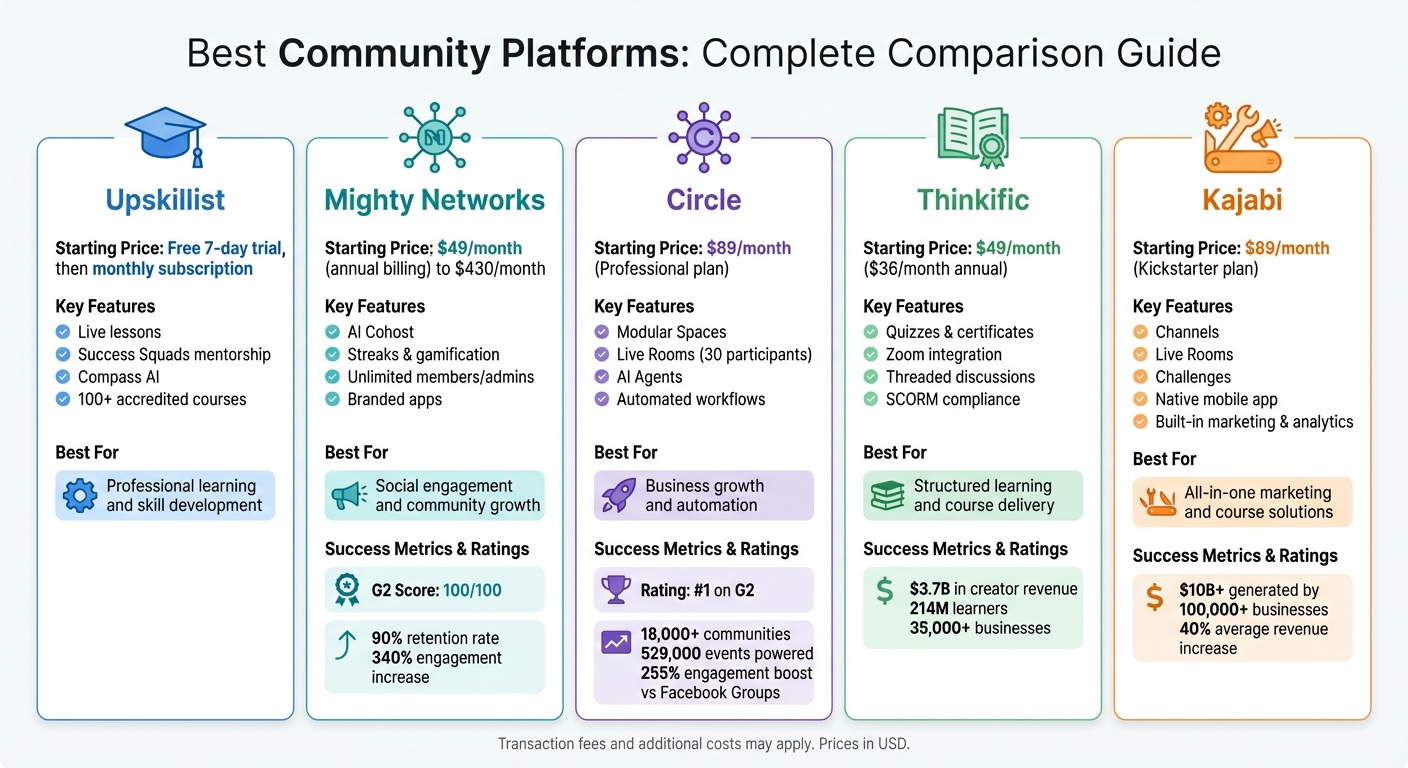
Community Platform Comparison: Features, Pricing, and Best Use Cases
The ULTIMATE Community Platform Showdown - Pros, Cons, and Best Picks
1. Upskillist

Upskillist focuses on goal-driven learning, combining education with a sense of community to help professionals enhance their skills. Instead of simply offering a platform for discussions, it integrates educational resources with community-driven features, making it perfect for those who want to learn while connecting with others who share similar goals.
Interactive Features
Upskillist’s live lessons allow instructors to host real-time sessions where students can engage through an integrated chat feature. This setup encourages direct interaction with instructors and collaboration with peers, creating a dynamic learning environment. Participants can ask questions during these sessions and connect with fellow learners who share their objectives.
The platform also introduces Success Squads, small, focused groups offering mentorship and support. These squads help learners stay motivated and accountable while working toward their goals. All of this is offered with simple and transparent pricing.
Pricing (in USD)
Upskillist provides a 7-day free trial that includes access to premium courses and AI-driven tools. After the trial, users can subscribe on a monthly basis, with the flexibility to cancel anytime before the trial ends.
Learning Opportunities
With accredited courses spanning over 100 subjects, Upskillist equips learners with globally recognized certifications. AI tools like Compass AI and Pathfinder create tailored learning paths for users, while lifetime access to lessons ensures students can revisit materials and stay engaged with the community for the long term.
2. Mighty Networks
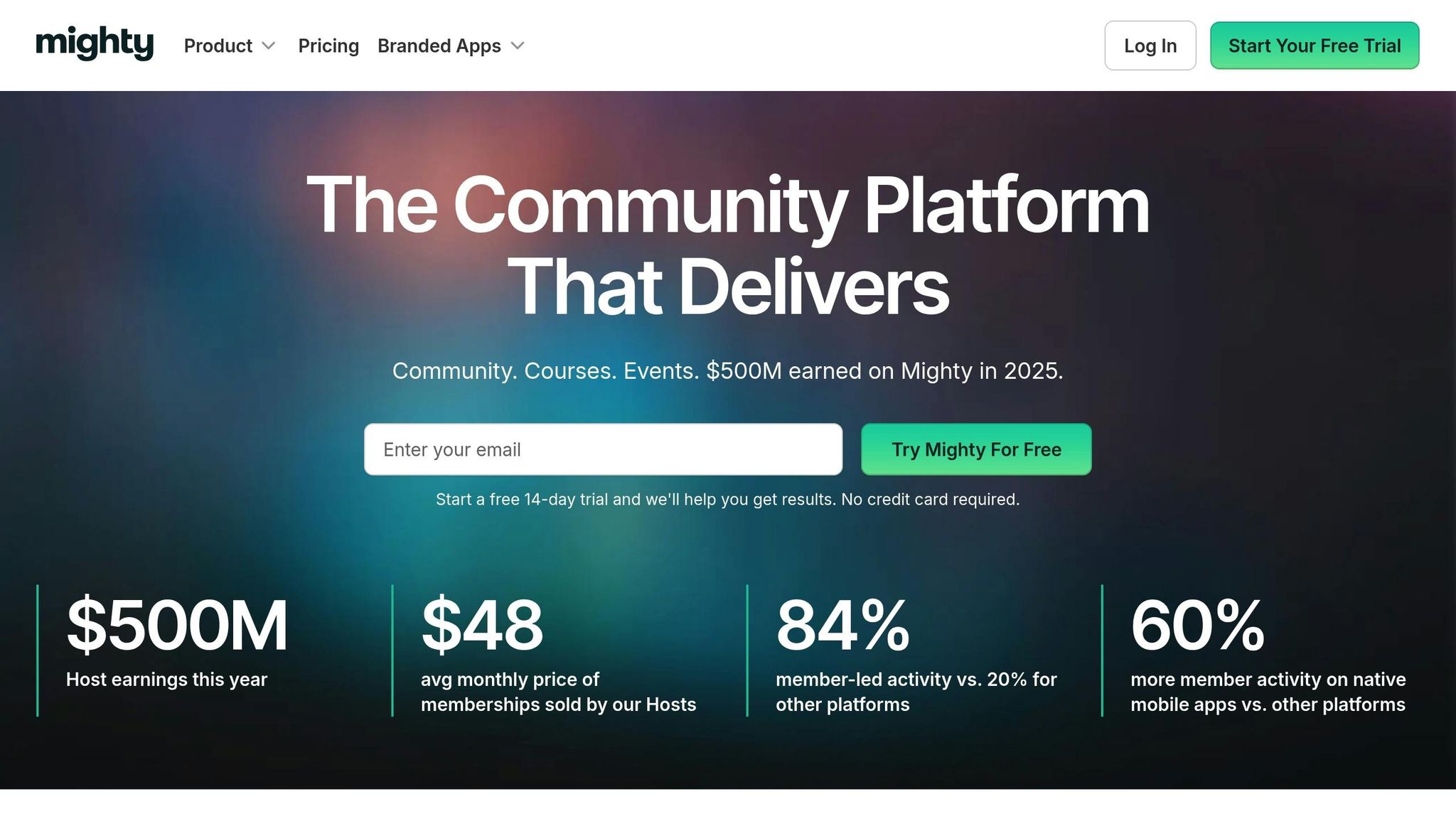
Mighty Networks brings together courses, discussions, live events, and chats in one place, keeping members engaged without the hassle of switching between platforms. With a perfect satisfaction score of 100/100 on G2 and over 80,000 ratings across app stores, it’s clear this platform resonates with users.
Interactive Features
The platform’s AI Cohost streamlines tasks like creating course outlines, landing pages, and member profiles. To keep members motivated, Mighty Networks offers gamification tools such as Streaks for daily participation, Points & Recognitions for peer appreciation, custom badges, and habit trackers. Automated workflows guide users to new spaces based on their activity and course progress.
Member profiles can be tailored to highlight expertise and interests, while built-in Icebreaker questions and Things in Common prompts make networking easier for new members. Additionally, the Ambassador Program rewards active participants for inviting others to join.
These features create an environment primed for steady community growth, supported by flexible pricing options.
Pricing (in USD)
Mighty Networks offers several plans to fit different needs:
- Launch Plan: $79/month (or $49/month when billed annually). Includes essentials like AI Cohost, courses, events, and live streaming.
- Scale Plan: $179/month. Adds advanced automations and APIs.
- Growth Plan: $354/month. Includes growth expert sessions.
- Path-to-Pro: $430/month. Provides extra storage and design support.
- Mighty Pro: Custom pricing for fully branded iOS and Android apps.
All plans come with unlimited members, admins, and moderators. Transaction fees range between 2% and 3%, depending on the plan.
Scalability
Mighty Networks’ comprehensive features and straightforward pricing lead to real-world success stories. For instance, one community achieved a 90% retention rate and generated six-figure revenue from a single course:
"We have a 90% retention rate, 65% of our members are annual members, and from one course alone in our app, we've generated over six figures."
Another example comes from the Category Design Academy, which launched on Mighty Pro in November 2024. By the end of the year, they had doubled their revenue. Katrina Kirsch, Head of Publishing & Ops at Category Pirates, shared:
"We launched the Category Design Academy on Mighty Pro in November, and it doubled our revenue before the year was over."
The platform highlights that top-performing communities maintain a 90% retention rate, with the average membership costing around $48 per month.
3. Circle
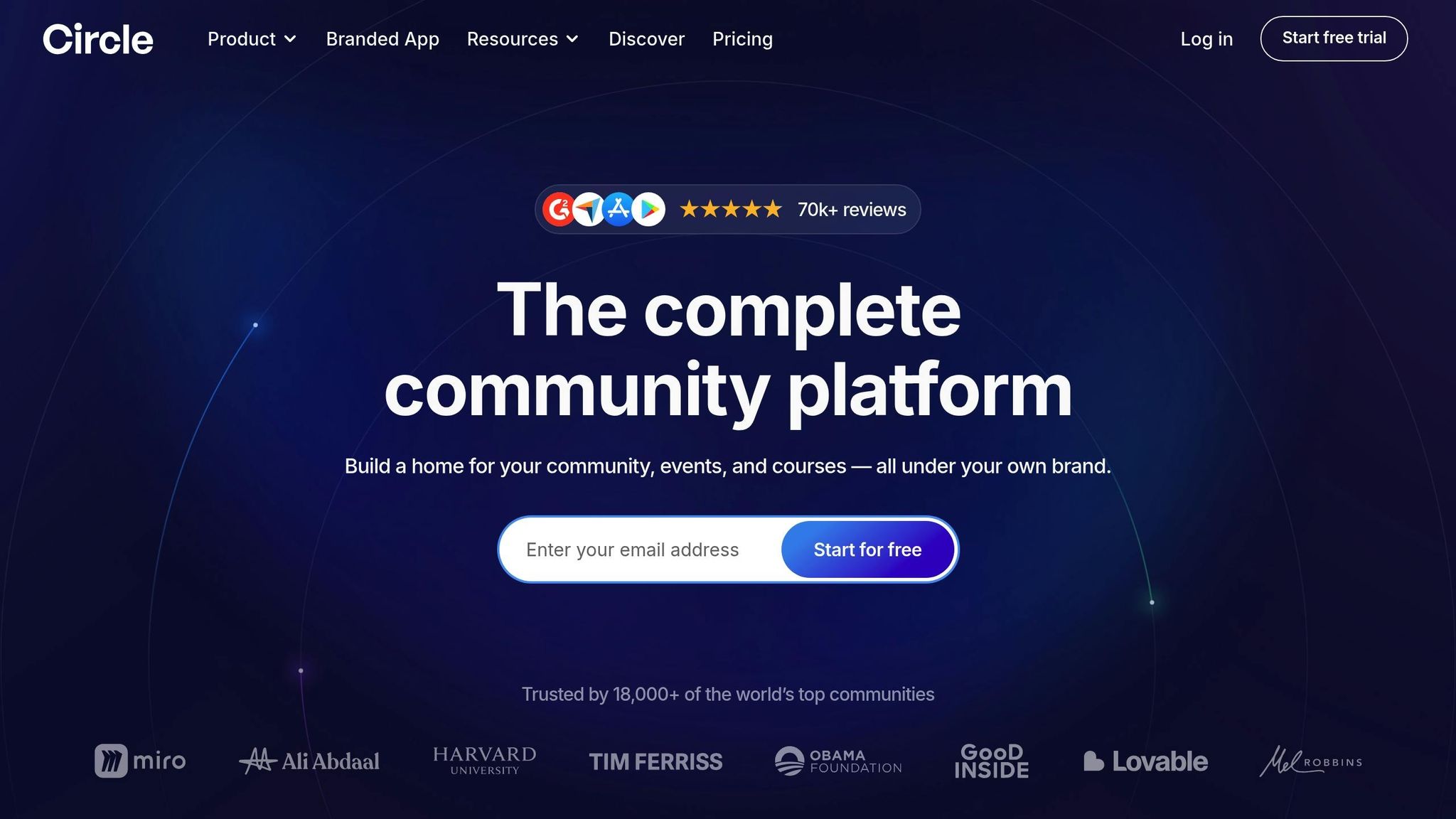
Circle combines discussions, courses, live events, and member management into one platform. With over 18,000 communities onboard and a #1 rating on G2, Circle’s impact is impressive: last year alone, it powered 529,000 events, 31,000 courses, 20 million comments, and 4.9 million posts.
Interactive Features
Circle organizes content using Spaces, which can function as forums, chats, course modules, or event listings. The platform also offers Live Streams for large webinars and Live Rooms for smaller, more personal video or audio meetings with up to 30 participants.
For those on the Enterprise plan, AI Agents act as 24/7 assistants trained on your content to guide members. Meanwhile, Automated Workflows handle repetitive tasks like sending welcome messages, assigning badges, and nudging members to stay engaged. Gamification features, such as leaderboards and custom badges, encourage participation by rewarding members for their activity.
Entrepreneur Tiago Forte used Circle to generate over $3 million in revenue in just two years by hosting live cohorts, self-paced courses, and summits.
"We've made over $3 million on Circle over the last two years... This is the power of a true 'all-in-one' platform."
These tools, combined with flexible pricing plans, make Circle a standout choice for building vibrant online communities.
Pricing (in USD)
| Plan | Price (Annual Billing) | Key Features |
|---|---|---|
| Professional | $89/month | Courses, live streams, events, 20 spaces, 3 admins |
| Business | $199/month | Workflows, API access, 30 spaces, 5 admins |
| Enterprise | $419/month | AI Agents, AI workflows, 100 spaces, 10 admins |
| Circle Plus | Custom Pricing | Branded iOS/Android apps, 500 spaces, 20 admins |
All plans include unlimited members. For additional functionality, the Email Hub add-on starts at $99/month for up to 10,000 contacts.
Customization
Circle allows extensive customization to reflect your brand’s identity. You can adjust logos, colors, imagery, and layouts across both web and mobile platforms. Higher-tier plans include advanced options like custom domains, JavaScript/CSS code snippets, and integrations with tools like Google Analytics and Facebook Pixel. For those seeking a fully branded experience, the Circle Plus plan offers white-labeled mobile apps with your brand’s name and icon in app stores.
Dave Gerhardt, founder of Exit Five, shared how switching to Circle Plus transformed his community:
"I've 10x'ed the value of my community since moving to Circle. I should have started with Circle Plus from the beginning."
Scalability
Circle is built to grow with your needs. For example, Income School successfully transitioned a community of over 2,000 members from a custom WordPress forum to Circle without losing a single member. This move streamlined their operations by consolidating their tools into one platform. Whether you’re managing 20 Spaces on the Professional plan or 500 on Circle Plus, Circle supports everything from intimate coaching groups to large-scale brand communities.
4. Thinkific
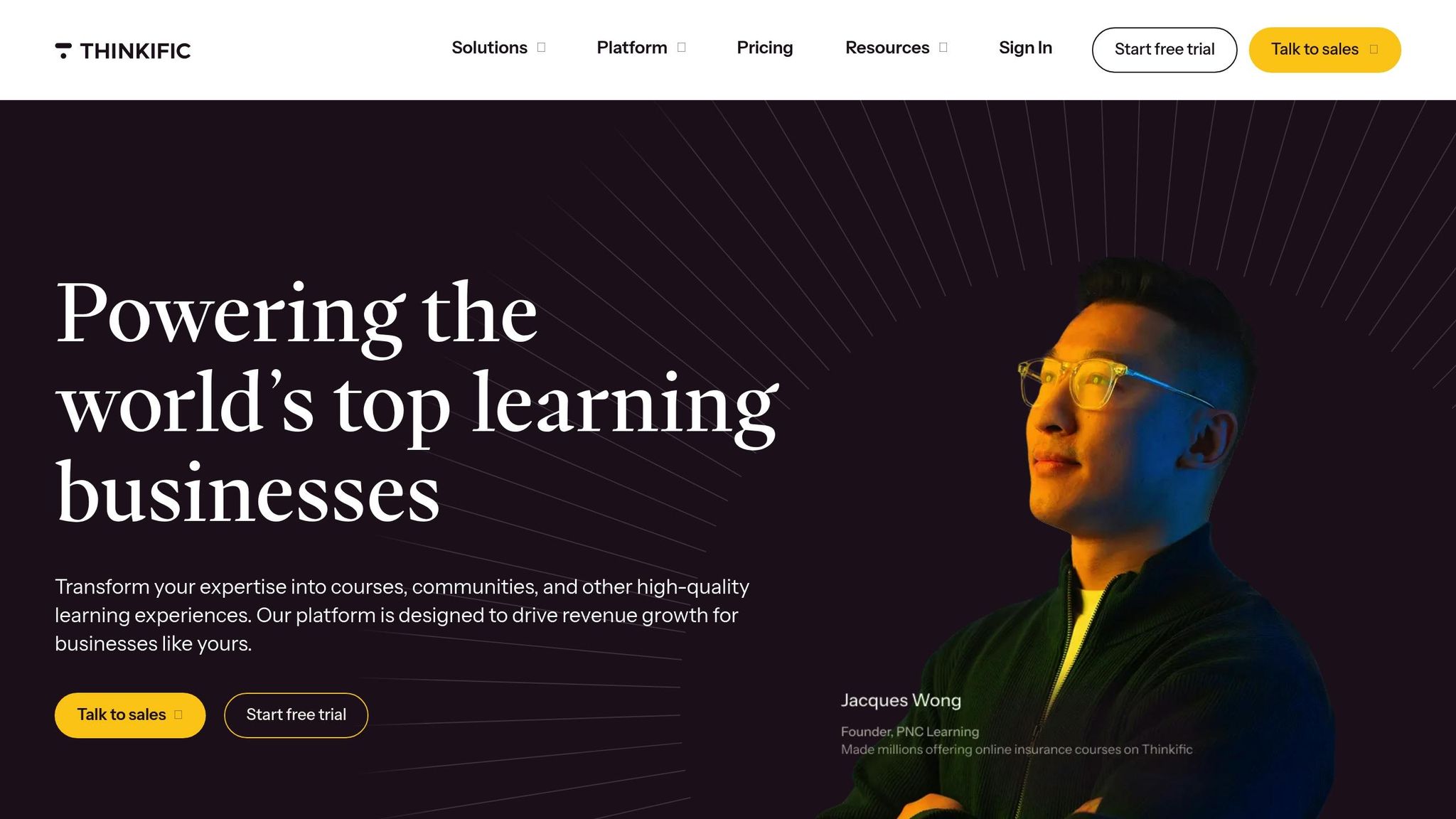
Thinkific combines course creation with community features to create an engaging learning environment. With over 35,000 businesses using the platform across 100+ countries, it has helped creators generate $3.7 billion in revenue and reach 214 million learners globally. Its pricing options are designed to accommodate creators at all stages.
Interactive Features
Thinkific connects learning content with community interaction through what it calls an "integrated user experience". Users can create profiles, use @mentions, and participate in threaded discussions with reactions. The platform also integrates with Zoom for live workshops, Q&A sessions, and coaching.
Communities are broken into Spaces, which act as discussion rooms tailored to specific topics or groups. Features like automated weekly digests, trending post notifications, and a branded mobile app with push alerts keep users engaged and connected. Travis Bader from Silvercore Outdoors shared:
"I've been using Thinkific basically since it came out. About 13 years now. It's our primary learning management system. I use it for all of our courses".
By integrating content and community, Thinkific fosters deeper engagement among learners.
Pricing (in USD)
| Plan | Monthly | Annual (per month) | Communities | Spaces | Key Features |
|---|---|---|---|---|---|
| Basic | $49 | $36 | 1 | 5 | DMs, custom domain, unlimited courses/students |
| Start | $99 | $74 | 1 | 10 | Live events, assignments, certificates, HTML/CSS editing |
| Grow | $199 | $149 | 3 | 20 per community | White-labeling, API access, bulk enrollment |
| Plus | Custom | Custom | Unlimited | Unlimited | SCORM compliance, SSO, dedicated support |
Creators keep 100% of their revenue with no transaction fees (excluding standard processing fees). Opting for annual billing also saves 25% compared to monthly payments.
Customization
Thinkific offers robust customization options to tailor your learning environment. Its drag-and-drop builder comes with customizable themes. For those on the Start plan or higher, HTML and CSS editing are available for more advanced design tweaks. The Grow plan takes it a step further by enabling full white-labeling, removing Thinkific branding from pages, products, and emails. Senna Filter from Easily Excel highlighted:
"I like that I can put my own branding on my Thinkific courses. I can change my fonts, the background color, and other aspects so my students still feel like they're on my website".
Scalability
All paid plans allow unlimited courses and students. Thinkific Plus has proven its scalability, with Hootsuite expanding its educational program to 500,000 students and Keap cutting partner onboarding time by 30% after switching from their old system. Guy Marion, Chief Marketing Officer at Chargebee, remarked:
"Thinkific offers exceptional scalability, enabling businesses to grow their course offerings and student base without any limitations".
5. Kajabi
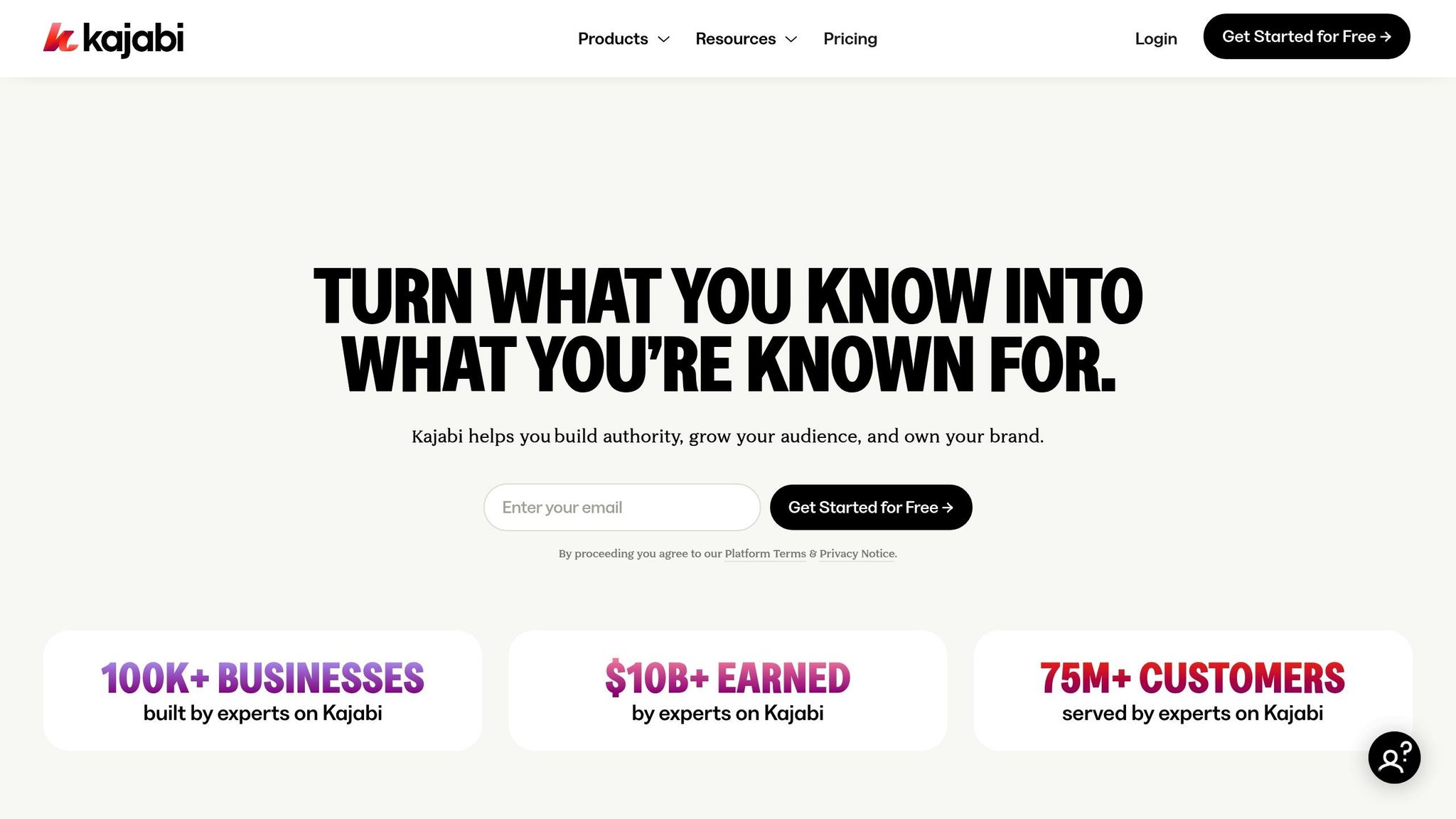
Kajabi stands out as an all-in-one platform that combines course creation, marketing, and community management into a single cohesive system. It has been utilized by over 100,000 businesses, collectively generating more than $10 billion in revenue. This approach reflects the growing trend toward unified digital learning environments.
Interactive Features
Kajabi uses Channels to organize communities, creating focused spaces for discussions. Features like Live Rooms and Meetups enable real-time coaching and Q&A sessions, while Challenges encourage group activities and regular check-ins to achieve shared goals. A unique aspect of Kajabi is its ability to embed community channels directly within course modules, incorporating elements like check-ins and gamification to keep learners engaged. Nigel McGill, founder of Sax School, highlights this integration:
"Having a great community that's built into our Kajabi membership platform is a game changer for our business. With Kajabi Communities, we can provide a more engaging learning experience for our students and make it easier for them to connect with each other."
Kajabi also offers a native mobile app for both iOS and Android, ensuring members stay connected wherever they are. For those on higher-tier plans, there’s even an option for a branded app. These features create a dynamic and accessible learning experience, paving the way for Kajabi's flexible pricing options.
Pricing (in USD)
| Plan | Monthly Price | Products | Communities | Contacts | Admins | Transaction Fee |
|---|---|---|---|---|---|---|
| Kickstarter | $89 | 1 | 1 | 250 | 1 | 2.9% + $0.30 |
| Basic | $179 | 5 | 1 | 2,500 | 1 | 2.9% + $0.30 |
| Growth | $249 | 50 | 1 | 25,000 | 10 | 2.8% + $0.30 |
| Pro | $499 | Unlimited | 3 | 100,000 | 25 | 2.7% + $0.30 |
Every plan includes unlimited members, admins, and moderators. Kajabi doesn’t take a cut from creator revenue beyond standard payment processing fees. The platform claims to replace a collection of tools that would otherwise cost around $1,653 per month.
Customization
Kajabi allows creators to fine-tune their branding with options to customize titles, descriptions, cover images, and URL slugs. It supports custom domains and offers unlimited Access Groups for audience segmentation. Higher-tier plans come with a custom code editor for advanced design tweaks, while members can use personalized reactions, and creators can add custom pages to the community interface. Younghae Chung, founder of Logos Calligraphy and Design, shares:
"The online community allows us to come alongside each other during the duration of the course. Students can ask questions, post their homework pages, receive encouragement, and engage with their classmates from around the world!"
Scalability
Kajabi’s Pro plan supports unlimited products and up to 100,000 contacts. The platform has served over 31 million customers through more than 39,000 businesses. Its built-in analytics provide insights into member growth, retention rates, post engagement, and event participation. According to Kajabi, integrating its community features can increase revenue by an average of 40%. This scalability makes it a powerful choice for creators looking to grow their businesses efficiently.
Pros and Cons
Breaking down the strengths and limitations of each platform gives a clearer sense of what they bring to the table.
Each platform has its own standout features and compromises. Mighty Networks shines when it comes to scalability - every plan allows unlimited members, hosts, and moderators, making it a solid choice for communities planning for rapid growth. One host even reported a 340% increase in engagement after switching to the platform. However, its heavy focus on social engagement means it lacks robust certification features.
Circle offers a sleek, modular interface and powerful automation tools, including workflows and AI agents. Its personalized weekly digest emails have been shown to boost engagement by 255% compared to Facebook Groups. Karl, the Founder of Dreamgrow, praised its usability:
"Circle is the slickest community platform on the market. Somehow all the configuration options you have are super easy in the app".
Thinkific is built for structured learning, with strong support for exams, assignments, and certificates - features that social-focused platforms don’t prioritize. However, its community tools are more basic, making it less suitable for fostering deep peer-to-peer interaction.
Kajabi combines marketing, courses, and community into one platform, but its community features are less flexible. This all-in-one approach comes at a higher price point, which might not suit every budget.
Here’s how these platforms compare across key features:
| Platform | Interactive Features | Pricing (USD/mo) | Scalability | Customization | Learning Outcomes |
|---|---|---|---|---|---|
| Mighty Networks | Streaks, habit trackers, challenges, live streaming | $49 – $430 | Unlimited members & admins | Branded apps, personalized feeds | Focus on social learning; lacks exams |
| Circle | Live rooms (150 people), streams (2,000), AI agents, leaderboards | $99 – $499 | Limits on spaces/admins per plan | White-label app, custom domains | Quizzes only; no certificates |
| Thinkific | Discussion forums, quizzes, live chat prompts | $49 – $199+ | Scalable for course volume | Course-centric branding, landing pages | Robust exams and certificates |
| Kajabi | Community spaces, live calls, meet-ups | $149 – $399 | All-in-one scaling; higher tiers for more products | Custom domains, site builder, funnels | Strong course delivery & assessments |
One key consideration is transaction fees, which range from 0.5% to 4% on lower-tier plans. These fees can add up as your community grows and revenue increases. Comparing these factors can help you choose the platform that best fits your community’s needs and educational goals.
Conclusion
Choose a platform that aligns with your primary goal - whether that's fostering engagement, driving revenue, or delivering structured learning experiences. Mighty Networks is ideal for building social engagement, Circle supports business growth, Thinkific focuses on structured learning, and Kajabi emphasizes marketing-driven strategies. These recommendations tie directly to the feature analysis outlined earlier.
Keep in mind, 78% of successful community projects emphasize strong communication, and collaborative efforts are 60% more likely to succeed compared to solo ventures. While the platform sets the stage, the real success of your community lies in how effectively you nurture connections and provide meaningful value to your members.
FAQs
What should I look for when choosing the right community platform?
When picking a community platform, it’s important to start with a clear understanding of your goals. Make sure the platform’s features match what you need to achieve those objectives. Ideally, the right platform will bring together tools for content sharing, payments, events, and member communication all in one place. This not only streamlines management for you but also keeps your members actively involved.
Some key things to look for include an easy-to-use interface that simplifies onboarding, customization options to showcase your brand and community vibe, and room to grow as your needs expand. It’s also worth checking if the platform provides strong moderation tools and works smoothly with integrations like email marketing software, payment processors, and analytics tools. Choosing a platform with these features ensures it supports your goals and helps build a thriving, engaged community.
How does pricing affect the suitability of community platforms for small businesses?
Most community platforms come with tiered pricing plans, making it easier for small businesses to find an option that fits their budget. For those just starting out, entry-level plans provide the basic tools needed to build a community without breaking the bank. These are ideal for businesses looking to keep costs low while getting the essentials in place.
As businesses grow, they can move up to mid-range or premium plans, which offer additional perks like detailed analytics, event integration, and marketing tools. However, higher-tier plans with features like course hosting and automation can be pricey. For small businesses, these might only make sense if they lead to a clear boost in revenue.
The beauty of tiered pricing is its flexibility - it allows businesses to start small and upgrade as their community grows and begins to generate more income. This way, the cost of the platform can scale alongside the business’s success.
What is the best platform for combining educational content with community engagement?
Upskillist offers a platform that blends educational content with community engagement tools, creating an environment where learning and interaction go hand in hand. Designed to encourage collaboration and meaningful connections, it’s a great fit for individuals or organizations aiming to build dynamic, purpose-driven online communities.
Whether the goal is personal growth, business advancement, or educational projects, Upskillist provides intuitive tools to keep learners and community members actively involved. The platform’s approach ensures an engaging and motivating experience for all participants.