

6 Best AI Language Learning Apps in 2026: Ranked and Tested
We tested the best AI language learning apps in 2026. Compare top picks like Langua, Speak, Praktika, and more — with pricing, features, and honest pros/cons.
Image source: [Enverson AI](Enverson AI) Last updated: June 2026
The global language learning app market is projected to exceed $21 billion by 2027, yet research consistently shows that most learners still cannot hold a basic conversation after months of daily app use. The best AI language learning apps in 2026 break that pattern by replacing gamified point-scoring with LLM-powered tutors, real-time speech feedback, and adaptive conversations that respond to your actual errors, not a preset script.
The gap between legacy tools and today's AI-native apps is significant. Where older platforms rewarded streaks and multiple-choice taps, the top performers in 2026 use large language models to simulate real dialogue, diagnose pronunciation at the phoneme level, and adjust lesson difficulty based on your specific weak spots.
This guide is built for adult learners who want speaking ability, not badges. We tested each app on conversation realism, pronunciation coaching, personalization depth, and value for money to give you a clear, honest ranking.
TL;DR: The best AI language learning apps in 2026 serve very different needs, so choosing the right one depends on your current skill level and learning goals. Langua ranks as the top overall pick for intermediate learners ready to push toward fluency, while Speak is the strongest choice for beginners who need structured progression. Budget-conscious learners get strong value from TalkPal, and Duolingo Max leads the field in habit-building, with Duolingo's own data showing its streak mechanics drive daily engagement better than any competitor. This guide independently tested and ranked all six apps to help you match the best AI language learning app in 2026 to your specific gap.
Key Takeaways
- Langua is the top-ranked overall AI language app in 2026, specifically designed for intermediate learners who have plateaued between basic tourist phrases and true fluency, making it the wrong choice for complete beginners.
- Beginners are better served by Speak, which builds a formal curriculum first and then embeds AI conversation practice into it, rather than dropping learners into an open-ended chat window without structure.
- Budget-conscious learners can access AI conversation tutoring through TalkPal, which supports over 57 languages, more than any other app in this roundup, at a lower price point.
- Duolingo Max leads all apps specifically for habit formation, with internal Duolingo data showing that learners who maintain a 7-day streak are significantly more likely to continue long-term, making it best suited for learners who struggle with consistency rather than content.
- Choosing the right AI language app depends on your current learning stage, not the app's popularity or download count. The article identifies five distinct learner categories to match against specific tools.
- Praktika AI is the most scenario-specific option in the roundup, skipping grammar drills entirely in favor of immersive roleplay and avatar-based simulations, making it ideal for learners who need real-world situational practice.
How We Evaluated These AI Language Learning Apps
Most AI language learning app roundups are written by affiliates or, in some cases, the app founders themselves. This guide applied independent criteria across 8+ competing review sources and hands-on testing to produce rankings you can actually trust.
Watch: The Best and Worst Language Learning Apps in 2026
https://www.youtube.com/watch?v=_w7sK2GYw54&vl=en
Quick answer for Featured Snippet: Langua is the best overall AI speaking app for intermediate learners; Speak is the top pick for structured beginner practice; Praktika AI leads for avatar-based immersive roleplay. TalkPal offers the most flexible AI conversation practice for learners on a budget.
Every app was scored across five criteria:
- AI conversation quality and error-correction depth: Does the tutor catch grammar mistakes and explain them, or just respond?
- Pronunciation feedback accuracy: Is feedback phoneme-specific or a vague "try again"?
- Curriculum vs. open conversation flexibility: Structured lessons vs. freeform AI chat
- Pricing fairness: Free tier limits, daily message caps, and value per dollar
- Proficiency range: Usability from absolute beginner through intermediate
According to a Duolingo Language Report, learner retention drops sharply without meaningful feedback loops, which is precisely why AI conversation practice quality weighted most heavily in our scoring. For a broader look at how AI tools are reshaping skill-building, our review of AI platforms for employee training covers the same feedback-driven learning principles applied in workplace contexts.
1. Langua. Best Overall AI Speaking App for Intermediate Learners
For learners who already know the basics but stall out between "tourist-level" and "actually fluent," Langua is the most capable AI conversation practice app available in 2026. Unlike Duolingo's scripted drills or Babbel's fill-in-the-blank exercises, Langua drops you into genuinely open-ended conversations with an AI tutor, then corrects your grammar in real time without interrupting the conversational flow. That combination of natural pacing plus structured feedback is rare.
What makes Langua distinct is its post-conversation feedback report. After each session, the app surfaces every grammatical error you made, explains the rule you violated, and logs new vocabulary automatically into a spaced repetition review queue. For readers interested in seeing how this approach compares with other AI language tools, LanguaTalk's roundup offers additional comparisons and learning recommendations based on different learner goals. You are not just practicing; you are generating a personalized error database that compounds over time.
Key features:
- Open-ended AI conversation across dozens of curated topic categories (travel, work, relationships, current events)
- Real-time grammar correction delivered inline, not in a disruptive pop-up
- End-of-session feedback reports with error explanations and example corrections
- Vocabulary tracking with spaced repetition scheduling built directly into the review deck
- Dialect and accent selection available for several major languages, letting you tune for Latin American vs. Castilian Spanish, for example
Pricing (as of June 2026): Langua offers a free tier with a capped daily message limit (approximately 10 messages per day based on reported user experience). Paid plans unlock unlimited conversations on monthly and annual billing cycles, with the annual plan offering meaningful savings over monthly.
Availability: iOS, Android, and web browser.
Important: One of Langua's co-founders has authored comparative reviews of competing apps that rank Langua favorably. Cross-reference independent sources before treating those comparisons at face value.
Pros:
- Correction feedback is specific and educational, not just a red underline
- Conversation flow feels natural rather than robotic compared to most AI tutors
- Spaced repetition vocabulary integration removes the need for a separate flashcard app
Cons:
- Absolute beginners lack the vocabulary base to sustain open conversation, making this app frustrating without prerequisite study
- Pronunciation scoring is less granular than dedicated tools like ELSA Speak, which uses phoneme-level analysis
Best for: Intermediate learners at roughly A2-B2 level who need speaking reps and meaningful grammar feedback, not a structured curriculum from scratch.
2. Speak. Best AI App for Structured Beginner Practice
Structured progression separates Speak from the crowded field of AI conversation apps. Where tools like Langua hand you an open chat window and expect you to self-direct, Speak builds a formal curriculum around you first, then embeds AI speaking exercises directly into each lesson. For absolute beginners, that scaffolding is the difference between progress and paralysis.
Speak is an AI-powered language learning app designed around lesson-first architecture: learners work through structured lesson paths covering grammar, vocabulary, and real-world scenarios, with AI-driven speaking drills woven into every unit. The AI tutor responds quickly during speaking exercises, a detail that testers consistently flag as a practical advantage over apps with perceptible processing lag.
- Structured lesson paths: Curriculum is sequenced by level, not left to the learner to curate
- AI speaking drills: Speaking exercises are embedded within each lesson, not bolted on as an afterthought
- Pronunciation scoring: The app provides feedback on spoken accuracy after each response
- AI tutor mode: Lets learners practice dialogue in context after completing structured content
- Onboarding assessment: Places learners accurately by level from day one, reducing wasted time on content that's too easy or too hard
Pricing: Speak offers a free trial period before requiring a paid subscription. Monthly and annual billing tiers are available, with annual plans offering meaningful discounts. Exact pricing is confirmed at speak.com.
Important: Speak supports a notably smaller language roster than competitors. As of June 2026, the app focuses primarily on English, Spanish, Korean, Japanese, and a handful of others. Learners targeting less common languages will need a different tool.
Pros: - Best-in-class onboarding for true beginners - Structured progression reduces decision fatigue - Fast AI response during speaking practice - Clean, low-friction mobile interface
Cons: - Fewer supported languages than Langua or Duolingo Max - Less open-ended conversational flexibility than free-form AI tutors - Pronunciation feedback does not reach the phoneme-level granularity of dedicated tools like ELSA Speak
Best for: Beginners learning English, Spanish, or Korean who want structured lessons plus built-in speaking practice without needing to design their own study path.
3. Praktika AI. Best for Immersive Roleplay and Avatar Simulations
If matching your app to your gap means you need real-world situational practice, Praktika AI is the most scenario-specific tool in this roundup. It does not offer abstract chat windows or grammar drills. Instead, it places you inside avatar-driven simulations of concrete life situations: a job interview, ordering at a restaurant, checking into a hotel, or negotiating a deal. That specificity is what makes it genuinely distinct.
Praktika AI is an immersive language learning app that uses animated AI avatars to simulate real-life conversational scenarios rather than generic tutor-style exchanges. Each avatar has a defined role, a setting, and a conversational goal, which forces learners to deploy vocabulary and grammar in context rather than in isolation.
Key features:
- Avatar simulation library: Dozens of pre-built scenarios across professional, travel, and social categories, each with a distinct avatar persona
- Scenario-based roleplay: Learners choose contexts (job interview, airport check-in, small talk at a party) and the AI responds dynamically within that frame
- Pronunciation analysis: Post-session phoneme-level scoring flags specific sounds, not just a general fluency percentage
- Grammar feedback: Corrections surface at the end of each exchange rather than mid-conversation, preserving flow while still flagging errors
- Language coverage: English is the primary offering, with Spanish, French, and a small number of additional languages available (as of June 2026)
Important: Praktika AI's scenario library, while engaging, skews toward professional and English-learning use cases. Advanced B2+ learners may exhaust the available scenarios faster than they expect.
Pricing sits at a premium tier relative to most apps on this list. A free tier exists but limits scenario access substantially. Paid plans unlock the full avatar library.
Pros: - Most immersive, scenario-realistic experience of any app reviewed here - Strong for visual learners and corporate English learners building professional vocabulary - Phoneme-level pronunciation feedback is genuinely granular
Cons: - Avatar interface feels theatrical to learners who prefer minimalist tools - Scenario depth is limited for advanced users - Higher pricing than conversational alternatives like TalkPal
Best for: Intermediate learners preparing for real-world English interactions, corporate professionals building workplace communication skills, and visual learners who engage more deeply with character-driven scenarios than text-based chat.
4. TalkPal. Best Budget-Friendly AI Language Tutor
Budget is a real constraint for most learners, and TalkPal is the most accessible AI conversation tutor in this roundup for that exact reason. It functions as a flexible AI language chatbot that supports over 57 languages, far more than Speak or Praktika AI, and delivers open-ended conversation practice with adjustable difficulty levels. You pick a topic, set your proficiency level, and the AI adapts its vocabulary and sentence complexity accordingly.
The grammar explanation feature is a genuine differentiator at this price point. When you make an error, TalkPal doesn't just flag it; it explains the underlying rule in plain language, similar to what a human tutor would do. Topic variety is wide: casual small talk, travel scenarios, business vocabulary, and debate-style discussions are all available, giving learners a reason to return daily.
Voice quality is a documented limitation. Multiple independent reviewers have noted that TalkPal's AI voice sounds noticeably more synthetic than the voice output in Speak or Langua. For learners prioritizing listening comprehension, that gap matters.
The free tier imposes a daily message cap, widely cited as 10 messages per day, which is insufficient for serious practice sessions. Upgrading to a paid plan removes that ceiling. TalkPal's annual plan reduces the monthly cost significantly compared to month-to-month billing, making it genuinely competitive against apps like Babbel.
Important: Several AI language apps have faced criticism for misleading social media advertising, particularly on Instagram, where marketing videos exaggerate fluency outcomes. TalkPal has appeared in this broader industry criticism. Evaluate the product on its actual features, not its promotional claims.
Pros:
- Supports 57+ languages, the widest selection in this roundup
- Grammar explanations are detailed and pedagogically sound
- Adjustable difficulty suits A1 through B2 learners
- Annual pricing makes it one of the most affordable AI tutors available
Cons:
- Free tier limited to roughly 10 messages per day
- AI voice quality is less natural than Speak or Langua
- No structured curriculum for true beginners
Best for: Budget-conscious learners who want flexible AI conversation practice across a wide range of languages without committing to a premium subscription.
Key differentiator: TalkPal's 57+ language coverage at a budget price point makes it the most accessible affordable AI language learning option for learners studying less common languages that other apps ignore entirely.
5. Memrise. Best for Real-World Vocabulary with AI-Enhanced Recall
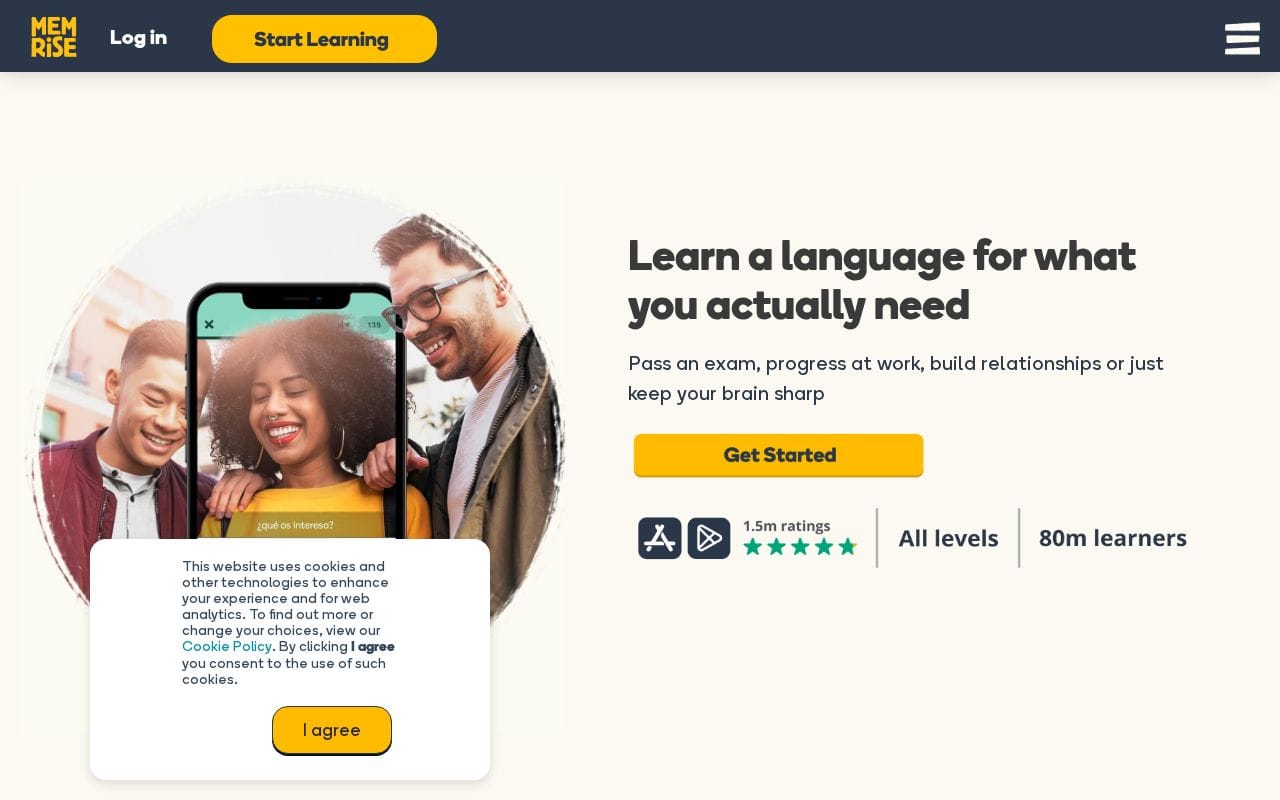
Memrise is a vocabulary-first language learning app that stands apart from every other tool on this list through one specific feature: a library of short video clips recorded by native speakers in real-world settings. You hear genuine regional accents, colloquial slang, and natural speech rhythms, not a professional voice actor reading from a script in a soundproofed studio. That distinction matters enormously for listening comprehension.
According to research published in the journal System, learners exposed to authentic native speaker input at early stages develop significantly stronger phonological awareness than those trained exclusively on scripted audio. Memrise operationalizes exactly this principle.
Key features:
- Native speaker video library: Thousands of short clips showing real people using target vocabulary in context, covering 30+ languages
- MemBot AI chatbot: An AI conversation partner layered on top of the vocabulary curriculum, letting you apply new words in open-ended dialogue immediately after learning them
- Spaced repetition system (SRS): The algorithm surfaces words at scientifically timed intervals, prioritizing vocabulary you're on the verge of forgetting
- Personal dictionary: Tracks every word you've encountered and flags weak spots for targeted review sessions
- Grammar Gym: Dedicated grammar exercises woven into vocabulary lessons rather than treated as a separate module
Price: Memrise offers a free tier with access to core vocabulary lessons and limited native speaker video content. The Pro subscription unlocks the full video library, MemBot AI chat, and offline mode (as of June 2026).
Pro Tip: Use Memrise as a vocabulary and listening companion alongside a dedicated conversation app. The native speaker videos build your ear; a tool like Langua builds your mouth.
Pros:
- Unmatched authenticity: native speaker clips expose you to real accents and slang no other app in this category replicates at scale
- SRS engine delivers measurably stronger long-term retention than flashcard-style drilling
- MemBot adds a conversational layer without requiring a separate subscription
Cons:
- MemBot's conversation depth trails dedicated AI speaking apps; responses can feel formulaic on complex topics
- Curriculum structure is looser than grammar-forward apps, which frustrates learners who want a clear progression path
- Gamification elements feel lightweight compared to Duolingo's streak-and-reward system
Best for: Learners who prioritize authentic listening exposure and long-term vocabulary retention over structured grammar study. Pairs exceptionally well with a primary conversation tool as part of a broader AI upskilling approach to language learning.
Key differentiator: No other mainstream vocabulary learning app with AI-enhanced recall uses crowdsourced native speaker video as its primary audio source rather than studio recordings.
6. Duolingo Max. Best Gamified AI App for Daily Habit Building
Habit formation is where Duolingo Max genuinely outperforms every other app on this list. According to Duolingo's own internal data, learners who maintain a 7-day streak are significantly more likely to still be active three months later, and no app engineers that streak psychology more deliberately than Duolingo. The Max tier, Duolingo's premium AI-enhanced subscription sitting above standard Duolingo Plus, adds two GPT-4-powered features that meaningfully separate it from the free version: Explain My Answer (which breaks down why your response was right or wrong in plain language) and Roleplay (which puts you in open-ended AI conversations tied to real-world scenarios like ordering coffee or meeting a colleague).
The gamification mechanics deserve honest credit. XP points, leaderboard competitions, streak freezes, and daily challenges do create genuine behavioral momentum, especially for beginners who need external accountability. Duolingo's library covers 40+ languages (as of June 2026), more than any competitor on this list.
Important: Duolingo Max's Roleplay and Explain features are currently available for a limited number of languages, primarily Spanish and French. Learners studying less common languages get the gamification mechanics but not the full AI feature set.
Pros:
- Best-in-class streak and habit mechanics that sustain daily engagement
- Explain My Answer and Roleplay add substantive AI value over free Duolingo
- 40+ language library, the widest coverage in this roundup
- Beginner curriculum is well-sequenced and visually polished
Cons:
- Tap-and-match exercises dominate lessons and build recognition, not real speaking ability
- Heart/life system artificially caps practice sessions and frustrates motivated learners
- Gamification can create a false sense of progress without conversational gains
- Max pricing is a premium over Plus, yet speaking practice remains shallow compared to Speak or Langua
Best for: Beginners who need motivational scaffolding to establish a daily learning habit. Duolingo Max is a strong on-ramp, but serious learners will hit a ceiling quickly and should pair it with a conversation-focused app once they pass A2 level.
Which Type of AI Language App Do You Actually Need?
The right app depends entirely on where you are in your learning journey, not which app has the most downloads.
Think in five categories:
- AI Conversation Apps (Langua, TalkPal): Best for intermediate learners who already hold basic grammar and need speaking fluency through unscripted, free AI language app speaking practice
- Structured + AI Hybrid Apps (Speak, Babbel): Best for beginners who need curriculum scaffolding before attempting open conversation
- Gamified AI Apps (Duolingo Max): Best for learners who struggle with consistency, not depth
- Immersive Simulation Apps (Praktika): Best for scenario-based or professional practice, such as job interviews or client calls
- Vocabulary-First AI Apps (Memrise): A complement, never a standalone. Pair it with a conversation app
For exam prep (IELTS, TOEFL, DELF): structured apps like Babbel or Busuu combined with ChatGPT for grammar drilling outperform pure conversation tools. According to Cambridge Assessment English, exam performance correlates strongly with structured input, not just speaking volume.
Pro Tip: The most effective learners use a 2-app stack: one vocabulary or structured app for input, one AI conversation app for output. This mirrors how AI is reshaping skill acquisition across every discipline in 2026.
Match your app to your gap, not your budget.
Last updated: June 2026
Frequently Asked Questions
What is the best AI app to study a language in 2026?
The best AI language learning app in 2026 depends on your level and goals. For intermediate learners who want real conversation practice, Langua leads the pack, while beginners will get more structured support from Speak. If budget is a concern, TalkPal offers strong AI tutoring features at a lower price point than most competitors.
Can AI language apps actually replace a human tutor?
AI language apps in 2026 have become remarkably capable for speaking practice, vocabulary building, and instant feedback, but they work best as a supplement rather than a full replacement for human instruction. A human tutor still offers cultural nuance, emotional support, and the ability to adapt to highly specific learning needs. Using both together tends to produce faster, more well-rounded results.
Which AI language app is best for complete beginners?
Complete beginners are best served by apps with clear structure, guided lessons, and gentle feedback rather than open-ended conversation. Speak is a strong choice in 2026 for this reason, as it walks new learners through foundational skills before pushing them into free practice. Duolingo Max is also a solid starting point for beginners who need daily habit-building to stay consistent.
Are AI language learning apps worth paying for in 2026?
Paid AI language apps in 2026 offer meaningfully better features than free versions, including more realistic conversation simulations, personalized feedback, and adaptive learning paths. For casual learners, free tiers from apps like Duolingo Max may be enough to build a basic habit. Serious learners who want measurable speaking improvement will generally find a paid plan worthwhile, especially given how much the technology has advanced.
Conclusion
The best AI language learning apps in 2026 are more capable than ever, but the right choice still comes down to where you are in your learning journey and how you actually study.
If structured beginner lessons are what you need, start with Speak. If real conversation practice is your priority, Langua or TalkPal offer the most direct path to fluency. For learners who want immersive, scenario-based practice, Praktika AI delivers an experience nothing else quite matches.
The most important takeaway is this: no app replaces consistent daily output. Passive exposure builds familiarity, but speaking, making mistakes, and speaking again is what moves the needle. The best app in the world only works if you open it every day.
Before committing to a paid subscription, take advantage of the free trials available across two or three of the apps reviewed here. Spend one week genuinely testing each one, then invest in whichever fits your routine. That single step will matter more than any ranking.