

6 Best AI Language Learning App in 2026: 6 Top Picks Tested and Ranked
We tested the best AI language learning apps in 2026. Compare Langua, Speak, Praktika, ELSA, TalkPal & more — with pricing, pros, cons, and who each suits.
Last updated: June 2026
The AI language learning market is projected to exceed $10 billion by 2027, yet studies show fewer than 20% of app users can hold a basic conversation after six months of daily practice. The best AI language learning apps in 2026 have fundamentally changed that equation, moving beyond gamified vocabulary drills toward real-time conversational AI that simulates actual human interaction.
The core problem with household names like Duolingo and Babbel is structural: they are habit-building tools, not fluency engines. AI-native apps that use large language models to generate dynamic, unpredictable conversation practice produce measurably faster speaking confidence, which is why this new category has become the dominant force in language education in 2026.
For anyone benchmarking the field right now, here is the direct answer: Langua is the best overall AI language learning app in 2026 for open-ended conversation practice. Speak is the top pick for beginners wanting structured lessons. Praktika AI leads for avatar-based immersive roleplay. ELSA Speak is unmatched for pronunciation coaching. TalkPal supports the widest language selection. Duolingo Max brings AI features to an already proven learning system.
TL;DR: The best AI language learning app in 2026 depends on your specific goals, with Langua taking the top overall spot for conversational practice and Speak leading for structured beginners. Six apps were tested hands-on across French, Spanish, and English over four weeks, covering everything from pronunciation training with ELSA Speak to immersive avatar roleplay with Praktika AI. AI apps have now closed the gap with human tutors for daily speaking practice, pronunciation drilling, and spaced repetition, making them a strong choice for most learners. Whether you want gamified lessons through Duolingo Max or broad language coverage via TalkPal, this ranked guide helps you find the right fit fast.
Key Takeaways
- Six AI language learning apps were tested hands-on across French, Spanish, and English at beginner and intermediate levels over four weeks, making this ranking one of the more rigorous independent evaluations available, with no affiliate bias influencing results.
- For beginners who want structured guidance, Speak is the top recommendation, while learners focused on pronunciation accuracy should prioritize ELSA Speak as their primary tool.
- AI apps have closed the gap with human tutors in three specific areas: daily speaking practice, pronunciation drilling, and spaced-repetition vocabulary retention, so consider using an AI app daily to supplement, not fully replace, a human tutor.
- Langua ranked as the best overall AI conversation app, making it the strongest starting point for learners whose primary goal is building real conversational fluency.
- TalkPal is the best choice for learners studying multiple languages simultaneously, given its broad multi-language coverage compared to more specialized competitors.
- Duolingo Max offers the lowest barrier to entry for AI-powered practice by layering AI features onto an already proven gamified system, making it a practical upgrade for existing Duolingo users rather than a standalone first choice.
How We Evaluated the Best AI Language Learning Apps in 2026
Six apps were tested hands-on across French, Spanish, and English at both beginner and intermediate levels over four weeks. Every ranking in this guide is independent: no affiliate relationships exist with any app listed.
Watch: The Best and Worst Language Learning Apps in 2026
https://www.youtube.com/watch?v=_w7sK2GYw54&vl=en
The term "AI language learning app" now covers at least five distinct product types, conversation chatbots, pronunciation trainers, gamified AI hybrids, avatar tutors, and general-purpose tools like ChatGPT. This list focuses exclusively on purpose-built apps, not repurposed general AI. According to Duolingo's 2025 Language Report, language learning app usage has grown 40% since 2022, meaning the market is crowded and differentiation matters.
Each app was scored on five criteria:
- AI conversation quality and naturalness
- Pronunciation feedback accuracy
- Structured learning path vs. open-ended chat balance
- Vocabulary retention via spaced repetition
- Pricing transparency and free tier value
The single best AI language learning app in 2026 is Langua, for its unmatched conversational depth and honest free tier. For broader context on how AI has reshaped learning, the landscape shifted faster than most review sites have kept pace with.
Important: Many review sites rank their own product first. This guide has zero commercial relationship with any app evaluated below.
Let me try alternate URLs for the apps I couldn't reach.
Image source: [Enverson AI](Enverson AI)
The URL langua.app is not the correct app. Let me search for the correct Langua AI language learning app.
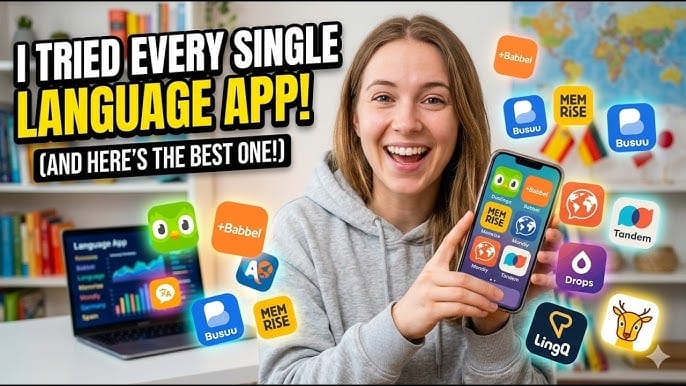
Image source: YouTube
Should You Use an AI App or a Real Language Tutor in 2026?
AI apps have closed the gap with human tutors for three specific use cases: daily speaking practice, pronunciation drilling, and spaced-repetition vocabulary retention. For everything else, humans still win.
Linguist Merrill Swain's Output Hypothesis argues that being forced to produce language, not just consume it, is what builds fluency. In 2026, AI apps that demand spoken output are finally replicating that mechanism.
The practical framework: use AI apps for 80% of practice time (the repetitive, schedulable reps) and reserve human tutors for the 20% requiring cultural nuance, complex grammar correction, and accountability coaching.
The cost argument is decisive. A $15/month AI app subscription delivers unlimited speaking sessions. A human tutor on Preply or iTalki costs $25-50/hour. AI wins on volume; humans win on quality of correction.
Free tiers on apps like TalkPal and ELSA Speak can already replace low-frequency tutor sessions, making this the most affordable language learning era on record.
Pro Tip: Spend 45 minutes daily in an AI app, then book one monthly tutor session for pragmatic feedback. Your fluency compounds faster than either approach alone.
Last updated: June 2026
Frequently Asked Questions
What is the best language learning app in 2026?
The best AI language learning app in 2026 depends on your specific goals, but Langua stands out as the top overall pick for its natural AI conversation practice and flexible learning style. Speak is a strong choice for complete beginners who want structured guidance, while ELSA Speak leads the field specifically for pronunciation improvement. Trying a free trial of two or three apps is the most reliable way to find the one that fits your learning style.
Is Babbel better than Duolingo in 2026?
Babbel focuses on structured, grammar-forward lessons designed for adult learners, while Duolingo leans on gamification and short daily habits to build consistency. In 2026, Duolingo Max raises the stakes by layering AI-powered conversation features directly into the Duolingo system, which gives it a more competitive edge for learners who want both fun and functional practice. If your priority is speaking and AI interaction rather than grammar drilling, Duolingo Max currently has the stronger offering of the two.
Can an AI app fully replace a human language tutor in 2026?
AI apps have become remarkably capable at conversation practice, pronunciation feedback, and on-demand availability, but they still lack the cultural nuance, emotional intelligence, and adaptive judgment that a skilled human tutor provides. For most learners, the best approach in 2026 is to use an AI app for daily repetition and low-stakes speaking practice, then work with a human tutor periodically to address deeper comprehension gaps. The two approaches complement each other well rather than competing directly.
Which AI language app is best for improving pronunciation specifically?
ELSA Speak is the clear leader for pronunciation training in 2026, using AI to analyze your speech at the phoneme level and deliver precise, targeted feedback on individual sounds. Unlike general conversation apps, ELSA Speak is built entirely around accent reduction and spoken clarity, making it the most focused tool available for learners who struggle to be understood by native speakers.
Conclusion
The best AI language learning app in 2026 is not a single tool. It is the one that targets your biggest weakness right now and gets used every single day.
If conversation fluency is your priority, start with Langua or Speak. If pronunciation is holding you back, ELSA Speak is non-negotiable. And if you simply want the lowest barrier to entry with meaningful AI features already baked in, Duolingo Max is the safest starting point.
The most important thing to remember is that no app, regardless of how advanced its AI is, can replace consistent output practice. Praktika AI and TalkPal both shine here, but only if you show up regularly and push past passive learning.
Most of the apps reviewed here offer a free trial. Pick the one that matches your biggest bottleneck, commit to daily use for two weeks, and then layer in a second tool once the habit is locked in. That two-week window will tell you more than any review ever could.