

AI platforms for employee training
AI platforms personalize employee training with skill-gap analysis, real-time feedback and immersive simulations to boost productivity and retention.
AI is transforming how companies train employees by replacing outdated, generic programs with dynamic, personalized learning systems. These platforms analyze real-time data on skills, goals, and performance to create customized learning paths that evolve with changing job roles. Key benefits include:
- Personalized Training: Tailored content adjusts to each employee's needs, skipping mastered material and focusing on skill gaps.
- Skill Gap Analysis: Identifies areas for improvement using data from HR systems, ensuring training efforts are targeted and effective.
- Real-Time Feedback: Instant insights help employees improve while giving leaders actionable data for workforce planning.
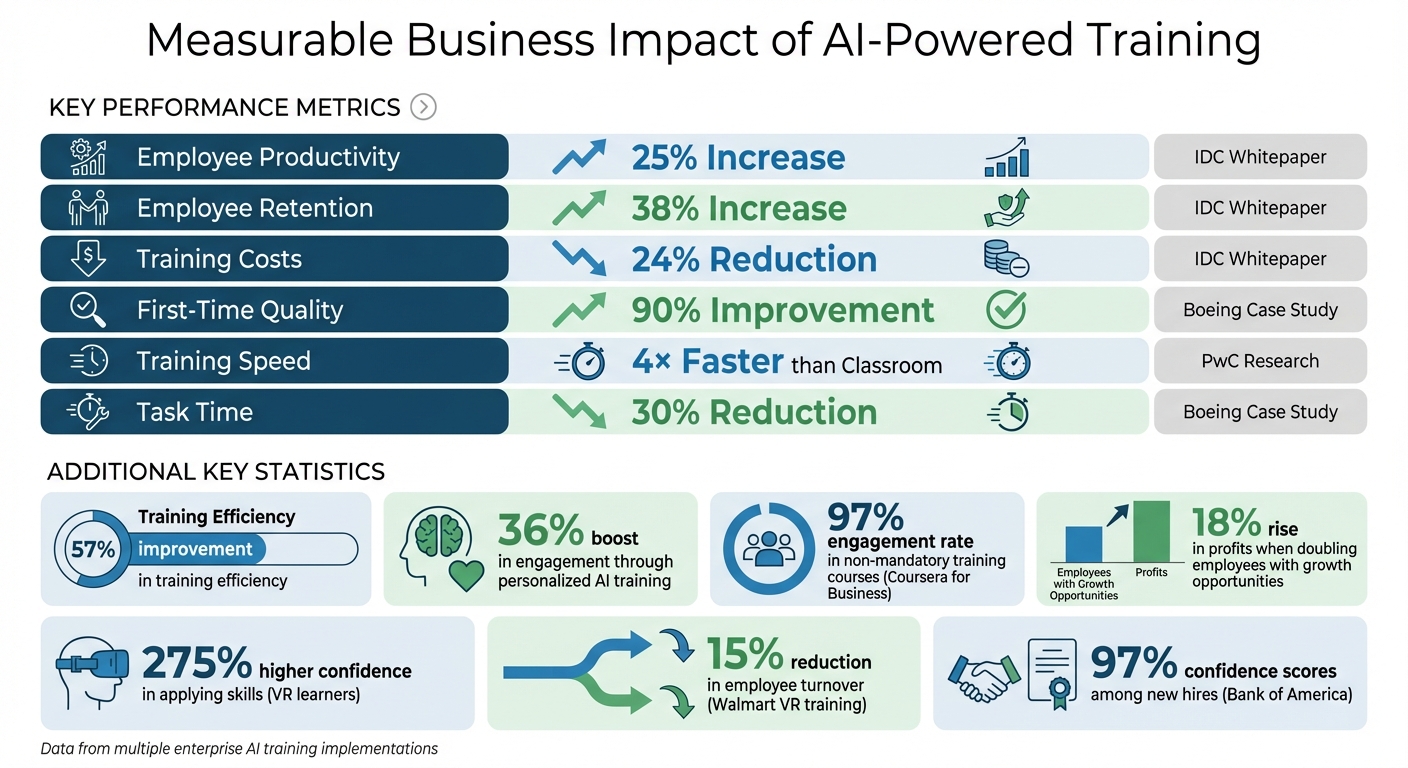
- Efficiency Gains: Companies using AI training tools report a 57% improvement in training efficiency, faster onboarding, and reduced costs.
For example, Walmart and Bank of America have successfully used AI-powered VR training to enhance employee skills, reduce turnover, and improve operational outcomes. Platforms like Upskillist simplify workforce development by integrating training into daily workflows and offering predictive analytics to anticipate future skill needs. These tools are reshaping employee growth, delivering measurable results like higher productivity, retention, and engagement.
How AI can be a partner in employee development with Josh Penzell
Upskillist's AI-Powered Training Solutions

Upskillist takes AI-driven training to a new level by offering precise and efficient workforce development tools. With Compass AI and Pathfinder at its core, the platform removes the guesswork from employee training, creating tailored learning experiences that align with individual needs and career aspirations.
Customized Learning Paths
Compass AI evaluates an employee's performance, job role, and learning preferences to design training paths that are highly personalized. It skips over content employees have already mastered and focuses on areas where they need improvement. The system even recommends extra courses and skill-building resources directly within their workflow, making learning a seamless part of their daily routine. This ensures employees gain the skills they need without wasting time on irrelevant material, helping them succeed in their current roles and prepare for future opportunities.
To enhance this further, Pathfinder sharpens the focus on identifying skill gaps across the entire workforce.
Skill Gap Analysis
Pathfinder continuously evaluates performance data to detect skill gaps before they can impact productivity. By syncing with existing HR and business systems, it provides a clear, detailed view of each employee’s strengths and areas for improvement. This allows businesses to prioritize training efforts where they’ll have the most impact, driving both individual growth and organizational success.
Real-Time Progress Tracking and Analytics
Upskillist also offers powerful tools to monitor and analyze progress. Automated feedback loops provide unbiased performance tracking, while managers gain access to predictive analytics that highlight future skill gaps based on historical data and engagement trends. Employees, on the other hand, benefit from real-time career dashboards that outline potential career paths within the company. These dashboards offer actionable insights, enabling employees to proactively address skill gaps and explore opportunities for internal mobility. The result is a transparent, data-driven training process that transforms learning into an ongoing journey of growth and improvement, benefiting both individuals and the organization as a whole.
Benefits of AI in Employee Training
Measurable Impact of AI-Powered Employee Training Platforms
AI is reshaping employee training, turning it into a powerful tool for workforce development. Building on Upskillist's tailored solutions, AI-driven training offers businesses a way to gain a strategic edge.
Scalability and Efficiency
AI eliminates many of the hurdles that traditional training programs face. By automating the creation of customized content for onboarding, compliance, and reskilling, AI platforms streamline the entire process. For example, Upskillist's technology uses real-time data and automation to simplify training delivery. This becomes especially impactful for global companies, as AI can instantly create and translate courses into more than 20 languages, ensuring consistency across multinational operations.
Real-world examples highlight these benefits. Companies report faster onboarding processes and higher engagement levels. AI also integrates seamlessly into tools like Slack and Microsoft Teams, delivering bite-sized lessons directly within these platforms. This approach removes the need for employees to dedicate separate time for training.
Another key advantage is AI's ability to predict workforce needs. Manual processes often fall short - 90% of HR leaders admit they struggle to anticipate future skill requirements. AI bridges this gap by analyzing data from HR and business systems to identify skill gaps and allocate training resources effectively. For instance, VR-based training enables learners to complete sessions four times faster than traditional classroom methods, setting the stage for better engagement and outcomes.
Increased Engagement Through Interactivity
Unlike traditional training, which often applies a one-size-fits-all approach, AI adapts to individual learning needs. By analyzing performance in real time, AI adjusts the difficulty and pacing of content to ensure learners master concepts before moving forward. This personalized approach has been shown to boost engagement by 36%.
Immersive learning takes this engagement even further. Walmart, for instance, introduced VR training to 1.6 million employees across 4,900 stores, helping them prepare for holiday rush scenarios and crisis management. The result? A 15% reduction in employee turnover and improved customer satisfaction during peak seasons. Similarly, Bank of America expanded VR training to all 200,000 employees after seeing 97% confidence scores among new hires practicing branch transactions and emergency scenarios.
"VR learners complete training four times faster than classroom participants and demonstrate 275% higher confidence in applying skills."
- Paola Cecchi-Dimeglio, Harvard Faculty and UN Global Initiative Co-chair
Hands-on learning is clearly effective - 86% of employees say they learn best by doing rather than passive listening. AI-powered platforms make this possible at scale through simulations, interactive assessments, and gamified learning experiences. Coursera for Business, for example, reports a 97% engagement rate in non-mandatory training courses.
Measurable Business Impact
AI-based training doesn’t just improve learning - it delivers tangible business results. Companies using AI platforms have reported a 25% boost in employee productivity and a 38% increase in retention rates. These improvements also impact financial performance; organizations that double the number of employees with growth opportunities can see an 18% rise in profits.
Operationally, the benefits are just as striking. Boeing, for instance, implemented AR headsets for technical training, allowing technicians to view digital assembly instructions directly on aircraft components. This led to a 90% improvement in first-time quality and a 30% reduction in task time. Similarly, Salesforce launched "Career Connect", an AI-powered internal platform that recommends learning paths and alerts employees to internal opportunities. By Q1 2025, 50% of Salesforce’s open positions were filled by existing employees, significantly reducing recruitment costs and boosting morale.
| Metric | Impact of AI-Powered Training | Source |
|---|---|---|
| Employee Productivity | 25% Increase | IDC Whitepaper |
| Employee Retention | 38% Increase | IDC Whitepaper |
| Training Costs | 24% Reduction | IDC Whitepaper |
| First-Time Quality | 90% Improvement | Boeing Case Study |
| Training Speed | 4× Faster than Classroom | PwC Research |
| Task Time | 30% Reduction | Boeing Case Study |
These numbers make it clear: AI-powered training platforms provide measurable ROI. By speeding up onboarding, reducing errors, and improving internal mobility, they transform training from a necessary expense into a strategic investment that drives business success.
How to Implement AI-Powered Training Platforms
Implementing AI-powered training platforms isn’t just about adopting new technology - it’s about taking deliberate, well-informed steps to ensure success. Organizations that approach this process thoughtfully can maximize the benefits of AI-driven learning.
Assess Training Needs
Before diving into platform selection, start by analyzing your workforce’s skill gaps. AI-powered tools can integrate data from learning systems, HR platforms, and business operations to highlight critical gaps and trends. Segment your workforce to tailor training effectively - C-suite executives might need strategy-focused sessions, managers may benefit from leadership development, and frontline workers often require practical, hands-on training. For example, CMA CGM's CEO Rodolphe Saadé introduced an AI skills accelerator that brought together executives, managers, and frontline workers to build a culture of learning across their global operations.
It’s also essential to identify tasks that could be automated or enhanced by AI. By 2030, up to 30% of current work hours in the U.S. could be automated, with generative AI accelerating this trend. At the same time, employee sentiment matters - while 60% of workers feel the need to reskill due to AI, 88% lack confidence in their employer’s support. Bridging this trust gap is key to a successful rollout.
Choose the Right AI Platform
The platform you choose will make or break the success of your training initiative. Look for platforms with adaptive learning capabilities that adjust content in real time based on user performance. This feature is gaining traction, with the adaptive learning market expected to grow from $1.72 billion in 2025 to $5.47 billion by 2032.
Data security and privacy should be non-negotiable. Ensure the platform complies with standards like GDPR, SOC 2, and ISO 27001, and confirm it doesn’t use learner data to train external models. With 62% of leaders citing a lack of skilled talent as a major hurdle in AI implementation, safeguarding your data is essential to maintaining a competitive edge.
Ease of integration is another critical factor. Platforms that can embed directly into tools like Slack or Microsoft Teams help address time constraints - an issue cited by 41% of employees. Additionally, choose platforms that align with your workforce’s learning needs. For soft skills, VR is a powerful tool - VR learners complete training four times faster and report 275% higher confidence in applying new skills. For technical skills, AR features can be invaluable; Boeing’s use of AR headsets led to a 90% improvement in first-time quality and reduced task completion times by 30%. After selecting the right platform, focus on a deployment strategy that ensures measurable outcomes.
Deploy and Monitor Training Programs
Rolling out AI-powered training requires a phased approach with ongoing evaluation. Begin with small-scale pilots, involving 50 to 100 volunteers, to assess effectiveness before expanding across the organization. Using methods like A/B testing with control groups can help you measure specific impacts, such as improvements in sales or customer satisfaction.
Offer employees a variety of learning options tailored to their career goals. Salesforce exemplified this with its "Career Connect" platform, which used AI to support internal mobility. By early 2025, half of its open positions were filled by existing employees.
To track effectiveness, use the Kirkpatrick Method, which evaluates training outcomes across four levels: the quality of the learning experience, skill development, individual productivity, and overall business impact. Tie these achievements to performance reviews and certifications to make progress tangible and rewarding.
Finally, context and timing are crucial. As Jim Link, Chief Human Resources Officer at SHRM, explains:
"When training isn't timely or contextual, both business progress and employee growth stall."
- Jim Link, Chief Human Resources Officer, SHRM
Future Trends in AI for Employee Training
Building on Upskillist's cutting-edge approach, the latest advancements in AI training are reshaping how companies develop their workforce. By 2025, the AI-driven workplace learning market is projected to hit $6 billion, with 92% of businesses planning to boost their AI investments. Let’s dive into how predictive analytics, immersive simulations, and advanced data integrations are changing the game in employee training.
Predictive Analytics for Workforce Development
Predictive AI is revolutionizing workforce development by identifying skill gaps before they become a problem. Rather than reacting to challenges as they arise, learning and development teams can now anticipate the skills their employees will need in the near future. By analyzing a wide range of data - such as performance metrics and industry trends - these tools highlight emerging skill demands and pinpoint areas where employees may struggle. This forward-thinking approach helps organizations allocate their training resources more effectively, ensuring better returns on investment.
"The most significant training trend in 2025 is using AI to customize training... not just at the organizational level, but down to the individual" - Dmitri Adler, Co-Founder of Data Society
This trend of hyper-personalization means that learning paths can adapt in real-time to each employee’s progress, creating a more dynamic and effective training experience.
Immersive AI-Powered Simulations
Virtual reality (VR) and augmented reality (AR) technologies are transforming hands-on training by offering employees risk-free environments to practice complex tasks. Employees trained through VR show 40% better recall and are four times more focused. Gamified training systems have also proven effective, delivering 90% retention rates and boosting productivity by 20%.
In June 2025, researchers from the New Jersey Institute of Technology and Robert Wood Johnson Medical School, in collaboration with Robust AI, introduced an AI-powered laparoscopic surgery simulation. Using convolutional neural networks, the system provided real-time feedback and achieved ratings comparable to - or better than - human instructors. Around the same time, BSH Home Appliances (Bosch Group) adopted the Synthesia AI platform to create compliance and technical training videos. This initiative, led by Lindsey Bradley, achieved a 70% reduction in external video production costs and enabled instant localization into over 10 languages without requiring actors.
Another innovative example comes from BrightAI, where CEO Alex Hawkinson introduced an AI copilot for a pool cover manufacturer. This system, embedded into smart glasses and mobile devices, offered real-time guidance through autonomous scanning. By integrating training into daily tasks, this "learning in the flow of work" approach reduced training time and minimized errors.
Advanced Enterprise Integrations
For AI training platforms to thrive, seamless integration with existing enterprise systems is essential. The emerging Model Context Protocol (MCP) enables real-time delivery of skills, roles, and contextual learning data into tools like Microsoft Copilot.
"AI without context is like a map without GPS. It may look useful, but it can't guide you where you need to go from where you are. With MCP, Degreed turns the GPS on for enterprise learning" - Sanjay Parmar, Chief Technology Officer at Degreed
Modern platforms now offer two-way data flows with systems like Workday, creating a unified source of truth for talent development. For instance, Colgate-Palmolive integrated AI-powered skill data into its corporate strategy, enabling leadership to upskill 14,000 employees and assess 5,000 unique skills. This allowed them to identify digital proficiency trends and make informed decisions about growth.
Embedding AI coaching tools into collaboration platforms like Slack or Microsoft Teams has also proven effective. With 40% of employees expected to use AI teaching assistants hourly and 60% anticipating daily integration, these tools make training a seamless part of the workday. Together, these advancements highlight the direction AI is heading, further enhancing Upskillist's tailored training solutions.
Conclusion
AI-powered training platforms are proving their worth with measurable outcomes. By delivering personalized learning paths, real-time feedback, and predictive skill gap analysis, these tools go beyond the outdated one-size-fits-all approach. Employees benefit from customized development programs tailored to their roles, experience, and skill sets, making the learning process more relevant and impactful.
The numbers speak volumes: 158% higher employee engagement, 61% greater retention, a 15% improvement in operational efficiency, and 20% higher productivity. These stats highlight the tangible benefits, but the broader impact is just as compelling:
"Personalized career development is one of the most impactful ways to improve retention. AI-powered career pathing and internal gig marketplaces help employees see a future within the company." - Jim Link, CHRO at SHRM
Tools like Upskillist's Compass AI and Pathfinder are game-changers. They handle routine tasks, provide real-time coaching, and identify future training needs. This allows L&D teams to shift their focus to strategic initiatives while ensuring employees receive timely and targeted support.
With 84% of employees expecting their employers to provide training and development opportunities to stay competitive, investing in AI-driven solutions isn't just smart - it's essential for building a skilled and engaged workforce prepared for what’s ahead.
FAQs
How does AI create personalized employee training programs?
AI takes employee training to the next level by diving into performance data, skill evaluations, and individual learning preferences. Using this information, it suggests customized content, creates flexible learning paths, and delivers instant feedback to meet specific needs.
This method ensures employees get training that's directly aligned with their roles and current skill levels. The result? Businesses can address skill gaps more effectively while enhancing overall workforce growth.
What are the advantages of using AI for identifying skill gaps?
AI makes skill gap analysis faster and more efficient by identifying areas where employees may need improvement. It provides insights based on data, allowing for the creation of customized learning plans that address individual needs. This approach saves both time and the expense associated with traditional manual assessments.
By automating the process, AI gives organizations the ability to monitor progress instantly and prioritize addressing skill gaps in a targeted way. The result? A more capable workforce that contributes directly to achieving business objectives by aligning employee development with the company's goals.
How do AI-powered platforms enhance employee engagement and reduce turnover?
AI-driven learning platforms offer a customized training experience by aligning content with each employee's specific role, skills, and career ambitions. Using advanced algorithms, these platforms pinpoint skill gaps, create tailored learning paths, and deliver content precisely when it's needed. This targeted approach not only keeps employees engaged but also eliminates the frustration of one-size-fits-all training, seamlessly integrating learning into their daily routines.
With real-time progress tracking and gamified milestones, employees can easily link their training efforts to visible rewards, like promotions or expanded responsibilities. Managers can instantly acknowledge accomplishments, boosting morale and cultivating a culture of appreciation. On top of that, AI tools can identify early signs of disengagement and suggest timely interventions, such as bite-sized learning sessions or team-based activities, to rekindle interest.
When training programs align with both organizational objectives and individual goals, employees feel recognized and motivated. The result? A more engaged workforce and reduced turnover, benefiting the entire organization.